

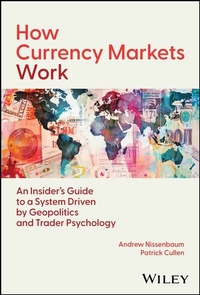
How Currency Markets Work
Description

An insider's original take on how global currency markets operate in the real world
In How Currency Markets Work, a veteran currency trader and a geopolitical risk analyst deliver a comprehensive and street-smart guide for understanding currency markets. The authors combine insights from the worlds of trading, economics, and geopolitics to create an eye-opening and original new take on how currency prices are determined.
This book bridges the gap between how currency markets are taught and how they actually trade, using character-driven narratives built on real-world market events and data to explain currency trading successes and failures in intuitive and practical ways.
Inside the book:
- Actionable tools and tested strategies for currency trading you can apply immediately to improve your returns and your portfolio's risk profile
- Clear real-world examples of how geopolitical events, wars, and political shifts impact currency values
- Profiles of the speculators, corporate hedgers, and central banks whose interplay shapes exchange rates
- Advanced strategies for options, volatility trading, and exploiting mathematical relationships in currency markets
A deeply insightful and accessible exploration of a much-discussed topic, How Currency Markets Work is a powerful new resource for academics, researchers, hedge fund managers, bank traders, policymakers, and practicing and aspiring forex traders.
More details
Other editions
Additional editions
Persons
ANDREW NISSENBAUM is the Founder and CEO of Macrofund and a seasoned interbank currency trader. He served as Head of Macro Research at Soros Fund Management's Quantum Fund and ran the top-ranked Hypothesis Macro Fund LTD at the age of 22.
PATRICK CULLEN is a Geopolitical Risk Analyst with a PhD from the London School of Economics and Political Science. His work in the intelligence sector includes strategic foresight and horizon scanning. He is a though leader in early warning and detection of hybrid threats.
Content
Preface xiii
Acknowledgments xv
Chapter 1 The Global Currency Market 1
Chapter 2 Speculators: The Bank of China, Proprietary Desks, Hedge Funds, and Retail Traders 17
Chapter 3 Corporate Hedgers: The Hidden Giants of Currency Markets 39
Chapter 4 Market Structure: The Architecture of Major and Emerging Currencies 59
Chapter 5 Trading Political and Geopolitical Risk 81
Chapter 6 The Psychology of Currency Trading 101
Chapter 7 How Traders React to Market Events 123
Chapter 8 Liquidity, Volatility, Basis, and Tail: A Trader's Guide 141
Chapter 9 Stocks, Bonds, and the Currency Markets 159
Chapter 10 Mathematical Patterns in Triangles, Convexity, and Forward Gaps 177
Chapter 11 Advanced Trading: Probability, Volatility, and Speed 195
Appendix 217
Glossary 221
About the Authors 231
Index 233
Chapter 1
The Global Currency Market
In January 2015, the currency market experienced one of the most extraordinary and disruptive events in modern financial history. In a surprising move, the Swiss National Bank discontinued its minimum exchange rate policy of 1.20 Swiss francs per euro, which had been a key mechanism for maintaining currency stability. Within minutes, the franc moved as much as 30 percent versus the euro and nearly 28 percent versus the dollar, unleashing chaos across financial markets. Hedge funds and proprietary trading desks with large short positions against the franc suffered devastating losses, while businesses with debts in Swiss francs faced skyrocketing repayment costs. Some brokers became insolvent as cascading margin calls overwhelmed their risk controls. Yet for some astute speculators, the event yielded massive profits, almost unheard of at the time, as $10,000 stakes turned into $550,000. Traders who purchased short-term Swiss franc call options the day before the announcement saw returns of 5,500 percent, with more aggressive strikes reaching approximately 35,000 percent.1 Modest option premiums were transformed into fortunes of remarkable scale.
The Swiss franc's surge in 2015 was neither the first nor the last instance of extreme market movements. During October 6-8, 1998, the yen rose approximately 14 percent versus the dollar. One-month USD/JPY implied volatility spiked to approximately 41 percent.2 This sharp movement was driven by the unwinding of yen carry trades and widespread market panic following the collapse of Long-Term Capital Management, the massive hedge fund whose 1998 collapse threatened global financial stability. As seen during this episode, when markets panic and traders rush to unwind positions, it can trigger dramatic and sudden currency movements. While the yen's appreciation was not as dramatic as the Swiss franc's spike, the speed and impact on global markets were similar.
The Journey Through This Book
In the chapters that follow, we take you inside the multi-trillion-dollar daily battlefield of currency markets. Each chapter uncovers a different layer of how these markets truly operate. Not the textbook version, but the reality faced by traders managing billions every day.
You will first meet the major players who move these markets. Chapter 2 profiles the speculators. From state-backed Chinese entities to proprietary trading desks exploiting microsecond inefficiencies, hedge funds engineering macro attacks, and retail traders adding volatility through leveraged momentum trades. Chapter 3 exposes the hidden giants: corporate hedgers who quietly execute trillions in flows from unmarked offices, whose invisible hand often matters more than any speculative attack.
The middle section explores the market's architecture and human elements. Chapter 4 dissects market structure, showing why emerging market currencies operate by entirely different rules than majors, and how liquidity can evaporate in seconds. Chapter 5 analyzes how traders respond to geopolitical and political risks through contrasting events: the October 7, 2023, Hamas attacks on Israel versus Myanmar's 2021 military coup. Chapter 6 delves into trading psychology. From paralysis after losses to the confirmation bias that destroys funds, we show how the market's greatest edge exists not in the math but in exploiting predictable human behavior.
The final sections provide the advanced toolkit. Chapter 7 shows how currency traders react to economic releases and central bank decisions. Chapter 8 explores algorithmic trading, volatility, and options strategies. Chapter 9 exposes how equity and bond market disruptions cascade through currencies. Chapter 10 uncovers mathematical relationships in triangular arbitrage and forward rate anomalies. Chapter 11 presents quantitative approaches for recognizing when market correlations permanently change.
In this chapter, we give a brief introduction to the essential players and concepts of the currency marketplace, providing you with a toolkit for this book and a blueprint to navigate and trade these complex systems of the global currency market.
Who Moves the Market
The currency market is incredibly liquid with daily trading volumes over $9.6 trillion.3 This makes it the largest financial market in the world. Beneath the surface lies a dynamic system shaped by the interplay of three major participant groups: speculators, corporate hedgers, and central banks. Each group approaches the market with distinct motivations and strategies, yet their actions are deeply interconnected, influencing exchange rates, market liquidity, and the overall direction of global finance. Understanding the motivations and strategies of each of these market participants is crucial, but equally important is understanding how they anticipate future currency movements.
Speculators are key players within the currency markets; this group includes hedge funds who take large macroeconomic bets, proprietary trading desks at major banks, retail traders leveraging online platforms, and sometimes even central banks, who add a degree of speculation by actively trading. Speculators' actions can intensify volatility as large speculative bets on currency depreciation or appreciation can move markets, drawing in traders and causing price overshoots. For example, in the 2008 financial crisis, hedge funds and proprietary trading desks speculated heavily on the US dollar's strength as global investors sought safe-haven assets. Their collective bets contributed to a dramatic surge in the dollar's value, which placed significant pressure on emerging market currencies and forced central banks in those countries to intervene.
Corporate hedgers, by contrast, primarily approach the currency market with the goal of mitigating risk rather than generating profits, though their hedging strategies can be highly sophisticated, involving complex timing decisions, layered execution strategies, and tactical positioning. Multinational corporations, importers, and exporters routinely hedge their currency exposures to protect against unfavorable exchange rate movements. A French-based company importing machinery from Japan, for instance, might enter a forward contract to lock in an exchange rate, hedging against potential yen appreciation. This type of hedging allows corporations to plan budgets and project costs with greater certainty, ensuring that currency volatility does not erode profit margins. While corporate hedging is generally seen as stabilizing, large-scale hedging by multinationals can have unintended market consequences. For instance, imagine many large European companies, all fearing a drop in the euro's value, rushing to buy US dollars to hedge their future earnings. This sudden surge in demand for dollars could push up the dollar's value faster and higher than expected, potentially harming smaller businesses that did not hedge against this risk, and thus leading to new rounds of destabilizing speculative trading.
When numerous corporations hedge simultaneously, often in response to geopolitical or economic uncertainty, it can drive demand for certain currencies, inadvertently influencing exchange rates and inciting speculative activity.
While corporate hedgers aim to stabilize their finances through risk management, central banks take a broader approach, intervening in currency markets to influence macroeconomic conditions and stabilize economies. These interventions are typically aimed at managing inflation, fostering economic growth, and maintaining overall financial stability. They can take the form of direct market activity, such as buying or selling currencies, or indirect measures, like adjusting interest rates or signaling future monetary policy intentions through verbal intervention. The decision by the Swiss National Bank to remove the franc's floor against the euro shows how central bank actions can have profound and widespread effects. While the move was intended to relieve long-term pressure on the Swiss economy, its immediate effect was market-wide disruption, underscoring the delicate balance that central banks must maintain when shaping monetary policy.
Central banks intervene via spot, forwards, and swaps, using sterilized or non-sterilized measures. Sterilized interventions adjust exchange rates without affecting the domestic money supply, often by offsetting currency transactions with domestic asset sales or purchases. In contrast, non-sterilized interventions directly impact the money supply in the currency markets by increasing or decreasing the amount of domestic currency in circulation. This means the central bank's actions also change domestic liquidity and can influence inflation. For instance, Japan's Ministry of Finance financed and sterilized yen-selling interventions by issuing short-term Financing Bills, with the Bank of Japan executing as agent, preventing inflationary side effects and ensuring that currency actions did not expand the domestic money supply. Conversely, during the 1997 Asian Financial Crisis, Thailand's defense of the baht drained domestic liquidity, forcing interest rates above 24 percent.4 When a central bank buys domestic currency with foreign reserves without sterilizing, it contracts the money supply. This liquidity drain imposed severe costs on Thai businesses, particularly importers, and ultimately proved unsustainable, contributing to the abandonment of the baht's peg in July...
