

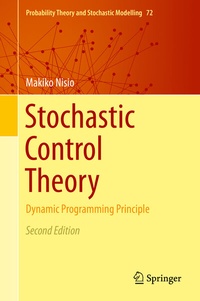
Stochastic Control Theory
Description

This book offers a systematic introduction to the optimal stochastic control theory via the dynamic programming principle, which is a powerful tool to analyze control problems.
First we consider completely observable control problems with finite horizons. Using a time discretization we construct a nonlinear semigroup related to the dynamic programming principle (DPP), whose generator provides the Hamilton-Jacobi-Bellman (HJB) equation, and we characterize the value function via the nonlinear semigroup, besides the viscosity solution theory. When we control not only the dynamics of a system but also the terminal time of its evolution, control-stopping problems arise. This problem is treated in the same frameworks, via the nonlinear semigroup. Its results are applicable to the American option price problem.
Zero-sum two-player time-homogeneous stochastic differential games and viscosity solutions of the Isaacs equations arising from such games are studied via a nonlinear semigroup related to DPP (the min-max principle, to be precise). Using semi-discretization arguments, we construct the nonlinear semigroups whose generators provide lower and upper Isaacs equations.
Concerning partially observable control problems, we refer to stochastic parabolic equations driven by colored Wiener noises, in particular, the Zakai equation. The existence and uniqueness of solutions and regularities as well as Itô's formula are stated. A control problem for the Zakai equations has a nonlinear semigroup whose generator provides the HJB equation on a Banach space. The value function turns out to be a unique viscosity solution for the HJB equation under mild conditions.
This edition provides a more generalized treatment of the topic than does the earlier book Lectures on Stochastic Control Theory (ISI Lecture Notes 9), where time-homogeneous cases are dealt with. Here, for finite time-horizon control problems, DPP was formulated as aone-parameter nonlinear semigroup, whose generator provides the HJB equation, by using a time-discretization method. The semigroup corresponds to the value function and is characterized as the envelope of Markovian transition semigroups of responses for constant control processes. Besides finite time-horizon controls, the book discusses control-stopping problems in the same frameworks.
More details
Other editions
Additional editions
Content
- Intro
- Preface
- Acknowledgement
- Contents
- Notations
- Abbreviations
- 1 Stochastic Differential Equations
- 1.1 Review of Stochastic Processes
- 1.1.1 Random Variables
- Monotone Convergence Theorem
- Fatou's Lemma
- Dominated Convergence Theorem
- Convergence Theorem
- 1.1.2 Stochastic Processes
- Burkholder-Davis-Gundy Inequality
- 1.1.3 Itô Integrals
- 1.1.4 Itô's Formula
- Itô's Formula
- Itô-Krylov Formula (Kr09, 2.10, Theorem 1)
- 1.2 Stochastic Differential Equations
- 1.2.1 Lipschitz Continuous SDEs with Random Coefficients
- 1.2.2 Girsanov Transformations
- 1.2.3 SDEs with Deterministic Borel Coefficients
- 1.2.4 Backward Stochastic Differential Equations
- 1.3 Asset Pricing Problems
- 1.3.1 Formulation
- 1.3.2 Backward SDE for the Selling Price
- 1.3.3 Parabolic Equation Associated with (1.84)
- 2 Optimal Control for Diffusion Processes
- 2.1 Introduction
- 2.1.1 Formulations
- 2.1.2 Value Functions: Basic Properties
- 2.2 Dynamic Programming Principle (DPP)
- 2.2.1 Discrete-Time Dynamic Programming Principle
- 2.2.2 Approximation Theorem
- 2.2.3 Dynamic Programming Principle
- 2.2.4 Brownian Adapted Controls
- 2.2.5 Characterization of the Semigroup (V?t, = t)
- 2.3 Verification Theorems and Optimal Controls
- 2.3.1 Verification Theorems
- 2.3.2 Examples of Optimal Control
- 2.4 Optimal Investment Models
- 2.4.1 Formulations
- 2.4.2 Investment Problems for Power Utility Function
- 2.4.3 Optimal Investment Strategy
- 3 Viscosity Solutions for HJB Equations
- 3.1 Formulations
- 3.1.1 Definition of Viscosity Solution Based on Parabolic Differentials
- 3.1.2 Equivalent Definitions
- 3.1.3 Viscosity Solutions via Semigroups
- 3.2 Uniqueness of Viscosity Solutions
- 3.2.1 Crandall-Ishii Lemma
- Ishii's Lemma
- Crandall-Ishii Lemma CI90
- 3.2.2 Structural Condition
- Structural Condition
- 3.2.3 Comparison Principle
- 3.3 HJB Equations for Control-Stopping Problems
- 3.3.1 Formulations
- 3.3.2 DPP
- 3.3.3 Semigroups Associated with DPP
- 3.3.4 American Option Price
- 4 Stochastic Differential Games
- 4.1 Formulations
- 4.1.1 Admissible Controls and Strategies
- 4.1.2 Formulation of Stochastic Differential Games
- 4.2 DPP
- 4.2.1 D-Lower and D-Upper Value Functions
- 4.2.2 DPP for Lower- and Upper Value Functions
- 4.3 Isaacs Equations
- 4.3.1 Semigroups Related to the DPP
- 4.3.2 Viscosity Solutions of the Isaacs Equations
- 4.4 Risk Sensitive Stochastic Controls and Differential Games
- 4.4.1 Logarithmic Transformation
- 4.4.2 Small Noise Limit
- 4.4.3 Note on Control with Infinite Time Horizon
- 5 Stochastic Parabolic Equations
- 5.1 Preliminaries
- 5.1.1 H-Random Variables
- Expectation of X
- Conditional Expectation
- 5.1.2 Continuous Martingales
- 5.1.3 Correlation Operators
- 5.2 Stochastic Integrals
- 5.2.1 Definitions and Basic Properties
- 5.2.2 Martingale Inequalities
- 5.3 Stochastic Parabolic Equations with Colored Wiener Noises
- 5.3.1 Preliminaries
- 5.3.2 Linear Stochastic Parabolic Equations
- 5.3.3 Regularities of Solutions
- 5.3.4 Semilinear Stochastic Parabolic Equations with Lipschitz Nonlinearity
- 5.4 Itô's Formula
- 5.4.1 Preliminaries
- Mean Value Theorem (La83, p. 107)
- Taylor Formula
- 5.4.2 Itô's Formula for H-Valued Semimartingales
- 5.4.3 Itô's Formula for Linear Stochastic Parabolic Equations
- 5.5 Zakai Equations
- 5.5.1 Partially Observable Controlled Diffusion
- System Equation
- Observation Equation
- 5.5.2 Zakai Equation for a Conditional Gaussian Process
- d-Dimensional System Equation
- m-Dimensional Observation Equation
- Riccati Equation
- Filtering Equation
- 6 Optimal Controls for Zakai Equations
- 6.1 Controlled Zakai Equations
- 6.1.1 Preliminaries
- 6.1.2 Basic Properties of Solutions
- 6.2 Formulations of Control Problems
- 6.2.1 Preliminaries
- 6.2.2 Properties of the Terminal Cost
- 6.2.3 Running Cost
- 6.2.4 Value Functions
- 6.3 Dynamic Programming Principle (DPP)
- 6.3.1 Discrete-Time DPP
- 6.3.2 Continuous-Time DPP
- 6.3.3 Characterization of (Vt)
- 6.3.4 Derivatives of VtF(?)
- 6.4 Viscosity Solutions of HJB Equations
- 6.4.1 Definitions
- 6.4.2 Existence of Viscosity Solutions
- 6.4.3 Uniqueness of the Viscosity Solution
- Comparison Theorem
- References
- Index
