

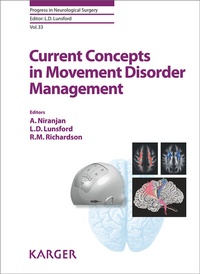
Current Concepts in Movement Disorder Management
1st Edition
Published on 12. January 2018
272 pages
978-3-318-06202-1 (ISBN)
Available for download
Description

This book summarizes the current state of movement disorder management and the role of surgical therapies as an alternative to medication. Following a chapter on the history of movement disorder surgery, leaders in their fields describe the pathophysiology, functional neuroanatomy, clinical presentation, and medical management of Parkinson's disease, dystonia, and essential tremor. This is followed by chapters on the spectrum of movement disorder surgery itself, from the lesioning procedures of radiofrequency ablation, stereotactic radiosurgery, and high-frequency ultrasound to the modulatory procedures of "asleep", image-guided deep brain stimulation (DBS) and "awake", microelectrode-guided DBS. The final chapters focus on closed-loop DBS, drug-delivery, gene therapy, and other emerging neurosurgical therapies, highlighting long-standing experimental strategies that are reaching exciting phases of clinical translation. This volume is a valuable tool for accessing the wide spectrum of concepts that currently define this dynamic field.
More details
Other editions
Additional editions
A. Niranjan | L.D. Lunsford | R.M. Richardson
Current Concepts in Movement Disorder Management
Book
01/2018
1st Edition
S. Karger
€197.95
Article exhausted; check different version
Persons
Content
- Cover
- Front Matter
- Contents
- VIISeries Editor's Note
- Preface
- The History of Movement Disorder Brain Surgery
- Abstract
- The Pre Stereotactic Era
- The Early Era of Stereotactic Brain Surgery
- The Era of Spreading Stereotactic Techniques
- The Era of Decline of Stereotactic Surgery
- The Early Transplant Era
- The Era of Advanced Stereotactic Imaging and Mapping
- The Deep Brain Stimulation Era
- The Era of Radiosurgery
- The Evolution of Frameless Technologies and Intraoperative MRI
- Conclusions
- References
- Pathophysiologic Basis of Movement Disorders
- Abstract
- Introduction
- Relevant Brain Circuit Anatomy
- Parkinson's Disease
- Dystonia
- Essential Tremor
- Conclusions
- References
- Clinical Presentation and Prognosis of Common Movement Disorders
- Abstract
- Introduction
- Parkinsonian Syndromes
- Tremor
- Dystonia
- Tics and Tourette Syndrome
- Conclusion
- References
- Medical Management of Movement Disorders
- Abstract
- Parkinson's Disease
- Early Stage
- Advanced Stage
- Essential Tremor
- Dystonia
- Chorea
- References
- Functional Anatomy of Basal Ganglia Circuits with the Cerebral Cortex and the Cerebellum
- Abstract
- Cortico-Basal Ganglia-Thalamo-Cortical Circuits
- Macro-Architecture of Cortico-Basal Ganglia-Thalamo-Cortical Loops
- The Basal Ganglia are Interconnected with the Cerebellum
- References
- Diffusion Tensor Imaging of the Basal Ganglia for Functional Neurosurgery Applications
- Abstract
- Introduction
- DTI Imaging: Atlas versus Patient-Based Targeting
- Diffusion Tensor Model: Brief Principles of Diffusion Imaging and Tractography Algorithms Available
- DTI of the Basal Ganglia
- Subthalamic Nucleus
- Globus Pallidus
- Thalamus
- Use of DTI in Movement Disorder Surgery: Implications for Non-Invasive Surgical Methods
- Conclusions
- References
- Patient Evaluation and Selection for Movement Disorders Surgery: The Changing Spectrum of Indications
- Abstract
- Patient Evaluation and Selection for DBS in PD
- Patient Evaluation and Selection for DBS in Tremor
- Patient Evaluation and Selection for DBS in Dystonia
- References
- Image-Guided, Asleep Deep Brain Stimulation
- Abstract
- Efficacy of aDBS Implantation
- Conclusions
- References
- Stereotactic Radiofrequency Lesioning for Movement Disorders
- Abstract
- Introduction
- Very Basic Keys to Successful Lesioning
- Macrostimulation
- Lesioning Parameters
- Thalamotomy for Tremor
- Thalamotomy for Focal Dystonia
- Pallidotomy for Segmental or Generalized Dystonia
- Cure or Control
- Bilateral Lesioning
- Other Targets
- Conclusions
- References
- Magnetic Resonance-Guided High Intensity Focused Ultrasound for Treating Movement Disorders
- Abstract
- Introduction
- Indications
- MRgFUS Procedure for Movement Disorders
- Controversial Issues
- Conclusion
- References
- Radiosurgical Thalamotomy
- Abstract
- Introduction: Physiology of Tremor and Initial Treatments
- Beyond Medical Therapy for Tremors
- History and Technique of GKRS Thalamotomy
- Advantages and Disadvantages of GKRS
- Conclusions
- References
- Radiosurgical Pallidotomy for Parkinson's Disease
- Abstract
- Method for GKP
- Long-Term Results for GKP
- Discussion
- References
- Radiosurgical Subthalamic Nucleotomy
- Abstract
- The Subthalamic Nucleus as a Target in Movement Disorders
- Radiosurgery as a Tool for Stereotactic Lesioning in Movement Disorders
- STN Radiosurgery
- Conclusions
- References
- Frameless Functional Stereotactic Approaches
- Abstract
- Introduction
- Accuracy of Stereotactic Systems, Targeting Errors
- Procedural Review of Frameless Systems
- Conclusion
- References
- Deep Brain Stimulation: Interventional and Intraoperative MRI Approaches
- Abstract
- Introduction
- Principles and Shortcomings of Traditional Stereotaxis
- Strategies for Optimizing Accuracy and Precision
- Rationale for an iMRI DBS Approach
- Conclusions
- References
- Thalamic Deep Brain Stimulation
- Abstract
- References
- Deep Brain Stimulation of the Subthalamic Nucleus and Globus Pallidus for Parkinson's Disease
- Abstract
- Introduction
- Patient Selection for DBS
- Cost Effectiveness of DBS
- Long-Term Outcomes
- Differential Effects of STN and GPi DBS for PD
- Differential Effects of STN and GPi DBS for Dystonia
- Targeting the STN and GPi
- Placement of DBS Electrodes without Microelectrode Recording
- Conclusions
- References
- Current and Expected Advances in Deep Brain Stimulation for Movement Disorders
- Abstract
- Introduction
- Patient Selection
- Target Selection
- Planning and Operative Techniques
- Hardware
- Stimulation Parameters
- MR-Guided Focused Ultrasound
- Conclusion
- References
- Adaptive Brain Stimulation for Movement Disorders
- Abstract
- Introduction
- Parkinson's Disease
- Parkinsonian and Essential Tremor
- Dystonia
- Conclusions
- References
- Drug Delivery for Movement Disorders
- Abstract
- Introduction
- Glial Cell-Line Derived Neurotrophic Factor
- Preclinical Studies of GDNF Delivery for PD
- Intraventricular Administration of GDNF in Rodents
- Intraventricular Administration of GDNF in Non-Human Primates
- Clinical Trials of Intraventricular Infusion of GDNF for PD
- Localized Intraparenchymal Delivery of GDNF in Rodents
- Intraputamenal Delivery of GDNF in Non-Human Primate Studies
- Chronic Intraputamenal Infusion of GDNF and Related Toxicity
- Clinical Trials of Intraputamenal Delivery of GDNF
- A Multicenter Randomized Controlled Trial of Intraputamenal GDNF Infusion for PD
- Convection-Enhanced Delivery of GDNF to the Brain
- Rationale for Chronic Intermittent CED
- References
- Gene Therapy for Parkinson's Disease
- Abstract
- The Need for Gene Therapy in Movement Disorders
- Scientific Background
- Clinical Experience
- Conclusion
- References
- Author Index
- Subject Index
- Cover

