

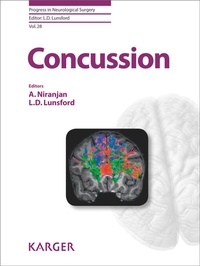
Concussion
1st Edition
Published on 15. May 2014
256 pages
978-3-318-02649-8 (ISBN)
Available for download
Description

The increasing recognition of concussion and its associated consequences has focused international attention on mild traumatic brain injury. The need for early diagnosis, evaluation, and management has expanded dramatically. This volume includes the experience of leading experts who describe the recent advances in the pathophysiology, biomechanics, imaging definition, and management of concussion. Advanced imaging and electrophysiological techniques are being used to help delineate the underlying metabolic and ultrastructural effects of concussive injuries. Papers in this volume review the role of emerging techniques including fMRI, SPECT, PET, DTI, MRS, and MEG, as well as report on multimodality concussion management programs which offer guidelines for selecting relevant team members, assessing community needs, and implementing management strategies that align with current practice standards. This publication provides neurosurgeons, neurologists, trauma and sports medicine specialists, physiatrists, neuropsychologists, and neuroscientists with a comprehensive overview of the current understanding of the causes of mild traumatic brain injury or concussion, newer methods to evaluate it, and current and evolving multimodality management strategies.
More details
Other editions
Additional editions
A. Niranjan | L.D. Lunsford
Concussion
Book
06/2014
1st Edition
S. Karger
€197.95
Article exhausted; check different version
Persons
Content
- Cover
- Front Matter
- Contents
- Series Editor's Note
- Overview and Mechanism of Concussion
- Cerebral Concussion: A Historical Perspective
- Abstract
- Neurosurgery and Concussion Management
- ImPACT TM (Immediate Post-Concussion Assessment and Cognitive Testing)
- NFL Concussion Management Advancements
- Chronic Traumatic Encephalopathy
- The Pathophysiology of Traumatic Brain Injury
- Concussion: Politics, Media, and Chronic Traumatic Encephalopathy
- The Treatment of Postconcussion Syndrome
- Alternative Treatments
- Conclusion
- Acknowledgements
- References
- Additional Reading
- Biomechanics of Concussion
- Abstract
- Basic Biomechanics
- Biomechanics of Traumatic Brain Injury
- Rotational Acceleration Magnitude- and Duration-Based Injury Tolerance
- Scaling Animals to Humans
- Biomechanics of Blast-Induced Concussion
- Long-Term Risks from Repetitive Concussion
- Chronic Traumatic Encephalopathy
- Conclusion
- References
- The Neurophysiology of Concussion
- Abstract
- Excitatory Neurotransmitters and Ionic Flux following Concussion
- The Metabolic Cascade and Corresponding Vulnerability
- Evidence of a Postconcussive Vulnerable Brain
- Evidence of Neurochemical and Metabolic Cascade in Human Concussion
- Conclusion
- Acknowledgements
- References
- Chronic Traumatic Encephalopathy
- Abstract
- Definition of Chronic Traumatic Encephalopathy
- Posttraumatic Encephalopathy versus Chronic Traumatic Encephalopathy
- Chronic Traumatic Encephalopathy Symptomatology and Clinimetrics
- Chronic Traumatic Encephalopathy Neuropathologic Changes
- Chronic Traumatic Encephalopathy Pathogenesis and Neurobiology
- References
- Cumulative Effects of Repetitive Mild Traumatic Brain Injury
- Abstract
- Clinical Effects of Repetitive Mild Traumatic Brain Injury
- Pathophysiology of Repetitive Mild Traumatic Brain Injury
- Advancing Recognition of Repetitive Mild Traumatic Brain Injury and Development of Chronic Traumatic Encephalopathy: Potential Role for Imaging in Diagnosis
- Return to Play
- Conclusion
- References
- Evaluation of Concussion
- Understanding Concussive Injuries Using Investigational Imaging Methods
- Abstract
- Functional Magnetic Resonance Imaging
- Single-Photon Emission Tomography and Positron Emission Tomography
- Diffusion Tensor Imaging
- Magnetic Resonance Spectroscopy
- Conclusion
- References
- Neurometabolic, Electrophysiological, and Imaging Abnormalities
- Abstract
- Neurometabolism
- Electrophysiology
- Microstructural Alterations
- Conclusion
- References
- Detection of White Matter Injury in Concussion Using High-Definition Fiber Tractography
- Abstract
- References
- Magnetoencephalography in the Diagnosis of Concussion
- Abstract
- Basic Principles of Magnetoencephalography
- Magnetoencephalography Forward and Inverse Modeling
- Clinical Applications of Magnetoencephalography
- Magnetoencephalography in Epilepsy
- Mapping of Eloquent Cortex Using Magnetoencephalography
- Determination of Hemispheric Language Dominance Using Magnetoencephalography
- Biomedical Research Applications of Magnetoencephalography
- Concussions and Conventional Brain Imaging
- Concussions and Magnetoencephalography
- Acknowledgements
- References
- Management of Concussion
- Evidence-Based Management of Sport-Related Concussion
- Abstract
- Evidence-Based Concussion Evaluation and Management
- Graduated Exertion and Return to Play
- Conclusion
- Appendix A
- Appendix B
- References
- In-Office Management of Sport-Related Concussion
- Abstract
- Establishing a Clinical Team
- In-Office Protocol
- Clinical Interview
- Vestibular/Ocular-Motor Screening
- Neurocognitive Assessment
- Case Studies
- Conclusion
- References
- Treating Prolonged Symptoms of Mild Traumatic Brain Injury: Neuropharmacology
- Abstract
- Headaches
- Cognitive Symptoms
- Emotional Symptoms
- Sleep Disorders
- Vestibular Impairments
- Conclusion
- References
- Rehabilitation from Postconcussion Syndrome: Nonpharmacological Treatment
- Abstract
- Nonpharmacological Treatment of Postconcussion Symptoms
- Acute Recovery Period: Education, Reassurance, and Symptomatic Treatment
- Subacute Recovery Period
- Chronic Recovery Period
- Other Factors Underlying Persistent Symptoms after Mild Traumatic Brain Injury
- Brief Case Vignette
- Conclusion
- References
- Concussion in Ice Hockey
- Abstract
- Incidence
- Evaluation
- Return to Play
- Further Treatment
- Prevention
- Conclusion
- References
- Management of Concussion in the Professional Football Player
- Abstract
- A Brief History of the NFL Concussion Program
- The Current NFL Program
- From a NFL Athletic Trainer Perspective (C.H.)
- From a Sports Neuropsychologist's Perspective (E.M.P.)
- Further Directions
- Conclusions
- References
- Developing an Interdisciplinary Community-Based Sports Concussion Management Program
- Abstract
- Key Components to Program Establishment
- Developing and Implementing Management Practices for Concussed Athletes
- Concussion Program Accessibility: Catering to Athletes' Unique Needs
- References
- The Multidisciplinary Concussion Management Program
- Abstract
- Foundations of Multidisciplinary Management
- Preinjury Preparations
- Postinjury Management: Initial Evaluation and Diagnosis
- Postinjury Management: Subacute to Chronic Concussion Management
- Return to Play
- Conclusion
- References
- Emerging Techniques and Future Development
- Vulnerability in Speed of Visuomotor Ability
- Abstract
- Conceptual Issues
- Study 1: Shuttleworth-Edwards et al., 2004 [14]
- Study 2: Shuttleworth-Edwards and Radloff, 2008 [15]
- Study 3: Shuttleworth-Edwards et al., 2014 [16]
- Conclusions
- References
- Detecting Eye Movement Abnormalities from Concussion
- Abstract
- Eye Movement and Eye Movement Recording
- Predictive Visual Tracking
- Performance Assessment of Circular Visual Tracking
- Concussion
- Conclusion
- References
- Neurodegenerative Changes after Mild Traumatic Brain Injury
- Abstract
- Links between Mild Traumatic Brain Injury and Alzheimer's Dementia
- Imaging Similarities between Mild Traumatic Brain Injury and Neurodegenerative Diseases
- References
- Future Directions in Brain Injury Research
- Abstract
- The Concussion Syndromes
- Future Research Needs
- Conclusion
- References
- Author Index
- Subject Index
- Cover

