

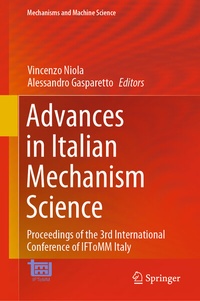
Advances in Italian Mechanism Science
Proceedings of the 3rd International Conference of IFToMM Italy
1st Edition
Published on 19. August 2020
XVII, 900 pages
978-3-030-55807-9 (ISBN)
Description

This book presents the proceedings of the 3rd International Conference of IFToMM ITALY, held online on September 9-11, 2020. It includes peer-reviewed papers on the latest advances in mechanism and machine science, discussing topics such as biomechanical engineering, computational kinematics, the history of mechanism and machine science, gearing and transmissions, multi-body dynamics, robotics and mechatronics, the dynamics of machinery, tribology, vibrations, rotor dynamics and vehicle dynamics. A valuable, up-to-date resource, it offers an essential overview of the subject for scientists and practitioners alike, and will inspire further investigations and research.
More details
Series
Language
English
Place of publication
Cham
Switzerland
Publishing group
Springer International Publishing
Product notice
Reflowable
Illustrations
XVII, 900 p. 644 illus., 444 illus. in color.
File size
163,80 MB
ISBN-13
978-3-030-55807-9 (9783030558079)
DOI
10.1007/978-3-030-55807-9
Schweitzer Classification
Other editions
Additional editions
Vincenzo Niola | Alessandro Gasparetto
Advances in Italian Mechanism Science
Proceedings of the 3rd International Conference of IFToMM Italy
Book
08/2020
Springer
€213.99
Shipment within 7-9 days
Content
- Intro
- Preface
- Contents
- I History of Mechanism Science
- The Bolognese Silk Mill: One of the Earliest Examples of Factory System
- Abstract
- 1 Introduction
- 2 The Silk Sector in the Early Modern Bologna and the Diffusion of the Bolognese Silk Mill Technology
- 3 The "Bolognese" Mill: A Technical Description
- 4 Conclusions
- References
- A Brief History of Piano Mechanics
- Abstract
- 1 Introduction
- 2 Evolution of Piano Mechanics
- 3 Modern Piano Mechanics
- 4 20th-Century Keyboards
- 5 Conclusions
- References
- Nikolai Kolchin (1894-1975)
- Abstract
- 1 Biographical Notes
- 2 List of Main Works
- 3 Review of Main Works
- 4 Modern Interpretation and Main Contributions
- 5 Conclusions
- References
- D'Alembert and the Wave Equation
- Abstract
- 1 Introduction
- 2 D'Alembert's Solution of the Vibrating String Problem
- 3 The Controversy Between D'Alembert and Euler
- 4 Final Remarks and Conclusion
- References
- Design Experiences for Reconstruction of an Ancient Roman Crane
- Abstract
- 1 Introduction
- 2 Backgrounds
- 3 Design Requirements
- 4 A Reconstruction Design
- 5 A Prototype
- 6 Conclusions
- Acknowledgments
- References
- The Italian Textbooks of Mechanics Applied to Machines in the Modern Age
- Abstract
- 1 Introduction
- 2 Backgrounds
- 2.1 Prof. Modesto Panetti (1875-1957)
- 2.2 The Structure of MaM Textbooks
- 3 "The Masters" Period
- 4 "The Schools" Period
- 5 "The Courses" Period
- 6 Conclusions
- References
- Using Old Schröder-Reuleaux Models in Modern Kinematics Lectures
- Abstract
- 1 Introduction
- 2 The Schröder-Reuleaux Collection and Models
- 3 The Teaching Method
- 4 Conclusions
- References
- Recent Teaching Experiences on Mechanism and Machine Theory
- Abstract
- 1 Introduction
- 2 Teaching MMT Fundamentals
- 3 Kinematics
- 4 Dynamics
- 5 Cases of Study
- 5.1 Design of a Robotic Finger
- 5.2 Bond Graph for a Transmission System
- 6 Conclusions
- References
- The Odometers of Marcus Vitruvius Pollio and Leonardo Da Vinci
- Abstract
- 1 Introduction
- 2 Vitruvius' Odometer
- 3 Leonardo's Odometer
- 4 Comparison Between the Two Designs
- 5 Conclusions
- References
- I Biomechanical Engineering
- Investigation of Internal Human Body Dynamic Forces Developed During a Vehicle Ride
- Abstract
- 1 Introduction
- 2 Mathematical Modelling
- 3 Random Road Disturbance
- 4 Bump Road Profile
- 5 Conclusions
- References
- Design of an Articulated Neck for Testbed Mannequin
- Abstract
- 1 Introduction
- 2 Problems and Requirements
- 3 A Conceptual Design
- 4 A CAD Design
- 5 Simulated Performance
- 6 Conclusions
- Acknowledgments
- References
- Design and Experimental Characterization of an Underactuated Finger Mechanism
- Abstract
- 1 Introduction
- 2 Kinematic Design and Finger Operation
- 3 Test Result
- 4 Conclusion
- References
- Handwheelchair.q: New Prototype of Manual Wheelchair for Everyday Life
- Abstract
- 1 Introduction
- 2 Functional Design
- 2.1 Transmission System
- 2.2 Return Pulleys
- 3 Prototype
- 4 Experimental Methods
- 5 Results
- 6 Conclusions
- References
- A Novel Architecture for a Fully Wearable Assistive Hand Exoskeleton System
- 1 Introduction
- 2 The Previous Prototypes
- 3 The New Architecture
- 3.1 sEMG Technology
- 3.2 Ergonomics
- 3.3 Overall Architecture and Power Supply System
- 4 Discussion
- 5 Conclusions and Future Perspectives
- References
- Rehabilitative Hand Exoskeleton System: A New Modular Mechanical Design for a Remote Actuated Device
- Abstract
- 1 Introduction
- 2 Design Specifications
- 2.1 Transmission Type
- 2.2 Performance Requirements and Physical Characteristics
- 2.3 Additional Requirements to Meet Commercial Environment
- 3 Background
- 3.1 The Reference Hand Exoskeleton
- 4 Redesign of the Hand Exoskeleton System
- 4.1 Base Platform
- 4.2 Interface Module
- 4.3 Finger Module
- 4.4 Remote Actuation System
- 5 Conclusions
- References
- A Compliant and Robust Robotic Hand Fabricated with 3D Printed Soft Materials
- 1 Introduction
- 2 Design of the CORA Hand
- 2.1 Mechanical Design
- 2.2 Actuation and Transmission
- 2.3 FEM Simulation of Strain and Deformation of the Soft Polymer Links
- 2.4 Implementation of the Prototype and Preliminary Evaluation of Grasping
- 3 Conclusion
- References
- Design of a Twisted String Actuated Haptic Thimble for Cutaneous Force Feedback
- 1 Introduction
- 2 The Twisted String Actuated Haptic Thimble
- 2.1 Actuation Scheme
- 3 Experimental Characterization
- 4 Discussions and Conclusion
- References
- A Biomechanical Rider Model for Multibody Applications
- 1 Introduction
- 2 Literature Review
- 3 Multibody Model
- 3.1 Frames and Bodies
- 3.2 Constraints
- 3.3 Implementation
- 4 Validation
- 5 Conclusions
- References
- Upper Limbs Musculoskeletal OpenSim Model: Customization and Assessment
- Abstract
- 1 Introduction
- 2 OpenSim
- 2.1 Existing Upper-Limb Models
- 3 Development of an Upper Limbs Model
- 4 Upper Limbs Musculoskeletal Model Assessment
- 4.1 Experimental Measurement
- 4.2 Simulations
- 4.3 Comparison and Results
- 5 Discussion and Conclusion
- Acknowledgement
- References
- I Robotics
- A Wearable Device for Ankle Motion Assistance
- Abstract
- 1 Introduction
- 2 Ankle Biomechanics
- 3 A Solution for Ankle Motion Assistance
- 4 Performance Evaluation
- 5 Conclusions
- References
- Modeling and Identification of Vibrations in a UAV for Aerial Manipulation
- Abstract
- 1 Introduction
- 2 Tested UAV
- 3 Testing Equipment and Methods
- 4 Experimental Results
- 5 Dynamic Models
- 5.1 1-Degree-of-Freedom (1-DOF) Vibrational Model
- 5.2 2-DOFs Vibrational Model
- 5.3 3-DOFs Model
- 6 Conclusions
- References
- A Novel Robotic System for Painting with Eyes
- 1 Introduction
- 2 Eye Tracking
- 3 The Robotic Painting System
- 4 Data Acquisition and Path Planning
- 5 Results
- 6 Conclusions
- References
- Flexible Multibody Modeling for Structural Flexibility Analysis of a Robotic Manipulator
- 1 Introduction
- 2 Modeling of the Robotic Manipulator
- 2.1 Multibody Modeling
- 2.2 Finite Element Modeling
- 3 Structural Flexibility Analysis by FMB Simulation
- 4 Discussion
- 5 Conclusions
- References
- Mode Predictive Control for Spatial Cable Driven Parallel Robot Based on Variation the Mass of End-Effector
- Abstract
- 1 Introduction
- 2 Inverse Geometric Modeling
- 3 Dynamic Response
- 3.1 Dynamic Model of the End Effector
- 3.2 The Dynamic Comportment of the Motors
- 4 Robot Workspace
- 5 Control Law and Architecture
- 6 Simulation Results
- 7 Conclusion
- Acknowledgements
- References
- Robust Control Strategies of Puma 560 Robot Manipulator
- Abstract
- 1 Introduction
- 2 Robot Manipulator Model
- 2.1 Dynamic Modeling
- 2.2 Gometric Modeling
- 3 Robot Control
- 3.1 Inner Loop Controller
- 3.2 Outer Loop Controllers Design
- 4 Simulation Results
- 5 Conclusion
- Acknowledgements
- References
- Working Cycle Sequence Optimization for Industrial Robots
- 1 Introduction
- 2 Related Work
- 3 The Travelling Salesman Problem (TSP)
- 3.1 Problem Constraints
- 4 Simulation Model and Results
- 5 Conclusions
- References
- Iterative Path Planning of a Serial Manipulator in a Cluttered Known Environment
- 1 Introduction
- 2 The New Planning Algorithm
- 2.1 First Path
- 2.2 Modified Path
- 2.3 Influence of the Parameter d
- 2.4 Proposed Method
- 3 Comparison with Existing Methods
- 4 Conclusion
- References
- One-Step Fast Calibration of an Industrial Workcell
- 1 Introduction
- 2 Standard Calibration
- 2.1 First Step: Surface Probing
- 2.2 Second Step: Image Acquisition
- 3 A New Calibration Tool and Procedure
- 3.1 The New Tool
- 3.2 The New Procedure
- 4 Experimental Results
- 5 Conclusion
- References
- Optimal Path Planning of a Redundant Robot in Food Industry
- 1 Introduction
- 2 Optimization Technique
- 3 Simulations and Results
- 4 Conclusions
- References
- Applications of Learning Algorithms to Industrial Robotics
- 1 Introduction
- 2 Applications of ANN to Industrial Robotics
- 2.1 Vision Systems
- 2.2 Assembly Task Learning
- 2.3 Learning from Demonstration
- 3 Conclusions
- References
- Terrain Sensing for Planetary Rovers
- Abstract
- 1 Introduction
- 2 Materials and Methods
- 3 Proprioceptive Features
- 4 Classifier Training and Testing
- 5 Conclusion and Future Works
- Acknowledgements
- References
- Real-Time Strategy for Obstacle Avoidance in Redundant Manipulators
- 1 Introduction
- 2 Obstacle Avoidance Strategy
- 3 Trajectory Planning
- 4 Implementation and Simulations
- 5 Conclusions
- References
- An Experimental Setup and Procedure for Stiffness Evaluation of Robot Manipulators
- Abstract
- 1 Introduction
- 2 The R-CUBE Manipulator
- 3 The Experimental Test Setup for Stiffness Evaluation
- 4 The Test Procedure and Results
- 5 Conclusion
- Acknowledgments
- References
- Investigation of Dynamically Decoupled Anatomies for a Serial Metamorphic Manipulator
- 1 Introduction
- 2 Research Study Methodology
- 2.1 The Metamorphic Structure
- 2.2 Proposed Analysis Methodology
- 3 Generalized Inertia Matrix Elements Analysis
- 3.1 Manipulator Inertia Matrix
- 3.2 Off-Diagonal Element Analysis
- 3.3 Diagonal Elements Analysis
- 3.4 Minimization of Configuration Variance
- 4 Dynamic Decoupling of the 2 DoF SMM Studied
- 4.1 Off-Diagonal Element Analysis
- 4.2 Diagonal Element Analysis
- 5 Conclusion
- References
- Gravity Compensation of Robotic Manipulators Using Non-linear Spring Configurations
- Abstract
- 1 Introduction
- 2 Robot Balancing Using Linear Springs
- 3 Robot Balancing Using Non-linear Springs
- 3.1 Non-linear Spring Arrangement
- 3.2 Application to a Single-Link Robotic Arm
- 3.3 Application to a Robotic Arm with Elbow Structure
- 4 Numerical Simulation
- 5 Conclusions
- References
- Energy Optimal Design of Jerk-Continuous Trajectories for Industrial Robots
- 1 Introduction
- 2 Spline-Based Trajectory Planning
- 2.1 Energy Consumption Estimation
- 3 Energy Optimization
- 4 Conclusion
- References
- Human Arm Motion Tracking by Kinect Sensor Using Kalman Filter for Collaborative Robotics
- Abstract
- 1 Introduction
- 2 Methodology
- 2.1 Human Arm Model
- 2.2 Kalman Filter
- 2.3 Shoulder Frame
- 2.4 Process Architecture and Link Length
- 3 Experimental Set-up
- 4 Results
- 5 Conclusions
- References
- A Simplified Approach to Size Multi-robot System for Pick and Place Applications
- Abstract
- 1 Introduction
- 2 Current Empirical Sizing Procedure
- 3 The Proposed Sizing Tool
- 4 Test Cases and Results
- 4.1 Evaluation of the Average Speed
- 4.2 Sizing Results
- 5 Conclusions
- References
- Automation of Glue Deposition on Shoe Uppers by Means of Industrial Robots and Force Control
- Abstract
- 1 Introduction
- 2 Definition of the End-Effector Trajectories
- 3 Robotic Tool Setup
- 3.1 Feed-Back Force Control
- 4 Glue Deposition Experimental Tests
- 5 Conclusions
- References
- Position Analysis of a Class of n-RRR Planar Parallel Robots
- 1 Introduction
- 2 Bilateration
- 3 Inverse and Direct Kinematic Problems
- 4 Example
- 5 Conclusions
- References
- A Mobile Robot for Undercarriage Inspection on Standard Railway Tracks
- 1 Introduction
- 2 The Railway Inspection Robot
- 2.1 The Mobile Platform
- 2.2 The Robotic Arm
- 2.3 Robot Control Unit and Operator's Interface
- 3 Experimental Validation
- 4 Conclusions
- References
- Modeling a Sensorized Soft Layer for Adding Compliance to the Environment in Robotic Manipulation
- 1 Introduction
- 2 The SoftPad
- 3 Models
- 4 Simulations
- 5 Discussion
- References
- Nonlinear Characterization of a Compact Series Visco-Elastic Element for Tendon-Driven Actuation
- 1 Introduction
- 2 Joint Description
- 3 Experimental Characterization
- 3.1 Static and Dynamic Characterization
- 3.2 Joint Bandwidth
- 4 Nonlinear Mathematical Hysteresis Model
- 5 Model Identification
- 6 Conclusion
- References
- Kinematic Synthesis of a Tendon-Driven Robotic Arm
- Abstract
- 1 Introduction
- 2 Endless Tendon-Driven Mechanisms
- 3 Tendon-Driven Robotic Arm
- 4 Conclusions
- References
- Robotic Additive Printing of Cylindrical Auxetic Structures
- 1 Introduction
- 2 Previous Robotic AM Systems
- 3 Materials and Methods
- 3.1 Experimental Setup
- 3.2 Used Ink
- 4 Experimental Tests and Results
- 5 Conclusion
- References
- Control Model for Collaborative Manufacturing: An Integrated Opened Framework for Human-Robot Collaboration
- 1 Introduction
- 2 Approach
- 2.1 OCM Level
- 2.2 RCM Level
- 2.3 CRCM Level
- 3 Conclusions
- References
- A Smart Gluing Process by a Vision Guided Robotic System
- Abstract
- 1 Introduction
- 2 Gluing Machine Description
- 3 Glue Path Planning
- 4 Hardware and Procedures Developing
- 5 Experimental Investigation
- 6 Conclusions
- Acknowledgment
- References
- Kinematic Optimization for the Design of a UR5 Robot End-Effector for Cardiac Tele-Ultrasonography
- 1 Introduction
- 2 Optimization of the End-Effector
- 2.1 UR5 Robot Kinematics
- 2.2 Manipulability Optimization
- 2.3 Implementation
- 3 Results
- 4 Conclusions
- References
- Collaborative Robotics for Rehabilitation: A Multibody Model for Kinematic and Dynamic Analysis
- Abstract
- 1 Introduction
- 2 Human-Robot System
- 3 Kinematics
- 4 Dynamic Simulations
- 5 Conclusions
- References
- I Mechanism Design
- Design Optimization of a Cartesian Assembly Cell
- Abstract
- 1 Introduction: Preliminary Description of the Machine and Specifications
- 2 Machine Head Redesign
- 2.1 Actuation of Machine Head
- 2.2 Multi Tool Hand Effector
- 3 Structural Improvement
- 4 Equipotential Link on Servo-Drives and Recalibration
- 5 Quantification of Productivity Improvement
- 6 Conclusions and Future Developments
- Acknowledgements
- References
- The Effect of the Optimal Route Selection on the Forward Position Solutions of Parallel Mechanisms
- Abstract
- 1 Introduction
- 2 The Effect of the Optimal Route Selection on the FPS
- 2.1 Criteria for Optimal Route Selection
- 2.2 Procedures of Optimal Route Selection
- 3 Topology Analysis
- 3.1 Description of a 3T PM
- 3.2 Analysis of the POC Set
- 3.3 Determining the DOF
- 3.4 Determining the Coupling Degree
- 4 Position Analysis
- 4.1 The Coordinate System and Parametrization
- 4.2 Direct Kinematics
- 4.3 Verification
- 5 Conclusions
- Acknowledgments
- References
- Multiphysical Design Optimization of Multibody Systems: Application to a Tyrolean Weir Cleaning Mechanism
- 1 Introduction
- 2 Primal Analysis with Multibody Dynamics and Hydraulic Actuator Model
- 3 Analytical Sensitivity Analysis of Time-Dependent Responses
- 4 Tyrolean Weir Cleaning Mechanism
- 5 Design Optimization of Tyrolean Weir Cleaning Mechanism
- 6 Conclusion
- References
- Improving Components Feeding: A Rotatory Device
- 1 Introduction
- 2 Blade Shaping Algorithm
- 2.1 Design of the Rotary Distributor
- 3 Experimental Apparatus
- 3.1 Image Processing Algorithm
- 4 Results
- 5 Conclusion
- References
- Innovative Project Development: A Successful Case Study
- Abstract
- 1 Introduction
- 2 Prospects for Implementing Redesign
- 3 Theoretical Framework
- 3.1 Concurrent Engineering
- 4 Proposition, Analysis and Characterization
- 4.1 Case Study
- 5 Results and Discussion
- 6 Conclusions
- Acknowledgments
- References
- Design and Analysis of a Top Locking Snap Hook for Landing Manoeuvres
- Abstract
- 1 Introduction
- 2 Design of the Proposed Hook
- 2.1 Design
- 2.2 Dynamic Model
- 2.3 Kinematic Model
- 2.4 Evaluation of Opening Time
- 3 Conclusion
- References
- Numerical Simulation of a 2D Harmonic Oscillator as Coupling System for Child Restraint Systems (CRS)
- Abstract
- 1 Introduction
- 2 Method
- 3 Results
- 4 Conclusion
- Acknowledgements
- References
- Design and Operation Improvements for CADEL Cable-Driven Elbow Assisting Device
- Abstract
- 1 Introduction
- 2 A CADEL Prototype
- 3 Aspects to Be Improved
- 4 A Solution for Improvement
- 5 Simulation Results and Performance Tests
- 6 Conclusions
- References
- I Design of Sustainable Systems
- Life Cycle Assessment for the ISWEC Wave Energy Device
- Abstract
- 1 Introduction
- 2 The ISWEC Device
- 2.1 System Parameters
- 3 Life Cycle Assessment
- 4 Conclusions
- References
- The Agri.q Mobile Robot: Preliminary Experimental Tests
- Abstract
- 1 Introduction
- 2 Functional and Mechanical Design
- 3 Prototype Description
- 4 Preliminary Experimentations
- 5 Conclusions
- Acknowledgments
- References
- Intermediate Agricultural Machines Energy Efficiency: The Example of Harvesting and Threshing
- Abstract
- 1 Introduction
- 2 Harvesting and Threshing the Grain
- 3 Materials and Methods
- 4 Results and Discussion
- 5 Conclusions
- References
- A Path Tracking Algorithm for an Autonomous Wind-Driven Robot
- Abstract
- 1 Introduction
- 2 Control Strategy
- 3 Path Planning
- 4 Guidance
- 5 Steering Control-PID
- 6 Sail Control-PID
- 7 Simulation Results
- 8 Conclusion
- References
- One Year Experimental Evaluation of the Electrical Gain by Solar Tracking a 12 KW Photovoltaic System Installed on a Building Rooftop
- Abstract
- 1 Introduction
- 2 Methodology
- 2.1 Evaluation of the Available Global Solar Energy
- 2.2 Evaluation of the PV System Global Efficiency
- 2.3 Evaluation of the Solar Tracking Gain
- 3 Experimental Setup
- 4 Results and Discussions
- 4.1 The Available Solar Energy
- 4.2 Evaluation of the PV System Global Efficiency
- 4.3 Evaluation of the Solar Tracking Gain
- 5 Conclusions
- References
- Efficient Power-Split Powertrain for Full Electric Vehicles
- Abstract
- 1 Introduction
- 2 Planetary Gear-Based Power Train
- 3 Optimization Strategy
- 4 Conclusions
- Acknowledgements
- References
- I Gearing and Transmission
- Speed, Torque and Mathematical Power Relationship Ratios, Using SolidWorks Parametric Designed Spur Gear
- Abstract
- 1 Introduction
- 2 Spur Gear Model
- 2.1 Parametric Modeling
- 2.2 Parametric Equations
- 2.3 Driven Equations
- 2.4 3D Model
- 3 Speed, Torque and Mathematical Power Relationship Ratios
- 3.1 Simple Gear Train
- 3.2 Equations
- 3.3 Calculations
- 4 Conclusions
- References
- Efficiency and Durability of DLC-Coated Gears
- Abstract
- 1 Introduction
- 2 Test Setup and Procedure
- 3 Experimental Results
- 4 Conclusions
- References
- I Special Session IFToMM Italy - IFToMM Japan
- Omnidirectional Mobile Robot and Vehicle, Uninterrupted Transmission System, Intuitive Operating Method, and Riding Robotics
- Abstract
- 1 Introduction
- 2 Active Omni Wheel and Omnidirectional Vehicle
- 3 Slidable-Wheeled Omnidirectional Mobile Robot
- 4 Uninterrupted Transmission System
- 5 Intuitive Operating Method
- 6 Riding Robotics
- 7 Conclusion
- References
- A UAV System Using an Eye-Tracking Device for Bedridden Patients: Consideration of Control Screens
- Abstract
- 1 Introduction
- 2 System
- 2.1 Overview
- 2.2 Control Screens and Control Method
- 3 Experiment
- 3.1 Subjects
- 3.2 Flight Course
- 3.3 Measurement of Flicker Values
- 3.4 Questionnaire
- 3.5 Experimental Procedure
- 3.6 Results and Discussion
- 4 Conclusion
- References
- Static Analysis and Actuator Selection of (2-RRU)-URR Parallel Mechanism for Thumb Rehabilitation
- 1 Introduction
- 2 (2-RRU)-URR Parallel Mechanism
- 2.1 Constraint Wrench, Actuation Wrench, and Overall Jacobian
- 3 Static Analysis
- 4 Numerical Example, Experiment, and Result
- 5 Actuation Selection for Thumb Rehabilitation
- 6 Discussion and Conclusion
- References
- A Novel, Scalable Shape Memory Alloy Actuator Controlled by Fluid Temperature
- 1 Introduction
- 2 Scalability of Actuators and SMA
- 2.1 Scalable Design Strategies
- 2.2 SMAs for Scalable Actuator Design and Its Challenges
- 3 Conceptual Design
- 4 Force-Scalable Zero-Flow SMA Linear Actuator (ZFSMALA) ch69Osorio2019
- 4.1 Experimental Setup
- 4.2 Results and Discussion
- 5 Force and Displacement Scalable Constant-Flow SMA Linear Actuator (CFSMALA)
- 5.1 Experimental Setup
- 5.2 Results and Discussion
- 6 Conclusions and Future Work
- References
- A Thermally-Driven Bipedal Walker with Rugby Ball Shaped Feet
- 1 Introduction
- 2 Cylindrical Feet of the Previous Thermal Walkers
- 3 Thermal Walker with Round Feet
- 3.1 Basic Concept
- 3.2 Prototype Design
- 4 Walking Experiment
- 5 Conclusions
- References
- An Experimental Analysis of Vibrations During Walking in Humans and Robots
- Abstract
- 1 Introduction
- 2 Vibration Characteristics in Walking
- 3 An Approach for Analysis of Walking Vibrations
- 4 Experimental Results
- 5 Conclusions
- Acknowledgements
- References
- A New Rehabilitation Device for Finger Extension Movement
- 1 Introduction
- 2 Proposed Design
- 3 Simulation
- 4 Conclusion and Future Work
- References
- Quasi-Static Analysis of a Tapered Extendable Arm Inspired by an Origami with Modified Folding Diagram
- Abstract
- 1 Introduction
- 2 Modification of the Folding Diagram
- 3 Observation of Prototypes' Behavior
- 4 Quasi-Static Analysis
- 5 Conclusions
- Acknowledgments
- References
- I Tribology
- A Simple Modular Test Rig for Measuring Static and Dynamic Friction
- Abstract
- 1 Introduction
- 2 Experimental Apparatus
- 3 Test Procedure and Preliminary Results
- 4 Concluding Remarks and Future Developments
- Acknowledgments
- References
- A Novel Characterization Method for Hard Coatings: Preliminary Results with TiN
- Abstract
- 1 Introduction
- 2 Materials and Methods
- 3 Results
- 4 Discussion
- 5 Conclusions
- References
- Evaluation of the Real Contact Area of Rough Surfaces by Using a Finite Element Model
- Abstract
- 1 Introduction
- 2 Materials and Method
- 3 Model
- 4 Results
- 5 Conclusions
- Acknowledgements
- References
- Diagnostics of Roller Bearings Faults During Long-Lasting Tests
- Abstract
- 1 Introduction
- 2 Experimental Data
- 2.1 Operating Conditions During the Tests
- 3 Improved Envelope-Based Methods for Bearing Diagnostics and Fault Indices
- 3.1 Squared Envelope Spectrum
- 3.2 Indices Used for the Definition of the Optimal Frequency Band for Signal Filtering and for the Evaluation of the Fault Severity
- 4 Results for the Test Bearing on the Left Side
- 4.1 Optimal Frequency Band of the Filter
- 4.2 Fault Identification
- 5 Results for the Test Bearing on the Right Side
- 6 Conclusions
- Acknowledgments
- References
- Air Pad Controlled by Means of a Diaphragm-Valve: Static and Dynamic Behaviour
- Abstract
- 1 Introduction
- 2 Materials and Methods
- 2.1 The Compensated Pad
- 2.2 The Pad Model
- 3 Results and Discussions
- 3.1 Static Performance
- 3.2 Dynamic Performance
- 4 Conclusions
- References
- Application of Generalized Models for Identification of Viscoelastic Behavior
- Abstract
- 1 Introduction
- 2 Rheological Models
- 3 Material Under Investigation
- 4 Identification of Viscoelastic Behaviour
- 5 Conclusions
- References
- Pseudo-Villari Experimental Characterization of Magneto-Rheological Elastomers
- Abstract
- 1 Introduction
- 2 Construction of the MR Elastomer Specimens
- 3 Test Setup and Characterization Procedure
- 4 Results
- 5 Conclusions
- Acknowledgments
- References
- Crank Mechanism Friction Modeling for Control-Oriented Applications
- Abstract
- 1 Introduction
- 2 The Physics - Based Model Adopted
- 2.1 Piston - Cylinder Model
- 2.2 Journal - Bearing Model
- 3 The Proposed Model Calibration Methodology
- 4 Results and Analyses
- 5 Conclusions
- References
- I Vehicle Dynamics and Control
- A Parametric Simulator for Railway Odometry Systems
- Abstract
- 1 Introduction: Odometry and Related Safety Issues
- 2 Specification and Design Features of the Model
- 3 Efficient Simulation of Three-Dimensional Data from Planar, Mono-dimensional Models
- 4 Conclusions
- References
- A Constrained Nonlinear Approach for Monitoring the Railway Anti-yaw Damping
- Abstract
- 1 Introduction
- 2 Estimator Design Model
- 3 Simulation Results
- 4 Conclusions and Future Developments
- Appendix. Parameters for the Estimator Design Model
- References
- Modelling and Experimental Validation of Articulated Mobile Robots with Hybrid Locomotion System
- Abstract
- 1 Introduction
- 2 System Modelling
- 2.1 Contact Forces
- 3 Experimental Validation
- 4 Conclusions
- References
- Design of Understeer Characteristics Through Torque Vectoring on a Lumped-Parameter Full Vehicle Model
- Abstract
- 1 Introduction
- 2 Design of a PID-Based Controller for TV in a LPFVM
- 3 Test Results
- 4 Conclusion
- Acknowledgement
- References
- Active Aerodynamics Design Methodology for Vehicle Dynamics Enhancement
- Abstract
- 1 Introduction
- 2 Dynamic Requirements and Baseline Analysis
- 2.1 Vehicle Dynamics Requirements
- 2.2 Aerodynamic Baseline Analysis
- 2.3 Vehicle Dynamics Enhancing Workflow
- 2.4 Aerodynamics Improvements Achieved
- 3 Conclusions
- Acknowledgements
- References
- Autonomous Driving Scenario Generation in Overtake Manoeuvres Through Data Fusion
- Abstract
- 1 Introduction
- 2 Manoeuvre Classification
- 2.1 Parameter Selection
- 2.2 Configuration of Decision Tree Classifier
- 2.3 Classifying the Manoeuvres
- 3 Database Generation
- 3.1 Selection of Comparison Variables
- 3.2 Database for Comparison of Scenarios
- 3.3 Database for Studying Individual Scenarios
- 4 Conclusions
- Acknowledgments
- References
- 4x4 Hybrid Electric Vehicle vs. Fully Electric Vehicle Mobility in Drastically Changing Terrain Conditions
- Abstract
- 1 Introduction
- 2 Two 4x4 Driveline Models with Controllable Power Split
- 2.1 Vehicle with Hybrid Electric-Power Transmitting Unit (HE-PTU)
- 2.2 FE Vehicle with Individual Wheel Drives
- 3 Mobility in Drastically Differing Terrain Condition
- 4 Conclusion
- Acknowledgments
- References
- Development of an Innovative Instrument for Non-destructive Viscoelasticity Characterization: VESevo
- Abstract
- 1 Introduction
- 2 Viscoelastic Properties and Characterization Methods
- 3 Prototypal Device Description
- 4 Signal Acquisition and Processing
- 5 Conclusions
- References
- Identification of Tire Transient Parameters from Vehicle Onboard Sensors Data
- Abstract
- 1 Introduction
- 2 Proposed Methodology
- 3 Double Track Model
- 3.1 Roll Dynamics
- 3.2 Vertical Forces
- 3.3 Steering and Inclination Angles
- 3.4 Contact Patch Dynamics
- 4 Conclusions
- References
- Articulated Steering Control for an All-Terrain Tracked Vehicle
- Abstract
- 1 Introduction
- 2 Model Description
- 3 ATV Cornering Response
- 4 Hitch Angle Controller
- 5 Conclusions
- References
- I Mechatronics
- Experimental Approaches to Measure Displacements in Mechanical Systems Through Vision Devices
- Abstract
- 1 Introduction
- 2 Experimental Setup
- 3 Methods
- 3.1 Two Markers
- 3.2 One Marker
- 3.3 No-Marker
- 4 Results
- 4.1 Two Markers
- 4.2 One Marker
- 4.3 No-Marker
- 5 Conclusions
- References
- RGB-D Vision Device for Tracking a Moving Target
- Abstract
- 1 Introduction
- 2 Experimental Setup
- 3 Methodology
- 3.1 Target Object Detection
- 3.2 Measuring Actuator Stroke Position Through Vision-Devices
- 4 Application
- 5 Results
- 6 Conclusions
- References
- Design Formulation for a Multi-criteria Optimization of Mechatronic Systems
- Abstract
- 1 Introduction
- 2 Design Requirements
- 3 Design Criteria
- 4 Optimization Problem and Its Solution
- 5 An Example of Application to a Four-Bar Mechanism
- 6 Conclusions
- Acknowledgments
- References
- An Implantable Biocompatible Smart Stent for Monitoring Eventual Restenosis
- Abstract
- 1 Introduction
- 2 Device Operation Principle
- 3 A Blood Flow Simulation
- 4 Conclusions
- References
- I Vibrations
- Friction Coefficient Estimation in Sliding Isolators Through a Nonlinear Parametric Estimation Approach
- Abstract
- 1 Introduction
- 2 Estimator Design Model
- 3 Numerical Analysis
- 4 Conclusions
- Appendix. Parameters for the Estimator Design Model
- References
- An Active Vibration Isolator Based on an Electromagnetic Actuator
- Abstract
- 1 Introduction
- 2 Isolator Description
- 3 Experimental Set-Up
- 4 Actuator Characterization
- 5 Conclusion
- Acknowledgment
- References
- Development of an Innovative Torsional Vibration Damper with Magneto-Rheological Elastomers for Vehicle Driveline
- Abstract
- 1 Introduction
- 2 The Torsional Theoretical Model
- 3 The Experimental Test Rig Design
- 4 Multibody Simulations
- 5 Conclusions
- References
- Author Index
