

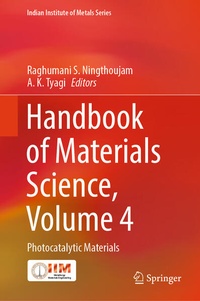
Handbook of Materials Science, Volume 4
Description

This book presents state-of-the-art coverage of the basic concept, new materials for photocatalysis and their applications. The contents cover types of photocatalysis, homogeneous photocatalysis, heterogeneous photocatalysis, photoelectrochemistry, basic principles of photocatalytic water splitting, theoretical models, UV-light-active photocatalysis, visible-light-active photocatalysis, NIR-lighter-active photocatalysis, various synthesis methods, solar energy conversion, photo-reductive process for trace metal ions, and theoretical design of novel photocatalyst for H2 generation under sunlight. Various semiconductors such as BiFeO3, BiVO4, titanate perovskites (ATiO3), nitrides, oxynitides, metal chalcogenides, graphenes, G-C3N4 based core-shells, transition metals based complexes, transition metal selenides, metal oxides like TiO2, ZnO, SnO2, NiO, CuO and MgO and their various nanocomposites, layered double hydroxides (LDHs), plasmonic semiconductor heterostructures, 2D-layered nanostructures, perovskite-oxide based nanostructures, semiconductors heterostructures, rare-earth ions doped nanomaterials, role of co-catalyst, and band gap engineering are also elaborated. The contents of this book are useful for researchers and professionals working in the areas of materials science, especially photocatalytic materials.
More details
Other editions
Additional editions
Persons
Dr. Raghumani S. Ningthoujam is presently Scientific Officer (G) at Chemistry Division, Bhabha Atomic Research Centre (BARC), Mumbai. He obtained M. Sc. in chemistry from Manipur University, India, in 1994. He was awarded Ph.D. in chemistry from Indian Institute of Technology (IIT) Kanpur in area of superconducting, electron transport and magnetic properties of nanostructured transition metal nitrides in 2004. He joined Bhabha Atomic Research Centre (BARC), Mumbai as Scientific Officer in 2006 after completion of Dr. K. S. Krishnan Fellowship. Currently, he is working in area of luminescent and magnetic nanomaterials and their applications in sensors, imaging, diagnosis and therapy. He did Post-doctoral Fellowship at University of Victoria, Canada, in the area of quantum dots. He has published about 190 papers in the refereed journals, 10 review articles, 24 book chapters and 6 books. He has been elected as a Fellow, The National Academy of Sciences, India (FNASc), a Fellow, Maharashtra Academy of Sciences (FMASc) and a Fellow, Physics Academy of the North East.
Dr. A. K. Tyagi is presently Dean and Senior Professor at Homi Bhabha National Institute (HBNI), Mumbai. He joined Chemistry Division, Bhabha Atomic Research Centre (BARC), Mumbai as Scientific Officer in 1986 through BARC Training School. During his career spanning close to four decades, he occupied various positions at BARC such as Head, Chemistry Division; Head, Analytical Chemistry Division; Head, Radiation Medicine Centre; Director, Chemistry Group and Director, Bio-Science Group. He was a Distinguished Scientist, DAE. His research interests are in the field chemistry of materials, which includes functional materials, nanomaterials, nuclear materials, energy materials, metastable materials, hybrid materials and structure-property correlation. He has published about 700 papers in journals, several books and has supervised 40 PhD students. He is an elected Fellow of the Indian National Science Academy (FNA), Indian Academy of Sciences (FASc); National Academy of Sciences, India (FNASc); Indian National Academy of Engineering (FNAE); Maharashtra Academy of Sciences; Royal Society of Chemistry, UK (FRSC); Asia Pacific Academy of Materials; World Academy of Ceramics; African Academy of Sciences and The World Academy of Sciences (FTWAS).
Content
Basic Concepts of Photo-catalytic Materials and Summary of all the Chapters.- Metal Chalcogenides: An emerging class of photocatalysts.- Potential of Nitride-Based Semiconductors for Photocatalytic Hydrogen Generation.- Theoretical Design of Novel Photocatalyst for H2 Generation under Sunlight.- Nanostructured Semiconductors for Broadband Photocatalysis.- Bismuth Iron Oxide Based Systems Toward Photocatalytic Degradation of Organic Pollutants.- Efficient charge separation mechanism in various nanostructured photocatalysts for their enhanced photocatalytic performance.- Doing chemistry of Bismuth Vanadate photo active materials: Role of doping, nano architecture, hetero-structure towards hydrogen generation by photoelectrochemical water splitting.- Photocatalysis: History, Fundamentals, and Applications.- Rare-earth ions doped nanomaterials for photocatalytic applications.- Titanateperovskite based hybrid materials for photocatalytic applications.- G-C3N4 based core-shells as emerging photocatalytic material towards energy and environmental applications.- Transition Metal Based Photoredox Catalysts in Organic Synthesis: Recent Developments.- Photocatalysis in Transition Metal Selenides.- Metal Oxide Nanomaterials for Photocatalytic Applications.
