

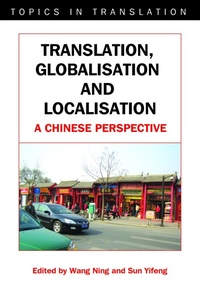
Translation, Globalisation and Localisation
A Chinese Perspective
Published on 28. March 2008
220 pages
978-1-84769-535-2 (ISBN)
Description

The global/local distinction has changed significantly, and the topic has been heatedly debated in literary and cultural as well as translation scholarship. In this age of globalisation, the traditional definition of translation has been altered. In the present anthology, translation is viewed as a cultural and political practice, and accordingly translation studies is based on a heightened awareness of global/local tensions in translation and of its moderating and transforming impact on local cultural paradigms. All the essays in this anthology deal with issues of translation from a cultural and theoretic perspective with regard to tensions and conflicts between global and local interests and values. No matter how different their approaches may seem, the essays are thematically integrated to discuss translation in a dialectical framework: either "globalising" Chinese issues internationally, or "localising" general and international issues domestically.
Reviews / Votes
The book successfully globalizes the research results on translation studies made by domestic Chinese researchers. This anthology excels in its richness and depth thanks to its refreshing views and critical perspectives. Extensive research by each contributor is conspicuous and highly appreciated. All in all, the book stands out as a fine collection of contemporary translation and cross-cultural studies that surely deepens our understanding of the underrepresented Chinese research community. * Ka-wai Yeung, Hang Seng School of Commerce in Linguist List 19.3819 * The book does credit to the editors who present a wide-ranging and comprehensive insight into the international discussion of globalisation and localisation with a focus on China. The book is recommended for its overall quality and its topicality. * Vladimir Khairoulline, Ufa, Russia on www.language-international.net * Translation, Globalisation and Localisation is an important and altogether timely contribution to a greater conversation about the meanings of globalization and cultural translation. * Robert E. Hegel, Washington University, St. Louis, Missouri, USA * This rich, searching and detailed collection of essays provides fine insight into a cluster of related issues: translation itself, globalization, postcoloniality, hegemony and appropriation, modes of cultural analysis. This fine collection shows how effectively rigorous academic analysis can deepen our understanding of contemporary social realities. * Richard Freadman, Lingnan University, Hong Kong. *More details
Series
Language
English
Place of publication
Bristol
United Kingdom
Publishing group
Channel View Publications Ltd
Target group
Professional and scholarly
ISBN-13
978-1-84769-535-2 (9781847695352)
Copyright in bibliographic data and cover images is held by Nielsen Book Services Limited or by the publishers or by their respective licensors: all rights reserved.
Schweitzer Classification
Other editions
Additional editions
Book
03/2008
Multilingual Matters
€127.20
Shipment within 10-20 days
Persons
Wang Ning is Professor of English and Director of the Centre for Comparative Literature and Cultural Studies, Tsinghua University. Apart from his numerous publications in Chinese, his English articles frequently appear in such international prestigious journals as New Literary History, Critical Inquiry, boundary 2, ARIEL, Neohelicon, Perspectives: Studies in Translatology, Comparative Literature Studies, Modern Language Quarterly and Semiotica. His most recent publication in English is Globalisation and Cultural Translation (2004).
Sun Yifeng is Head and Associate Professor of Department of Translation at Lingnan University, Hong Kong. He is the author of several books and numerous articles in Chinese and English. His most recent book in English entitled Misplaced Anxiety and Cultural Identity: Translations of Foreign Otherness is forthcoming.
Sun Yifeng is Head and Associate Professor of Department of Translation at Lingnan University, Hong Kong. He is the author of several books and numerous articles in Chinese and English. His most recent book in English entitled Misplaced Anxiety and Cultural Identity: Translations of Foreign Otherness is forthcoming.
Content
Acknowledgement
1. Introductory Remarks - Wang Ning and Sun Yifeng
Part One: Historical Overviews
2. Transvaluing the Global: Translation, Modernity and Hegemonic Discourse - Xie Ming
3. Translation in the Global-Local Tension - Cay Dollerup
4. Translation Studies in China: A Glocalized Theoretical Practice - Sun Yifeng and Mu Lei
5. On Cultural Translation: A Postcolonial Perspective - Wang Ning
6. Toward Pluralistic and Interdisciplinary Approaches: A Reflection on Translation Studies in Contemporary China - Xu Yanhong
Part Two: Current Developments
7. A Global View of Translation Studies: Toward an Interdisciplinary Field - Edwin Gentzler
8. Transgression and Appropriation in Transnational Cultural Translation: A Deconstructive Observation - Chen Yongguo
9. When a Turning Occurs: Counterevidence to Polysystem Hypothesis - Wang Dongfeng
10. Translating Popular Culture: Feng Xiaogang's Film Big Shot's Funeral as a Polynuclear Text - Mao Sihui
11. English as a Postcolonial Tool: Anti-Hegemonic Subversions in a Hegemonic Language - Eugene Chen Eoyang
Bibliography
Contributors
Index
1. Introductory Remarks - Wang Ning and Sun Yifeng
Part One: Historical Overviews
2. Transvaluing the Global: Translation, Modernity and Hegemonic Discourse - Xie Ming
3. Translation in the Global-Local Tension - Cay Dollerup
4. Translation Studies in China: A Glocalized Theoretical Practice - Sun Yifeng and Mu Lei
5. On Cultural Translation: A Postcolonial Perspective - Wang Ning
6. Toward Pluralistic and Interdisciplinary Approaches: A Reflection on Translation Studies in Contemporary China - Xu Yanhong
Part Two: Current Developments
7. A Global View of Translation Studies: Toward an Interdisciplinary Field - Edwin Gentzler
8. Transgression and Appropriation in Transnational Cultural Translation: A Deconstructive Observation - Chen Yongguo
9. When a Turning Occurs: Counterevidence to Polysystem Hypothesis - Wang Dongfeng
10. Translating Popular Culture: Feng Xiaogang's Film Big Shot's Funeral as a Polynuclear Text - Mao Sihui
11. English as a Postcolonial Tool: Anti-Hegemonic Subversions in a Hegemonic Language - Eugene Chen Eoyang
Bibliography
Contributors
Index
