

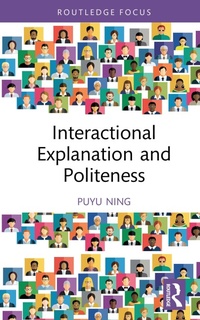
Interactional Explanation and Politeness
1st Edition
Published on 27. May 2026
94 pages
978-1-040-53528-8 (ISBN)
Description

This book explores the pragmatic concept of interactional explanation (IE) in linguistic (im)politeness research.
This volume establishes a working understanding of IE, understood as the response to a perceived appeal for information in an interaction. This book considers how IE is pragmatically sought, given, interpreted, and evaluated in interactions, processes which give rise to linguistic (im)politeness. This book highlights two case studies on Chinese linguacultural nuances, building on the foundational work of Brown and Levinson and more recent contribu-tions of Chen. In showcasing this particular context, Ning not only extends Chen's work on self-politeness theory, in which the desire to "save face" impacts what and how one speaks, but also underscores the importance of studying linguacultural variations in order to deepen our understanding of the connections between IE and linguistic (im)politeness research.
This book will appeal to students and researchers interested in interac-tional phenomena, in such areas as pragmatics, language and communication, and second and foreign language and teaching.
This volume establishes a working understanding of IE, understood as the response to a perceived appeal for information in an interaction. This book considers how IE is pragmatically sought, given, interpreted, and evaluated in interactions, processes which give rise to linguistic (im)politeness. This book highlights two case studies on Chinese linguacultural nuances, building on the foundational work of Brown and Levinson and more recent contribu-tions of Chen. In showcasing this particular context, Ning not only extends Chen's work on self-politeness theory, in which the desire to "save face" impacts what and how one speaks, but also underscores the importance of studying linguacultural variations in order to deepen our understanding of the connections between IE and linguistic (im)politeness research.
This book will appeal to students and researchers interested in interac-tional phenomena, in such areas as pragmatics, language and communication, and second and foreign language and teaching.
More details
Series
Edition
1. Auflage
Language
English
Place of publication
London
United Kingdom
Publishing group
Taylor & Francis Ltd
Target group
College/higher education
Illustrations
6 Tables, black and white; 7 Line drawings, black and white; 7 Illustrations, black and white
File size
2,19 MB
ISBN-13
978-1-040-53528-8 (9781040535288)
Copyright in bibliographic data and cover images is held by Nielsen Book Services Limited or by the publishers or by their respective licensors: all rights reserved.
Schweitzer Classification
Other editions
Additional editions
Puyu Ning
Interactional Explanation and Politeness
Book
05/2026
1st Edition
Routledge
€73.00
Shipment within 10-20 days
Person
Puyu Ning is a research fellow at the ELTE Research Centre for Linguistics, formerly an institute of the Hungarian Academy of Sciences, in Budapest, Hungary.
Content
1. Introduction, 2. Theoretical foundations, 3. Cross-cultural study of interactional explanation and politeness, 4. Interactional explanation and politeness in intercultural settings, 5. Summary and prospects for future research, References, Index
