

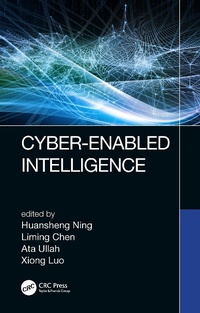
Cyber-Enabled Intelligence
1st Edition
Published on 8. August 2019
353 pages
978-0-429-58973-7 (ISBN)
Description

The book provides an advanced vision and trends of computational intelligence in cyberspace and cyber-enabled spaces. It reviews architectures and models, as well as state-of-the-art computational and interpretation capabilities for social, industrial, and multimedia applications. Cyber-enabled intelligence involves the design and development of intelligent and innovative application scenarios in social networks, computer vision, multimedia, and image processing. Application scenarios can also cover the applicability of intelligent sensing, data collection and predictive analysis in Internet of Things.
More details
Edition
1. Auflage
Language
English
Place of publication
London
United Kingdom
Publishing group
Taylor & Francis Ltd
Target group
Professional and scholarly
College/higher education
Product notice
Reflowable
Illustrations
22 Tables, black and white
ISBN-13
978-0-429-58973-7 (9780429589737)
Copyright in bibliographic data and cover images is held by Nielsen Book Services Limited or by the publishers or by their respective licensors: all rights reserved.
Schweitzer Classification
Other editions
Additional editions
Huansheng Ning | Liming Chen | Ata Ullah
Cyber-Enabled Intelligence
Book
06/2021
1st Edition
Taylor & Francis
€70.10
Shipment within 10-20 days
Huansheng Ning | Liming Chen | Ata Ullah
Cyber-Enabled Intelligence
Book
08/2019
1st Edition
CRC Press
€129.99
Shipment within 15-20 days
Persons
Huansheng Ning, PhD, earned his PhD from Beihang University in 2001. Currently, he is a professor and vice dean of the School of Computer and Communication Engineering, University of Science and Technology, Beijing, China. His current research focuses on Internet of Things, cyber philosophy, science and technology. Dr. Ning is the founder of Cyberspace and Cybermatics International Science and Technology Cooperation Base, and co-founder and vice chair of Beijing Engineering Research Center for Cyberspace Data Analysis and Applications. He serves as a steering committee member of IEEE Internet of Things Journal and associate editor of IEEE System Journal. He is co-chair of IEEE Transactions on Cybermatics. He hosted the 2013 World Cybermatics Congress and the 2015 Smart World Congress as the joint executive chair. Dr. Ning received the IEEE Computer Society Meritorious Service Award in 2013, and IEEE Computer Society Golden Core Award in 2014. He is an IET fellow and IEEE senior member.
Liming Chen, PhD, is professor of Computer Science in the School of Computer Science and Informatics at De Montfort University, Leicester, UK. He earned his BEng and MEng from Beijing Institute of Technology (BIT), China, and his PhD in Artificial Intelligence from De Montfort University, UK. His current research interests include data analytics, pervasive computing, artificial intelligence, and user-centered intelligent systems and their applications in smart healthcare. He is well published with more than 190 books, book chapters, journals/transactions, and conference and workshop articles in the above areas. Dr. Chen is an IET fellow, an IEEE senior member, a co-founder and co-director of the UK-China Gait and Health Innovation Institute at the DMU-USTB (University of Science and Technology Beijing, China) Joint Research Lab on Smart Healthcare and the IEEE CIS "User-centred Smart Systems" Task Force.
Ata Ullah, PhD, earned his BS and MS in Computer Science from COMSATS University, Islamabad, Pakistan, in 2005 and 2007, respectively, and PhD in Computer Science from IIUI, Pakistan, in 2016. From 2007 to 2008, he was a software engineer at Streaming Networks, Islamabad. Dr. Ullah contributed to the National University of Modern Languages (NUML), Islamabad, Pakistan as lecturer/head project committee from 2008 to 2015 and as assistant professor from 2015 to 2017 in the Department of Computer Science. From 2017 to 2018, he worked as a research fellow at the School of Computer and Communication Engineering, University of Science and Technology, Beijing, China. Dr. Ullah rejoined NUML in September 2018. He has supervised 112 projects. He has authored several papers in impact factor journals and contributed to books as well. He is also a reviewer and guest editor. His areas of interest are WSN, IoT, cyber physical social thinking (CPST) space, cyber-intelligence, and health services.
Xiong Luo, PhD, earned his PhD from Central South University, China, in 2004. From 2004 to 2005, he received postdoctoral fellowships from Tsinghua University, China. From 2012 to 2013, he was a visiting scholar at Arizona State University, USA. He currently works as a full professor in the School of Computer and Communication Engineering, University of Science and Technology, Beijing, China. His current research interests include machine learning, cloud computing, and cyber-physical systems. He has published extensively in his areas of interest in journals such as IEEE Transactions on Industrial Informatics, IEEE Transactions on Human-Machine Systems, IEEE Transactions on Network Science and Engineering, IEEE Internet of Things Journal, and Future Generation Computer Systems. Prof. Luo is a senior member of IEEE. He was a recipient of the 2002 IEEE CSS/Beijing Chapter Young Author Best Paper Award.
Liming Chen, PhD, is professor of Computer Science in the School of Computer Science and Informatics at De Montfort University, Leicester, UK. He earned his BEng and MEng from Beijing Institute of Technology (BIT), China, and his PhD in Artificial Intelligence from De Montfort University, UK. His current research interests include data analytics, pervasive computing, artificial intelligence, and user-centered intelligent systems and their applications in smart healthcare. He is well published with more than 190 books, book chapters, journals/transactions, and conference and workshop articles in the above areas. Dr. Chen is an IET fellow, an IEEE senior member, a co-founder and co-director of the UK-China Gait and Health Innovation Institute at the DMU-USTB (University of Science and Technology Beijing, China) Joint Research Lab on Smart Healthcare and the IEEE CIS "User-centred Smart Systems" Task Force.
Ata Ullah, PhD, earned his BS and MS in Computer Science from COMSATS University, Islamabad, Pakistan, in 2005 and 2007, respectively, and PhD in Computer Science from IIUI, Pakistan, in 2016. From 2007 to 2008, he was a software engineer at Streaming Networks, Islamabad. Dr. Ullah contributed to the National University of Modern Languages (NUML), Islamabad, Pakistan as lecturer/head project committee from 2008 to 2015 and as assistant professor from 2015 to 2017 in the Department of Computer Science. From 2017 to 2018, he worked as a research fellow at the School of Computer and Communication Engineering, University of Science and Technology, Beijing, China. Dr. Ullah rejoined NUML in September 2018. He has supervised 112 projects. He has authored several papers in impact factor journals and contributed to books as well. He is also a reviewer and guest editor. His areas of interest are WSN, IoT, cyber physical social thinking (CPST) space, cyber-intelligence, and health services.
Xiong Luo, PhD, earned his PhD from Central South University, China, in 2004. From 2004 to 2005, he received postdoctoral fellowships from Tsinghua University, China. From 2012 to 2013, he was a visiting scholar at Arizona State University, USA. He currently works as a full professor in the School of Computer and Communication Engineering, University of Science and Technology, Beijing, China. His current research interests include machine learning, cloud computing, and cyber-physical systems. He has published extensively in his areas of interest in journals such as IEEE Transactions on Industrial Informatics, IEEE Transactions on Human-Machine Systems, IEEE Transactions on Network Science and Engineering, IEEE Internet of Things Journal, and Future Generation Computer Systems. Prof. Luo is a senior member of IEEE. He was a recipient of the 2002 IEEE CSS/Beijing Chapter Young Author Best Paper Award.
Content
1. Introduction. 2. Cyber-Enabled Intelligence Architectures and applications. 3. Enabling Technologies and Research Domains. 4. Cyber Intelligence and Machine Learning Techniques. 5. Advancements of Social Intelligence with Cyber Intelligence. 6. Security and Privacy in Cyber-Enabled intelligent/smart Applications. 7. Supporting Technologies and Research Area for Cyber-Enabled Intelligence.
