

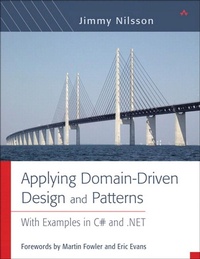
Applying Domain-Driven Design and Patterns
Description

Patterns, Domain-Driven Design (DDD), and Test-Driven Development (TDD) enable architects and developers to create systems that are powerful, robust, and maintainable. Now, there's a comprehensive, practical guide to leveraging all these techniques primarily in Microsoft .NET environments, but the discussions are just as useful for Java developers.
Drawing on seminal work by Martin Fowler (Patterns of Enterprise Application Architecture) and Eric Evans (Domain-Driven Design), Jimmy Nilsson shows how to create real-world architectures for any .NET application. Nilsson illuminates each principle with clear, well-annotated code examples based on C# 1.1 and 2.0. His examples and discussions will be valuable both to C# developers and those working with other .NET languages and any databases-even with other platforms, such as J2EE. Coverage includes
· Quick primers on patterns, TDD, and refactoring
· Using architectural techniques to improve software quality
· Using domain models to support business rules and validation
· Applying enterprise patterns to provide persistence support via NHibernate
· Planning effectively for the presentation layer and UI testing
· Designing for Dependency Injection, Aspect Orientation, and other new paradigms
More details
Other editions
Additional editions
Person
Jimmy Nilsson owns and runs the Swedish consulting company JNSK AB. He has written numerous technical articles and two books. He has also been training and speaking at conferences, but above everything else, he is a developer with almost 20 years of experience (www.jnsk.se/weblog/).
Content
About the Author xxv
Forewords xxvii
Preface: Bridging Gaps xxxi
Part I: Background
Chapter 1: Values to Value 3
Chapter 2: A Head Start on Patterns 47
Chapter 3: TDD and Refactoring 77
Part II: Applying DDD
Chapter 4: A New Default Architecture 113
Chapter 5: Moving Further with Domain-Driven Design 143
Chapter 6: Preparing for Infrastructure 181
Chapter 7: Let the Rules Rule 229
Part III: Applying PoEAA
Chapter 8: Infrastructure for Persistence 279
Chapter 9: Putting NHibernate into Action 311
Part IV: What's Next?
Chapter 10: Design Techniques to Embrace 349
Chapter 11: Focus on the UI 407
Part V: Appendices
Appendix A: Other Domain Model Styles 447
Appendix B: Catalog of Discussed Patterns 483
References 493
Index 501
