

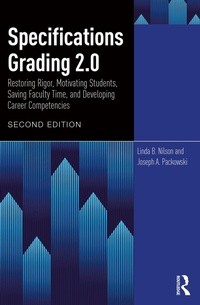
Specifications Grading 2.0
Restoring Rigor, Motivating Students, Saving Faculty Time, and Developing Career Competencies
2nd Edition
Published on 15. September 2025
246 pages
978-1-040-42149-9 (ISBN)
Description

This second edition of the alternative grading classic revisits specs grading with a robust body of research, exemplars, and strategies to elevate the quality of student work, increase engagement and buy-in, reduce faculty stress, and cultivate students' career competencies.
Nilson and Packowski present the unique characteristics of the specs grading schema, all of which simplify faculty decision making, reduce antagonism between the evaluator and the evaluated, and increase student receptivity to meaningful feedback, thus facilitating a mutually beneficial, rigorous learning process. Used consistently over time, specs grading can restore credibility to grades by demonstrating and making transparent to all stakeholders the learning outcomes that students achieve.
This book features five new chapters stemming from firsthand accounts of dozens of instructors actively using specs grading and new material in six of the remaining eight chapters. It lays out the surprisingly simple transition process, positioning specs grading as the most viable and easy-to-use system available to faculty.
Nilson and Packowski present the unique characteristics of the specs grading schema, all of which simplify faculty decision making, reduce antagonism between the evaluator and the evaluated, and increase student receptivity to meaningful feedback, thus facilitating a mutually beneficial, rigorous learning process. Used consistently over time, specs grading can restore credibility to grades by demonstrating and making transparent to all stakeholders the learning outcomes that students achieve.
This book features five new chapters stemming from firsthand accounts of dozens of instructors actively using specs grading and new material in six of the remaining eight chapters. It lays out the surprisingly simple transition process, positioning specs grading as the most viable and easy-to-use system available to faculty.
Reviews / Votes
Linda Nilson is a national treasure. For decades she has championed teaching at its best. Her practical and effective recommendations should be embraced widely, to ensure excellence in every college class. In Specifications Grading 2.0, co-authored with Joe Packowski, professors will learn how to provide clear and motivating feedback that promotes higher order thinking and creativity. The book shows how we can reduce students' stress while maintaining high expectations. A must-read!Jonathan Gyurko, President and Co-founder, ACUE, Adjunct Assistant Professor, Teachers College, Columbia University, USA
Bravo for this new edition of Specifications Grading! Instructors adopt specifications grading because it clearly articulates expectations for assignments and course grades. Nilson and Packowski expand on the first edition with detailed descriptions of specifications grading systems instructors designed for their courses. Two chapters present examples from STEM, health sciences, business, humanities, and social science courses. In addition, new chapters evaluate the impact of specifications grading, based on student perceptions of specifications grading and assessments of student learning.
Claudia J. Stanny, Director Emerita, Center for University Teaching, Learning, and Assessment, University of West Florida, USA
Since 2014, Linda Nilson's work on specifications grading has given faculty a guide to rethink how we assess student learning. With a clear, practical approach, specs grading tackles the frustrations of traditional systems while restoring academic rigor and boosting student motivation. This new updated edition expands the conversation with real classroom examples from around the world, covering a wide range of disciplines and course formats. Grounded in research and written for busy educators, it's a valuable guide for anyone ready to make grading more meaningful-for students and for themselves.
Todd Zakrajsek, Adjunct Associate Professor and Associate Director of The Faculty Development Fellowship, Department of Family Medicine, University of North Carolina at Chapel Hill, USA
Nilson and Packowski, in this second edition on specs grading, include specific examples from a wide variety of disciplines. Specs grading seamlessly implements the best practice of aligning student learning objectives and assessment assignments, resulting in greater student motivation (through student choice!), learning gains, academic rigor, faculty satisfaction and reduced workload-with the research in print to prove it! Readers benefit from faculty customization of specs grading to accommodate their modes of delivery, course design, and objectives.
Cynthia G. Desrochers, Professor of Education Emerita, California State University, Northridge, USA; Founding Director, Center for Excellence in Learning & Teaching, Former Director, Institute for Teaching & Learning, California State University System, Office of the Chancellor, USA
More details
Edition
2nd edition
Language
English
Place of publication
London
United Kingdom
Publishing group
Taylor & Francis Ltd
Target group
College/higher education
Professional and scholarly
Illustrations
11 Tables, black and white; 3 Line drawings, black and white; 3 Illustrations, black and white
File size
2,52 MB
ISBN-13
978-1-040-42149-9 (9781040421499)
Copyright in bibliographic data and cover images is held by Nielsen Book Services Limited or by the publishers or by their respective licensors: all rights reserved.
Schweitzer Classification
Other editions
Additional editions

Linda Burzotta Nilson
Specifications Grading 2.0
Restoring Rigor, Motivating Students, Saving Faculty Time, and Developing Career Competencies
Book
11/2025
Routledge
Unfortunately, price unknown
Available (delivery time upon request)
Linda B. Nilson | Joseph A. Packowski
Specifications Grading 2.0
Restoring Rigor, Motivating Students, Saving Faculty Time, and Developing Career Competencies
Book
09/2025
2nd Edition
Routledge
€51.40
Shipment within 10-20 days
Linda B. Nilson | Joseph A. Packowski
Specifications Grading 2.0
Restoring Rigor, Motivating Students, Saving Faculty Time, and Developing Career Competencies
Book
09/2025
2nd Edition
Routledge
€207.70
Shipment within 10-20 days
Persons
Linda B. Nilson, Ph.D., is Founding Director Emerita of the Office of Teaching Effectiveness and Innovation at Clemson University, USA.
Joseph A. Packowski is an award-winning educator who fosters empowerment and experiential learning, drawing on 25 years of workforce and corporate recruiting experience.
Joseph A. Packowski is an award-winning educator who fosters empowerment and experiential learning, drawing on 25 years of workforce and corporate recruiting experience.
Content
1. The Continuing Need for a New Grading System 2. Learning Outcomes and Course Design 3. Linking Grades to Outcomes 4. Pass/Fail Grading for Rigor, Motivation, and Faculty Peace of Mind 5. Essentials of Specifications Grading 6. Converting Specs-Graded Student Work into Final Letter Grades 7. Specs-Graded Course Designs in STEM and the Health Sciences 8. Specs-Graded Course Designs in Business, the Humanities, and the Social Sciences 9. Evidence of Restored Rigor, Student Motivation, and Saved Faculty Time 10. What Do the Students Think? 11. Developing Students' Career Competencies 12. Developing a Course With Specs Grading 13. An Evaluation of Specs Grading
