

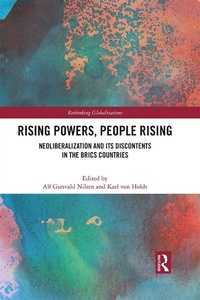
Rising Powers, People Rising
Neoliberalization and its Discontents in the BRICS Countries
1st Edition
Published on 25. April 2021
126 pages
978-1-000-37603-6 (ISBN)
Description

Rising Powers, People Rising is a pathbreaking volume in which leading international scholars discuss the emerging political economy of development in the BRICS countries centred on neo-liberalization, precarity, and popular struggles.
The rise of the BRICS countries - Brazil, Russia, India, China, and South Africa - has called into question the future of Western dominance in world markets and geopolitics. However, the developmental trajectories of the BRICS countries are shot through with socio-economic fault lines that relegate large numbers of people to the margins of current growth processes, where life is characterized by multiple and overlapping vulnerabilities. These socio-economic fault lines have, in turn, given rise to political convulsions across the BRICS countries, ranging from single-issue protests to sustained social movements oriented towards structural transformation. The contributions in this book focus on the ways in and extent to which these trajectories generate distinct forms and patterns of mobilization and resistance, and conversely, how popular struggles impact on and shape these trajectories. The book unearths the economic, social, and political contradictions that tend to disappear from view in mainstream narratives of the BRICS countries as rising powers in the world-system.
The chapters in this book were originally published as a special issue of Globalizations.
The rise of the BRICS countries - Brazil, Russia, India, China, and South Africa - has called into question the future of Western dominance in world markets and geopolitics. However, the developmental trajectories of the BRICS countries are shot through with socio-economic fault lines that relegate large numbers of people to the margins of current growth processes, where life is characterized by multiple and overlapping vulnerabilities. These socio-economic fault lines have, in turn, given rise to political convulsions across the BRICS countries, ranging from single-issue protests to sustained social movements oriented towards structural transformation. The contributions in this book focus on the ways in and extent to which these trajectories generate distinct forms and patterns of mobilization and resistance, and conversely, how popular struggles impact on and shape these trajectories. The book unearths the economic, social, and political contradictions that tend to disappear from view in mainstream narratives of the BRICS countries as rising powers in the world-system.
The chapters in this book were originally published as a special issue of Globalizations.
More details
Series
Edition
1. Auflage
Language
English
Place of publication
London
United Kingdom
Publishing group
Taylor & Francis Ltd
Target group
College/higher education
Product notice
Reflowable
ISBN-13
978-1-000-37603-6 (9781000376036)
Copyright in bibliographic data and cover images is held by Nielsen Book Services Limited or by the publishers or by their respective licensors: all rights reserved.
Schweitzer Classification
Other editions
Additional editions
Alf Gunvald Nilsen | Karl von Holdt
Rising Powers, People Rising
Neoliberalization and its Discontents in the BRICS Countries
Book
09/2023
1st Edition
Routledge
€51.98
Shipment within 15-20 days
Alf Gunvald Nilsen | Karl von Holdt
Rising Powers, People Rising
Neoliberalization and its Discontents in the BRICS Countries
Book
04/2021
1st Edition
Routledge
€179.51
Shipment within 15-20 days
Persons
Alf Gunvald Nilsen is Professor of Sociology at the University of Pretoria. His research focuses on the political economy of democracy and development in the Global South. His most recent books are Adivasis and the State: Subalternity and Citizenship in India's Bhil Heartland (2018) and Indian Democracy: Origins, Trajectories, Contestations (2019).
Karl von Holdt is Professor in the Society, Work and Politics Institute, University of the Witwatersrand. Publications include Transition from Below: Forging Trade Unionism and Workplace Change in South Africa; Conversations with Bourdieu: The Johannesburg Moment (with Michael Burawoy); and Beyond the Apartheid Workplace: Studies in Transition, co-edited with Edward Webster, as well as numerous articles. His research interests centre on movements, democracy, corruption, and violence.
Karl von Holdt is Professor in the Society, Work and Politics Institute, University of the Witwatersrand. Publications include Transition from Below: Forging Trade Unionism and Workplace Change in South Africa; Conversations with Bourdieu: The Johannesburg Moment (with Michael Burawoy); and Beyond the Apartheid Workplace: Studies in Transition, co-edited with Edward Webster, as well as numerous articles. His research interests centre on movements, democracy, corruption, and violence.
Content
Introduction: Rising powers, people rising: neo-liberalization and its discontents in the BRICS countries
Alf Gunvald Nilsen and Karl von Holdt
1. China's precariats
Ching Kwan Lee
2. Social mobilizations and the question of social justice in contemporary Russia
Karine Clement
3. Mapping movement landscapes in South Africa
Karl von Boldt and Prishani Naidoo
4. Uncovering a politics of livelihoods: analysing displacement and contention in contemporary India
Gayatri A. Menon and Aparna Sundar
5. A precarious hegemony: neoliberalism, social struggles, and the end of Lulismo in Brazil
Ruy Braga and Sean Purdy
6. Neo-development of underdevelopment: Brazil and the political economy of South American integration under the Workers' Party
Fabio Luis Barbosa dos Santos
Alf Gunvald Nilsen and Karl von Holdt
1. China's precariats
Ching Kwan Lee
2. Social mobilizations and the question of social justice in contemporary Russia
Karine Clement
3. Mapping movement landscapes in South Africa
Karl von Boldt and Prishani Naidoo
4. Uncovering a politics of livelihoods: analysing displacement and contention in contemporary India
Gayatri A. Menon and Aparna Sundar
5. A precarious hegemony: neoliberalism, social struggles, and the end of Lulismo in Brazil
Ruy Braga and Sean Purdy
6. Neo-development of underdevelopment: Brazil and the political economy of South American integration under the Workers' Party
Fabio Luis Barbosa dos Santos
