

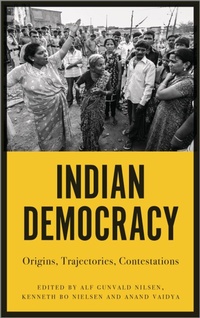
Indian Democracy
Origins, Trajectories, Contestations
1st Edition
Published on 20. March 2019
176 pages
978-1-78680-432-7 (ISBN)
Description

More than 70 years after its founding, with Narendra Modi's authoritarian Hindu nationalists in government, is the dream of Indian democracy still alive and well?
India's pluralism has always posed a formidable challenge to its democracy, with many believing that a clash of identities based on region, language, caste, religion, ethnicity and tribe would bring about its demise. With the meteoric rise to power of the Bharatiya Janata Party, its solidity is once again called into question: is Modi's Hindu majoritarianism an anti-democratic attempt to transform India into a monolithic Hindu nation from which minorities and dissidents are forcibly excluded?
With examinations of the way that class and caste power shaped the making of India's postcolonial democracy, the role of feminism, the media, and the public sphere in sustaining and challenging democracy, this book interrogates the contradictions at the heart of the Indian democratic project, examining its origins, trajectories and contestations.
India's pluralism has always posed a formidable challenge to its democracy, with many believing that a clash of identities based on region, language, caste, religion, ethnicity and tribe would bring about its demise. With the meteoric rise to power of the Bharatiya Janata Party, its solidity is once again called into question: is Modi's Hindu majoritarianism an anti-democratic attempt to transform India into a monolithic Hindu nation from which minorities and dissidents are forcibly excluded?
With examinations of the way that class and caste power shaped the making of India's postcolonial democracy, the role of feminism, the media, and the public sphere in sustaining and challenging democracy, this book interrogates the contradictions at the heart of the Indian democratic project, examining its origins, trajectories and contestations.
Reviews / Votes
'Indian democracy is a veritable riddle with its constitution promising the moon to people but its state denying them even the basic right to voice their miseries. This book will certainly provoke readers who still see nothing wrong with the system' -- Anand Teltumbde, author of 'Republic of Caste' 'If we want to know what's wrong with our present, we must know what's wrong with our past. This book offers insight into both. A three-dimensional view of India' -- Shehla Rashid, Activist 'How do we understand the threats now facing Indian democracy? This valuable book provides nuanced insights into processes that explain its current travails: the Constitution's missing revolution; identity, discrimination and marginalisation; pressures on and within the media; structured and unstructured violence - and much more' -- Jayati Ghosh, Jawaharlal Nehru University 'A sharp understanding of the complexities of contemporary Indian democracy. With their ears to the ground, the contributors have created an incisive volume on the subject' -- Ram Puniyani, author of 'Deconstructing Terrorist Violence' 'Takes readers on a journey through the complex systems shaping socio-political life India. Each essay offers new ways of understanding how issues like neoliberalism, casteism, jingoism and Hindutva take shape in our nation's everyday reality. This is a great primer for anyone looking to critically engage with our idea of democracy with all its politics, pitfalls and peril' -- Jignesh Mevani, Activist 'Like the stars at dawn, the institutions of democracy in India have lost their brightness one by one in recent years. Liberty, equality and solidarity are fading further away with this ominous metamorphosis. This engaging collection of essays is a major contribution to our understanding of the crisis of Indian democracy' -- Jean Dreze, co-author of 'An Uncertain Glory: India and its Contradictions'More details
Edition
1. Auflage
Language
English
Place of publication
London
United Kingdom
Target group
Professional and scholarly
File size
0,52 MB
ISBN-13
978-1-78680-432-7 (9781786804327)
Copyright in bibliographic data and cover images is held by Nielsen Book Services Limited or by the publishers or by their respective licensors: all rights reserved.
Schweitzer Classification
Other editions
Additional editions
Alf Gunvald Nilsen | Kenneth Bo Nielsen | Anand Vaidya
Indian Democracy
Origins, Trajectories, Contestations
Book
03/2019
Pluto Press
€54.65
Shipment within 10-20 days
Persons
Alf Gunvald Nilsen is Professor of Sociology at University of Pretoria. He is the author of Citizenship in India's Bhil Heartland among other books.
Kenneth Bo Nielsen is Associate Professor in the Department of Culture Studies and Oriental Languages at the University of Oslo. He is the author of Land Dispossession and Everyday Politics in Rural Eastern? India.
Anand Vaidya is Assistant Professor of Anthropology at Reed College.
Kenneth Bo Nielsen is Associate Professor in the Department of Culture Studies and Oriental Languages at the University of Oslo. He is the author of Land Dispossession and Everyday Politics in Rural Eastern? India.
Anand Vaidya is Assistant Professor of Anthropology at Reed College.
Content
Acknowledgements
Introduction: Trajectories and Crossroads: Indian Democracy at 70 - Alf Gunvald Nilsen, Kenneth Bo Nielsen and Anand Vaidya
1. Democratic Origins I: India's Constitution and the Missing Revolution - Sandipto Dasgupta
2. Democratic Origins II: The Minority Question in South Asia - Anupama Rao
3. Democratic Origins III: Violence and/in the Making of Indian Democracy - Sunil Purushotham
4. Democratic Origins IV: Comment - Ajay Skaria
5. The State and/of the Media in Modi's India - Siddharth Varadarajan
6. Writing Counter-insurgency, Conflict and Democracy - Nandini Sundar and Dolly Kikon
7. Democratic Trajectories I: Congressism, Anti-Congressism, and Composing the 'People-as-a-Whole' - Subir Sinha
8. Democratic Trajectories II: Merit and Caste in Contemporary India - Ajantha Subramanian
9. Democratic Trajectories III: Ritual Inclusivity in Turbulent Times - Kathinka Froystad
10. Democratic Trajectories IV: Comment - Manali Desai
11. India's Democracy: Contest for the Nation's Core - Kavita Krishnan
12. Feminism and the Politics of Gender - Raka Ray and Srila Roy
Conclusion: Indian Democracy and Its Prospects: 2019 and Beyond - Alf Gunvald Nilsen, Kenneth Bo Nielsen and Anand Vaidya
About the Editors
Notes on Contributors
Notes
Index
Introduction: Trajectories and Crossroads: Indian Democracy at 70 - Alf Gunvald Nilsen, Kenneth Bo Nielsen and Anand Vaidya
1. Democratic Origins I: India's Constitution and the Missing Revolution - Sandipto Dasgupta
2. Democratic Origins II: The Minority Question in South Asia - Anupama Rao
3. Democratic Origins III: Violence and/in the Making of Indian Democracy - Sunil Purushotham
4. Democratic Origins IV: Comment - Ajay Skaria
5. The State and/of the Media in Modi's India - Siddharth Varadarajan
6. Writing Counter-insurgency, Conflict and Democracy - Nandini Sundar and Dolly Kikon
7. Democratic Trajectories I: Congressism, Anti-Congressism, and Composing the 'People-as-a-Whole' - Subir Sinha
8. Democratic Trajectories II: Merit and Caste in Contemporary India - Ajantha Subramanian
9. Democratic Trajectories III: Ritual Inclusivity in Turbulent Times - Kathinka Froystad
10. Democratic Trajectories IV: Comment - Manali Desai
11. India's Democracy: Contest for the Nation's Core - Kavita Krishnan
12. Feminism and the Politics of Gender - Raka Ray and Srila Roy
Conclusion: Indian Democracy and Its Prospects: 2019 and Beyond - Alf Gunvald Nilsen, Kenneth Bo Nielsen and Anand Vaidya
About the Editors
Notes on Contributors
Notes
Index
