

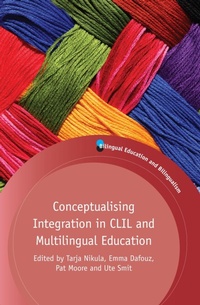
Conceptualising Integration in CLIL and Multilingual Education
Published on 18. August 2016
271 pages
978-1-78309-615-2 (ISBN)
Description

Content and Language Integrated Learning (CLIL) is a form of education that combines language and content learning objectives, a shared concern with other models of bilingual education. While CLIL research has often addressed learning outcomes, this volume focuses on how integration can be conceptualised and investigated. Using different theoretical and methodological approaches, ranging from socioconstructivist learning theories to systemic functional linguistics, the book explores three intersecting perspectives on integration concerning curriculum and pedagogic planning, participant perceptions and classroom practices. The ensuing multidimensionality highlights that in the inherent connectedness of content and language, various institutional, pedagogical and personal aspects of integration also need to be considered.
Reviews / Votes
This volume is a key step in establishing an understanding of the integration of language and content in CLIL and multilingual education. The authors provide a wealth of research, offering new and valuable insights into curriculum and pedagogy planning, participant perspectives and classroom practices, while introducing a conceptual framework to integration in CLIL. This volume is aimed at becoming a landmark to teachers, educators and researchers, and all those interested in an integrated approach to multilingual education. * Yolanda Ruiz de Zarobe, University of the Basque Country, Spain * Bringing together many accomplished and respected CLIL researchers, this timely volume presents highly provoking studies and dialogue about content and language integration. Both theoretically and methodologically rich, the book is essential reading for scholars in CLIL, CBI, and immersion education and will undoubtedly stimulate further discussion and inquiry in years to come. * Diane J. Tedick, University of Minnesota, USA * By expanding research on CLIL, the text provides a welcome addition to the field, by proposing ways to use the metaphor of integration to focus on how all educational practice requires consideration of the complex relationships between language and content at institutional, pedagogical, cultural and personal levels. Readers interested in learning in bilingual, sheltered, CLIL, and mainstream classrooms will find valuable insights for improving educational practice for all learners. * Juliet Langman, University of Texas at San Antonio, USA * "Conceptualising Integration in CLIL and Multilingual Education" is a great, well-organized resource for CLIL researchers and CLIL teacher educators, complete with rich data excerpts and theoretical models.The authors and the editors did a remarkable job conceptualizing the integration of language and content in CLIL and highlighting connections between the three perspectives on integration which serve as the organizing principle of the book. -- Anna M Krulatz, Sor-Trondelag University College, Norway * LINGUIST List 28.2284 * The volume is based on an international research project funded by the Academy of Finland and brings together sixteen accomplisged and valued researchers from a number of countries (...) The comprehensive rich and evidence-based data from multiple sources make convincing claims. The strengths of the book lie also in the varied disciplines that are examined...and in the implementation of wide-ranging theoretical and methodological approaches... -- Smadar Donitsa-Schmidt, Kibbutzim College of Education, Israel * Journal of Immersion and Content-Based Language Education, Vol. 6:1 (2018) *
More details
Series
Language
English
Place of publication
Bristol
United Kingdom
Publishing group
Channel View Publications Ltd
Target group
College/higher education
ISBN-13
978-1-78309-615-2 (9781783096152)
Copyright in bibliographic data and cover images is held by Nielsen Book Services Limited or by the publishers or by their respective licensors: all rights reserved.
Schweitzer Classification
Other editions
Additional editions
Tarja Nikula | Emma Dafouz | Pat Moore
Conceptualising Integration in CLIL and Multilingual Education
Book
08/2016
Multilingual Matters
€176.50
Shipment within 10-20 days
Persons
Tarja Nikula is Professor at the Centre for Applied Language Studies, University of Jyvaeskylae, Finland. Her research interests include CLIL, classroom discourse, pragmatics of language learning and use, language education policies, multilingual classroom practices.
Emma Dafouz is Associate Professor in the Department of English Language and Linguistics at the Universidad Complutense de Madrid, Spain. Her research interests include CLIL, English-medium instruction, language policies, higher education and classroom discourse.
Pat Moore is Senior Lecturer in the Department of Philology and Translation at the Universidad Pablo de Olavide, Spain. Her research interests include CLIL, bilingualism, translanguaging, bilingual education and classroom praxis.
Ute Smit is Associate Professor in the Department of English Studies at the University of Vienna, Austria. Her research interests include CLIL, English-medium instruction, English as a lingua franca, language policy and classroom discourse.
Emma Dafouz is Associate Professor in the Department of English Language and Linguistics at the Universidad Complutense de Madrid, Spain. Her research interests include CLIL, English-medium instruction, language policies, higher education and classroom discourse.
Pat Moore is Senior Lecturer in the Department of Philology and Translation at the Universidad Pablo de Olavide, Spain. Her research interests include CLIL, bilingualism, translanguaging, bilingual education and classroom praxis.
Ute Smit is Associate Professor in the Department of English Studies at the University of Vienna, Austria. Her research interests include CLIL, English-medium instruction, English as a lingua franca, language policy and classroom discourse.
Content
Contributors
Acknowledgements
Rick De Graaff: Foreword: Integrating Content and Language in Education: Best of Both Worlds?
Tarja Nikula, Christiane Dalton-Puffer, Ana Llinares and Francisco Lorenzo: More Than Content and Language: The Complexity of Integration in CLIL and Multilingual Education
Part 1: Curriculum and Pedagogy Planning
1. Christiane Dalton-Puffer: Cognitive Discourse Functions: Specifying an Integrative Interdisciplinary Construct
2. Francisco Lorenzo and Christiane Dalton-Puffer: Historical Literacy in CLIL: Telling the Past in a Second Language
3. Angela Berger: Learning Mathematics Bilingually: An Integrated Language and Mathematics Model (ILMM) of Word Problem Solving Processes in English as a Foreign Language
4. Richard Barwell: A Bakhtinian Perspective on Language and Content Integration: Encountering the Alien Word in Second Language Mathematics Classrooms
Part 2: Participants
5. Emma Dafouz, Julia Huettner and Ute Smit: University Teachers' Beliefs of Language and Content Integration in English-Medium Education in Multilingual University Settings
6. Kristiina Skinnari and Eveliina Bovellan: CLIL Teachers' Beliefs about Integration and about their Professional Roles: Perspectives from a European Context
Part 3: Practices
7. Tom Morton and Teppo Jakonen: Integration of Language and Content through Languaging in CLIL Classroom Interaction: A Conversation Analysis Perspective
8. Ana Llinares and Tarja Nikula: Teacher and Student Evaluative Language in CLIL across Contexts: Integrating SFL and Pragmatic Approaches
9. Pat Moore and Tarja Nikula: Translanguaging in CLIL Classrooms
10. Constant Leung and Tom Morton: Conclusion: Language Competence, Learning and Pedagogy in CLIL - Deepening and Broadening Integration
References
Acknowledgements
Rick De Graaff: Foreword: Integrating Content and Language in Education: Best of Both Worlds?
Tarja Nikula, Christiane Dalton-Puffer, Ana Llinares and Francisco Lorenzo: More Than Content and Language: The Complexity of Integration in CLIL and Multilingual Education
Part 1: Curriculum and Pedagogy Planning
1. Christiane Dalton-Puffer: Cognitive Discourse Functions: Specifying an Integrative Interdisciplinary Construct
2. Francisco Lorenzo and Christiane Dalton-Puffer: Historical Literacy in CLIL: Telling the Past in a Second Language
3. Angela Berger: Learning Mathematics Bilingually: An Integrated Language and Mathematics Model (ILMM) of Word Problem Solving Processes in English as a Foreign Language
4. Richard Barwell: A Bakhtinian Perspective on Language and Content Integration: Encountering the Alien Word in Second Language Mathematics Classrooms
Part 2: Participants
5. Emma Dafouz, Julia Huettner and Ute Smit: University Teachers' Beliefs of Language and Content Integration in English-Medium Education in Multilingual University Settings
6. Kristiina Skinnari and Eveliina Bovellan: CLIL Teachers' Beliefs about Integration and about their Professional Roles: Perspectives from a European Context
Part 3: Practices
7. Tom Morton and Teppo Jakonen: Integration of Language and Content through Languaging in CLIL Classroom Interaction: A Conversation Analysis Perspective
8. Ana Llinares and Tarja Nikula: Teacher and Student Evaluative Language in CLIL across Contexts: Integrating SFL and Pragmatic Approaches
9. Pat Moore and Tarja Nikula: Translanguaging in CLIL Classrooms
10. Constant Leung and Tom Morton: Conclusion: Language Competence, Learning and Pedagogy in CLIL - Deepening and Broadening Integration
References
