

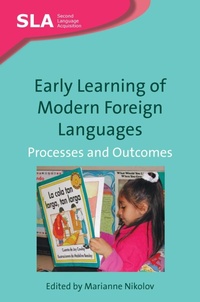
Early Learning of Modern Foreign Languages
Processes and Outcomes
Published on 27. February 2009
240 pages
978-1-84769-987-9 (ISBN)
Description

Modern languages are offered to young learners at an increasingly early age in many countries; yet few publications have focused on what is available to children in different contexts. This volume fills this gap by documenting the state-of-the-art in researching young language learners using a variety of research methods. It demonstrates how young children progress and benefit from an early exposure to modern languages in different educational contexts, and how affective, cognitive, social, linguistic and classroom-related factors interact in the processes. A special strength is the range of languages: although English is the most widely learnt language, chapters focus on various target languages: Croatian, French, English, German, Italian, Spanish and Ukrainian and the contexts include China, Croatia, Greece, Hungary, Ireland, Norway, Poland, the Ukraine, and the United Kingdom.
Reviews / Votes
Teaching foreign languages to young learners is currently one of the most exciting challenges for the profession. This volume gathers sixteen papers which span a wide range of topics, including the learners' cognitive and affective characteristics, their learning processes and outcomes, and the learning conditions inside and outside the classroom. Reporting on a variety of settings and concerns, the papers in this volume will broaden perspectives and give new insights to researchers and teachers in early foreign language programmes. -- Professor Carmen Munoz, University of Barcelona, Spain.More details
Series
Language
English
Place of publication
Bristol
United Kingdom
Publishing group
Channel View Publications Ltd
Target group
College/higher education
Professional and scholarly
ISBN-13
978-1-84769-987-9 (9781847699879)
Copyright in bibliographic data and cover images is held by Nielsen Book Services Limited or by the publishers or by their respective licensors: all rights reserved.
Schweitzer Classification
Other editions
Additional editions
Book
02/2009
Multilingual Matters
€48.40
Shipment within 10-20 days
Person
Marianne Nikolov is a professor of English Applied Linguistics at the University of Pecs, Hungary. Her research interests include early learning and teaching of modern languages, assessment of processes and outcomes in language education, teacher education, individual differences, language policy and research methods. Her work has been published in journals (e.g., Language Learning, Language Teaching Research, Annual Review of Applied Linguistics, Magyar Pedagogia, Modern Nyelvoktatas) as well as books.
Content
1. A Third Language at Primary Level in Ireland: An Independent Evaluation of the Modern Languages in Primary Schools Initiative - John Harris and Denise O'Leary
2. Can Today's Early Language Learners in England Become Tomorrow's Plurilingual European Citizens? - Janet Enever
3. Young Learners of Croatian as a Second Language: Minority Language Speakers and their Croatian Competence - Zrinka Jelaska and Lidija Cvikic
4. Cognitive Skills in Young Learners and their Implications for Foreign Language Learning - Thomai Alexiou
5. An Investigation into the Relationship of L2 Motivation and Cross-Cultural Contact Among Elementary-School Students - Kata Csizer and Judit Kormos
6. The Impact of Learning Conditions on Young FL Learners' Motivation - Jelena Mihaljevic Djigunovic
7. Early Modern Foreign Language Programmes and Outcomes: Factors Contributing to Hungarian Learners' Proficiency - Marianne Nikolov
8. Using the Early Years Literacy Programme in Primary EFL Norwegian Classrooms - Ion Drew
9. The Age Factor and L2 Reading Strategies - Renata Samo
10. A Study of FL Composing Process and Writing Strategies Employed by Young Learners - Eleni Griva, Helen Tsakiridou and Ioanna Nihoritou
11. How do 9-11-Year-Old Croatians Perceive Sounds and Read Aloud in French? - Vanda Marijanovic, Nathalie Panissal and Michel Billieres
12. Differences Between the Processes and Outcomes in 3rd Graders' Learning English and Ukrainian in Hungarian Schools in Beregszasz - Ilona Huszti, Marta Fabian and Erzsebet Baranyne Komari
13. The Growth of Young Learners' English Vocabulary Size - Andrea Orosz
14. Factors Influencing Young Learners' Vocabulary Acquisition - Magdalena Szpotowicz
15. An Eye on Target Language Use in Elementary English Classrooms in China - Jing Peng and Lily Zhang
16. What Primary-School Pupils Think About Learning English - Krisztina Nagy
2. Can Today's Early Language Learners in England Become Tomorrow's Plurilingual European Citizens? - Janet Enever
3. Young Learners of Croatian as a Second Language: Minority Language Speakers and their Croatian Competence - Zrinka Jelaska and Lidija Cvikic
4. Cognitive Skills in Young Learners and their Implications for Foreign Language Learning - Thomai Alexiou
5. An Investigation into the Relationship of L2 Motivation and Cross-Cultural Contact Among Elementary-School Students - Kata Csizer and Judit Kormos
6. The Impact of Learning Conditions on Young FL Learners' Motivation - Jelena Mihaljevic Djigunovic
7. Early Modern Foreign Language Programmes and Outcomes: Factors Contributing to Hungarian Learners' Proficiency - Marianne Nikolov
8. Using the Early Years Literacy Programme in Primary EFL Norwegian Classrooms - Ion Drew
9. The Age Factor and L2 Reading Strategies - Renata Samo
10. A Study of FL Composing Process and Writing Strategies Employed by Young Learners - Eleni Griva, Helen Tsakiridou and Ioanna Nihoritou
11. How do 9-11-Year-Old Croatians Perceive Sounds and Read Aloud in French? - Vanda Marijanovic, Nathalie Panissal and Michel Billieres
12. Differences Between the Processes and Outcomes in 3rd Graders' Learning English and Ukrainian in Hungarian Schools in Beregszasz - Ilona Huszti, Marta Fabian and Erzsebet Baranyne Komari
13. The Growth of Young Learners' English Vocabulary Size - Andrea Orosz
14. Factors Influencing Young Learners' Vocabulary Acquisition - Magdalena Szpotowicz
15. An Eye on Target Language Use in Elementary English Classrooms in China - Jing Peng and Lily Zhang
16. What Primary-School Pupils Think About Learning English - Krisztina Nagy
