

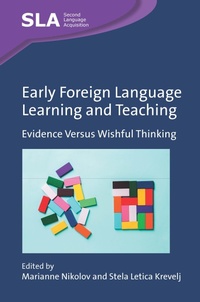
Early Foreign Language Learning and Teaching
Evidence Versus Wishful Thinking
Published on 15. October 2024
360 pages
978-1-80041-871-4 (ISBN)
Description

Over the past six decades, the field of teaching modern foreign languages to young learners has come a long way, from the early surmises about the advantages of a young start to today's widespread integration of foreign languages into curricula in public and private schools. The chapters in this book bring together internationally renowned researchers who have been vocal in establishing early language teaching and learning as an independent area of research and novice voices who represent a new generation of devoted researchers to present a state-of-the-art volume on the topic. The authors address key questions about young learner second/foreign language (L2/FL) development, methodological issues when conducting research with young learners, L2/FL teaching pedagogy, language education policy, technology enhanced learning and assessment. Together, the chapters capture the reality of early FL development in the context of a globalized world and will be of great interest to researchers and postgraduate students of SLA and Applied Linguistics, specifically in the field of early language development and teaching languages to young learners.
Reviews / Votes
This commemorative book pays tribute to Professor Jelena Mihaljevic Djigunovic and the pioneering Croatian contribution to the field of early foreign language learning. It contains an impressive collection of chapters from international scholars who explore new research methods and avenues, such as translanguaging and extramural language learning. This is essential reading for anyone who wants to build on the legacy and take the field to the next level. * Joanna Rokita-Jaskow, Uniwersytet Komisji Edukacji Narodowej, Poland * This fascinating collection provides a wealth of research focused not only on early FL/L2 development, strategy use, translanguaging, teaching pedagogy and policy, but also societal shifts and cutting-edge technology. The volume, compiled in honor of Jelena Mihaljevic Djigunovic, is packed with rich findings, revealing many new research directions for the reader to explore. This is surely a must-read for researchers and practitioners interested in young learners in many parts of the world. * Simone E. Pfenninger, University of Zurich, Switzerland * This volume is an engaging tribute to a scholar and practitioner who has had a major influence on the evolution of the field of Early Language Learning as a discipline that is recognised today not only as worthy of academic attention but as vital to the quality of education of millions of children worldwide. * Shelagh Rixon, Warwick University (retired), UK *More details
Series
Language
English
Place of publication
Bristol
United Kingdom
Target group
College/higher education
Product notice
Reflowable
ISBN-13
978-1-80041-871-4 (9781800418714)
Copyright in bibliographic data and cover images is held by Nielsen Book Services Limited or by the publishers or by their respective licensors: all rights reserved.
Schweitzer Classification
Other editions
Additional editions

Marianne Nikolov | Stela Letica Krevelj
Early Foreign Language Learning and Teaching
Evidence Versus Wishful Thinking
Book
approx. 11/2026
Channel View Publications
€56.00
Not yet published
Marianne Nikolov | Stela Letica Krevelj
Early Foreign Language Learning and Teaching
Evidence Versus Wishful Thinking
Book
10/2024
Multilingual Matters
€161.90
Shipment within 10-20 days
Persons
Marianne Nikolov is Professor Emerita of English Applied Linguistics at the University of Pecs, Hungary. Her publications include longitudinal classroom research, large-scale national assessment projects as well as case studies. She has published widely on how children learn languages and how teachers work with them.
Stela Letica Krevelj is Assistant Professor and the chair of SLA and TEFL section at the Department of English, Faculty of Humanities and Social Sciences, University of Zagreb, Croatia. Her areas of interest are second and third language acquisition, crosslinguistic influence and linguistic awareness, and early multilingual development in instructed contexts.
Stela Letica Krevelj is Assistant Professor and the chair of SLA and TEFL section at the Department of English, Faculty of Humanities and Social Sciences, University of Zagreb, Croatia. Her areas of interest are second and third language acquisition, crosslinguistic influence and linguistic awareness, and early multilingual development in instructed contexts.
Content
Contributors
Acknowledgements
Stela Letica Krevelj and Marianne Nikolov: Enriching the Tapestry of Early Foreign Language Learning and Teaching: A Preface
Chapter 1. Richard Johnstone in Conversation with Marianne Nikolov: Learners can be Applied to Children, Teachers and all Stakeholders
Chapter 2. Jelena Mihaljevic Djigunovic in Conversation with Stela Letica Krevelj: On How One Would Teach English to a Dalmatian Dog
Chapter 3. Annamaria Pinter: Innovations in Research On and With Young Learners
Chapter 4. Andrew D. Cohen: The Use of Verbal Report to Describe Strategies Used by Young Language Learners
Chapter 5. Yuko Goto Butler: Verbal Reports as an Instructional Tool for Young Second Language Learners: An Intervention Study
Chapter 6. Anna Vallbona and Elsa Tragant: Upper Primary School Learners' Interaction in Face-to-Face and Instant Messaging Modalities: A Focus on Metatask and Metalanguage Episodes
Chapter 7. Rivi Carmel and Marianne Nikolov: Translanguaging and Meaning Making in Young Learners' EFL Classes in Israel
Chapter 8. Carmen Munoz, Daniela Avello and Georgia Pujadas: Young Learners' L2 Vocabulary Acquisition Through Extensive Viewing
Chapter 9. Gloria Vickov and Eva Jakupcevic: Culture-Related Vocabulary in Textbooks for Young Learners of English
Chapter 10. Katalin Fenyvesi and Pia Suk Jensen: Natural Semantic Metalanguage: A Bridge Between Languages in the Multilingual Classroom
Chapter 11. Lucilla Lopriore: Early Language Oracy Development: Challenges from Research in Multilingual Contexts
Chapter 12. Mirna Erk: Children's Voices on Starting English at the Primary vs. Pre-Primary Level
Chapter 13. Andrea-Beata Jelic: 'Why Do You Learn Spanish?' 'To Play in La Liga': Attitudes and Motivation of Young Learners of Spanish in Croatia
Chapter 14. Reka Lugossy: 'I Didn't Know Such a Thing Existed': Young Adults' Early Encounters with Literature and the Meanings They Attach to Them
Chapter 15. Vesna Bagaric Medve and Visnja Pavicic Takac: Looking Back to Look Forward: Approaches to Young Foreign Language Learners' Assessment in Croatia
Chapter 16. Vera Savic and Danijela Prosic-Santovac: EFL Teachers' Perspectives on and Practices in Assessing Young Learners in Serbia
Chapter 17. Jasenka Cengic: The Role of Aptitude in Young Learners' Success: Domain-General or Domain-Specific Analytic Abilities?
Chapter 18. Colin J. Flynn and David Singleton: Primary School L2 Learning: The General Empirical Picture and Specific Policy Issues in the Irish Context
Chapter 19. Jing Peng and Xuan Huang: A Case Study on Family Language Policy of China in the Three Gorges Reservoir Area
Index
Acknowledgements
Stela Letica Krevelj and Marianne Nikolov: Enriching the Tapestry of Early Foreign Language Learning and Teaching: A Preface
Chapter 1. Richard Johnstone in Conversation with Marianne Nikolov: Learners can be Applied to Children, Teachers and all Stakeholders
Chapter 2. Jelena Mihaljevic Djigunovic in Conversation with Stela Letica Krevelj: On How One Would Teach English to a Dalmatian Dog
Chapter 3. Annamaria Pinter: Innovations in Research On and With Young Learners
Chapter 4. Andrew D. Cohen: The Use of Verbal Report to Describe Strategies Used by Young Language Learners
Chapter 5. Yuko Goto Butler: Verbal Reports as an Instructional Tool for Young Second Language Learners: An Intervention Study
Chapter 6. Anna Vallbona and Elsa Tragant: Upper Primary School Learners' Interaction in Face-to-Face and Instant Messaging Modalities: A Focus on Metatask and Metalanguage Episodes
Chapter 7. Rivi Carmel and Marianne Nikolov: Translanguaging and Meaning Making in Young Learners' EFL Classes in Israel
Chapter 8. Carmen Munoz, Daniela Avello and Georgia Pujadas: Young Learners' L2 Vocabulary Acquisition Through Extensive Viewing
Chapter 9. Gloria Vickov and Eva Jakupcevic: Culture-Related Vocabulary in Textbooks for Young Learners of English
Chapter 10. Katalin Fenyvesi and Pia Suk Jensen: Natural Semantic Metalanguage: A Bridge Between Languages in the Multilingual Classroom
Chapter 11. Lucilla Lopriore: Early Language Oracy Development: Challenges from Research in Multilingual Contexts
Chapter 12. Mirna Erk: Children's Voices on Starting English at the Primary vs. Pre-Primary Level
Chapter 13. Andrea-Beata Jelic: 'Why Do You Learn Spanish?' 'To Play in La Liga': Attitudes and Motivation of Young Learners of Spanish in Croatia
Chapter 14. Reka Lugossy: 'I Didn't Know Such a Thing Existed': Young Adults' Early Encounters with Literature and the Meanings They Attach to Them
Chapter 15. Vesna Bagaric Medve and Visnja Pavicic Takac: Looking Back to Look Forward: Approaches to Young Foreign Language Learners' Assessment in Croatia
Chapter 16. Vera Savic and Danijela Prosic-Santovac: EFL Teachers' Perspectives on and Practices in Assessing Young Learners in Serbia
Chapter 17. Jasenka Cengic: The Role of Aptitude in Young Learners' Success: Domain-General or Domain-Specific Analytic Abilities?
Chapter 18. Colin J. Flynn and David Singleton: Primary School L2 Learning: The General Empirical Picture and Specific Policy Issues in the Irish Context
Chapter 19. Jing Peng and Xuan Huang: A Case Study on Family Language Policy of China in the Three Gorges Reservoir Area
Index
