

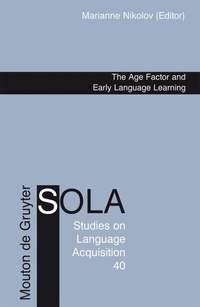
The Age Factor and Early Language Learning
Description

This edited volume documents the state of the art in research into how the age factor interacts with other factors in a variety of educational contexts. The book comprises 17 chapters examining early language learning and teaching in a range of countries in Europe, Asia and North America. Authors discuss main themes in research methodology, curricular and assessment issues, short- and long-term outcomes, the role of individual differences, innovation in teacher education, classroom processes, as well as the impact of the target language.
The first two chapters (Nikolov; Edelenbos and Kubanek) overview the main trends in research. Four papers (Curtain;Ofra Inbar-Lourie and Elana Shohamy; Jalkannen; Haenni Hoti, Heinzmann, and Müller) focus on the assessment of young learners; two authors examine how age impacts on language learning over time (Muñoz; Kasai). Individual differences (motivation, anxiety, aptitude, and socio-economic status) are explored byMihaljevi? Djigunovi?, Mattheoudakis and Alexiou, and Kiss. Innovation is the common theme in chapters written by Wang, Moon, and Peng and Zhang. The last three papers analyze the status of languages (Harris, Enever, Carmel).
The book is a must have for teacher educators of pre- and in-service teachers of modern languages to young learners, MA and PhD students in TEFL/TESOL and other languages, researchers and policy makers.
Reviews / Votes
"It is a valuable read to see what is happening in countries where foreign languages are taught to young learners."Jung In Kim in: JALT Journal 1/2012More details
Other editions
Additional editions
Person
Content
2 - Contents [Seite 5]
3 - 1. The age factor in context [Seite 7]
4 - 2. Early foreign language learning: Published research, good practice and main principles [Seite 45]
5 - 3. Assessment of early learning of foreign languages in the USA [Seite 65]
6 - 4. Assessing young language learners: What is the construct? [Seite 89]
7 - 5. Language proficiency and age-appropriate methodology at the English Kindergarten of Kuopio [Seite 103]
8 - 6. ''I can you help?'' Assessing speaking skills and interaction strategies of young learners [Seite 125]
9 - 7. Input and long-term effects of early learning in a formal setting [Seite 147]
10 - 8. English /l/ and /r/ acquisition by Japanese children and adults [Seite 167]
11 - 9. Individual differences in early language programmes [Seite 205]
12 - 10. Early foreign language instruction in Greece: Socioeconomic factors and their effect on young learners' language development [Seite 233]
13 - 11. The role of aptitude in young learners' foreign language learning [Seite 259]
14 - 12. Primary English in China: Policy, curriculum and implementation [Seite 283]
15 - 13. The teacher factor in early foreign language learning programmes: The case of Vietnam [Seite 317]
16 - 14. Chinese primary school students' use of communication strategies in EFL classrooms [Seite 343]
17 - 15. Expanding the comparative context for early language learning: From foreign to heritage and minority language programmes [Seite 357]
18 - 16. The status of the target language: Contemporary criteria influencing language choices for early learners in England [Seite 383]
19 - 17. English for Young Learners (EYL) in grades 1 and 2 in Israel: A critical discourse analysis [Seite 409]
20 - Backmatter [Seite 429]
