

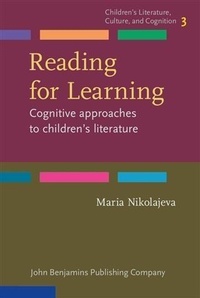
Reading for Learning
Cognitive approaches to children's literature
1st Edition
Published on 10. June 2014
VIII, 247 pages
978-90-272-6995-9 (ISBN)
Description

How does reading fiction affect young people? How can they transfer fictional experience into real life? Why do they care about fictional characters? How does fiction enhance young people's sense of self-hood? Supported by cognitive psychology and brain research, this ground-breaking book is the first study of young readers' cognitive and emotional engagement with fiction. It explores how fiction stimulates perception, attention, imagination and other cognitive activity, and opens radically new ways of thinking about literature for young readers. Examining a wide range of texts for a young audience, from picturebooks to young adult novels, the combination of cognitive criticism and children's literature theory also offers significant insights for literary studies beyond the scope of children's fiction. An important milestone in cognitive criticism, the book provides convincing evidence that reading fiction is indispensable for young people's intellectual, emotional and social maturation.
More details
Other editions
Additional editions
Book
06/2014
John Benjamins Publishing Co
€100.70
Shipment within 10-15 days
Person
Content
- Reading for Learning
- Editorial page
- Title page
- LCC data
- Table of contents
- Acknowledgements
- What is cognitive criticism and what's in it for children's literature research?
- Assumptions and reservations
- Chapter 1. Knowledge of the world
- Fact and fiction
- Realism, authenticity and representation
- Social knowledge and intentionality
- Possible worlds
- Cognitive strategies
- Chapter 2. Three possible worlds
- An impossible world
- A probable world
- An improbable world
- Chapter 3. Knowledge of other people
- Why do we care about literary characters?
- Where do emotions come from?
- Empathy and identification
- Representation and metarepresentation
- Higher-order mind-reading
- Emotions and empathy in multimedial narratives
- Chapter 4. Creative mind-reading
- Emotion ekphrasis: Emotions in multimedial texts
- Diegetic and extradiegetic emotions
- Reading non-human faces
- Higher-cognitive emotions
- Emotions and power hierarchies
- In defence of action-oriented texts
- Multiple protagonists and mind-reading
- Emotions, empathy and embodiment
- Chapter 5. Knowledge of self
- The self-reflective mind
- Retrospection
- Memory and narration
- The here and now
- Chapter 6. Memory of the present
- Deleted memory
- Amplified memory
- Distorted memory
- Chapter 7. Ethical knowledge
- Can children's literature be ethically neutral?
- Ethics and genre
- Breaking rules
- Whose ethics?
- Can fictional characters have a free will?
- The ethics of happy endings
- Intentionality, revisited
- Chapter 8. The ethics of address and the ethics of response
- Being guilty and feeling guilty
- Desire and duty
- The guiltless trickster
- "Time out of joint"
- First comes food, ethics later
- How to read a children's book and why
- Primary sources
- Children's books discussed
- Other primary texts mentioned
- Secondary sources
- Index
