

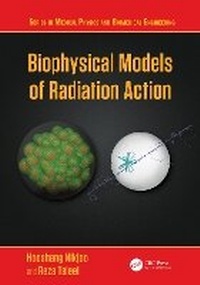
Biophysical Models of Radiation Action
Will be published approx. on 28. October 2026
530 pages
E-Book
978-1-040-62213-1 (ISBN)
Description

Three distinct processes occur in sequence when human cells encounter environmental toxins like radiation. Firstly, physical damage occurs as radiation particles deposit energy into cellular structures. A chemical reaction follows, as this energy creates fast-moving ions that attack and damage DNA. Lastly a biological response is initiated as the cells attempt to repair the damage.
Understanding this interaction is essential for assessing radiation risks, developing cancer treatments, and protecting human health.
Unlike traditional texts that focus solely on mathematical modelling, this work integrates the physics, chemistry, and biology of radiation damage into a unified framework. It provides researchers, students, and professionals with the tools to understand not just what happens when cells are irradiated, but how and why.
It presents comprehensive mathematical models for all three parts of this process, complete with computer programs that generate testable predictions. By comparing simulated data with experimental results, this book validates theoretical frameworks and bridges the gap between abstract mathematics and biological reality.
Each chapter is complemented by computer code, intended to support and encourage learning and understanding of the knowledge underlying biophysics and biology of this topic.
This will be a valuable guide for final year master's and PhD students in radiation related topics in addition to postdoctoral researchers seeking to understand the fundamental mechanisms of radiation-induced cellular damage. It will also be a useful reference for radiobiologists, medical physicists, and radiation oncologists involved in teaching and developing mathematical models in radiobiology.
Key features:
Written by one of the world's leading experts in biophysical modelling of radiation interaction with living material.
Offers researchers, teachers and students in the field a resource and programs for computer experimentation and learning.
Accompanied by computer codes used for the development of the models presented.
Understanding this interaction is essential for assessing radiation risks, developing cancer treatments, and protecting human health.
Unlike traditional texts that focus solely on mathematical modelling, this work integrates the physics, chemistry, and biology of radiation damage into a unified framework. It provides researchers, students, and professionals with the tools to understand not just what happens when cells are irradiated, but how and why.
It presents comprehensive mathematical models for all three parts of this process, complete with computer programs that generate testable predictions. By comparing simulated data with experimental results, this book validates theoretical frameworks and bridges the gap between abstract mathematics and biological reality.
Each chapter is complemented by computer code, intended to support and encourage learning and understanding of the knowledge underlying biophysics and biology of this topic.
This will be a valuable guide for final year master's and PhD students in radiation related topics in addition to postdoctoral researchers seeking to understand the fundamental mechanisms of radiation-induced cellular damage. It will also be a useful reference for radiobiologists, medical physicists, and radiation oncologists involved in teaching and developing mathematical models in radiobiology.
Key features:
Written by one of the world's leading experts in biophysical modelling of radiation interaction with living material.
Offers researchers, teachers and students in the field a resource and programs for computer experimentation and learning.
Accompanied by computer codes used for the development of the models presented.
More details
Series
Language
English
Place of publication
London
United Kingdom
Publishing group
Taylor & Francis Ltd
Target group
College/higher education
Professional and scholarly
Product notice
Reflowable
Illustrations
47 Tables, black and white; 40 Line drawings, color; 71 Line drawings, black and white; 7 Halftones, color; 3 Halftones, black and white; 47 Illustrations, color; 74 Illustrations, black and white
ISBN-13
978-1-040-62213-1 (9781040622131)
Copyright in bibliographic data and cover images is held by Nielsen Book Services Limited or by the publishers or by their respective licensors: all rights reserved.
Schweitzer Classification
Other editions
Additional editions
Hooshang Nikjoo | Reza Taleei
Biophysical Models of Radiation Action
Book
approx. 10/2026
1st Edition
CRC Press
€117.50
Not yet published
Persons
Hooshang Nikjoo is a retired Professor of Radiation Biophysics and currently a research visitor in the Department of Physiology, Anatomy and Genetics at the University of Oxford. He has lived in Oxford for more than 40 years. Previously, he spent many successful years at the Karolinska Institutet, Stockholm, the NASA Johnson Space Center in Houston, Texas, and the MRC Radiobiology/Genome Stability Unit in Harwell. His scientific work is reflected in the chapters of this book. Outside academia, he enjoys cycling and dancing Argentine tango.
Reza Taleei is an Associate Professor of Medical Physics and Director of Brachytherapy at Thomas Jefferson University. He earned his PhD in Medical Radiation Physics from the Karolinska Institutet. His work spans radiobiology, Monte Carlo-based radiation modeling, DNA Damage and Repair, and clinical medical physics. He has published widely, contributed to multiple book chapters, and serves as Associate Editor of Radiation Research
Reza Taleei is an Associate Professor of Medical Physics and Director of Brachytherapy at Thomas Jefferson University. He earned his PhD in Medical Radiation Physics from the Karolinska Institutet. His work spans radiobiology, Monte Carlo-based radiation modeling, DNA Damage and Repair, and clinical medical physics. He has published widely, contributed to multiple book chapters, and serves as Associate Editor of Radiation Research
Content
1. Radiation Track structure 2. Microdosimetry 3. DNA damage 4. DNA Repair Mechanisms and Their Biological Significance 5. The Auger Electrons 6. Cell Survival Curves: With practical applications
