

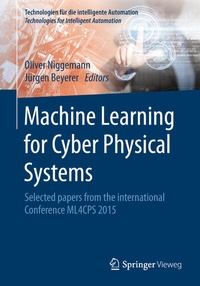
Machine Learning for Cyber Physical Systems
Description

The work presents new approaches to Machine Learning for Cyber Physical Systems, experiences and visions. It contains some selected papers from the international Conference ML4CPS - Machine Learning for Cyber Physical Systems, which was held in Lemgo, October 1-2, 2015.
Cyber Physical Systems are characterized by their ability to adapt and to learn: They analyze their environment and, based on observations, they learn patterns, correlations and predictive models. Typical applications are condition monitoring, predictive maintenance, image processing and diagnosis. Machine Learning is the key technology for these developments.
More details
Other editions
Additional editions
Persons
Prof. Dr. Oliver Niggemann ist seit November 2008 Mitglied des inIT. Er vertritt das Fachgebiet Embedded Software Engineering in der Lehre und forscht im inIT in den Bereichen Verteilte Echtzeit-Software und der Analyse und Diagnose verteilter Systeme. Gleichzeitig forscht Prof. Niggemann im Fraunhofer-Anwendungszentrum Industrial Automation (INA) in Lemgo.
Prof. Dr.-Ing. Jürgen Beyerer ist in Personalunion Inhaber des Lehrstuhls für Interaktive Echtzeitsysteme an der Fakultät für Informatik und Leiter des Fraunhofer IOSB. Die Schwerpunkte in Forschung und Lehre am Lehrstuhl für Interaktive Echtzeitsysteme liegen auf den Themen: automatische Sichtprüfung und Bildauswertung, Mustererkennung und Signal- und Informationsverarbeitung.
