

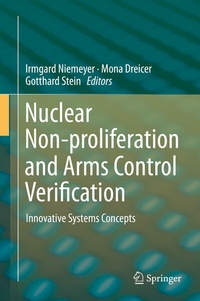
Nuclear Non-proliferation and Arms Control Verification
Description

This book strives to take stock of current achievements and existing challenges in nuclear verification, identify the available information and gaps that can act as drivers for exploring new approaches to verification strategies and technologies.
With the practical application of the systems concept to nuclear disarmament scenarios and other, non-nuclear verification fields, it investigates, where greater transparency and confidence could be achieved in pursuit of new national or international nonproliferation and arms reduction efforts.
A final discussion looks at how, in the absence of formal government-to-government negotiations, experts can take practical steps to advance the technical development of these concepts.
More details
Other editions
Additional editions
Persons
Irmgard Niemeyer, Forschungszentrum Jülich GmbH, Nuclear Waste Management and Reactor Safety, Jülich, Germany
Mona Dreicer, Lawrence Livermore National Laboratory, Center for Global Security Research, Livermore, California, USA
Gotthard Stein, Consultant, Bonn, Germany
Content
Foreword.- Acknowledgements.- System Concepts - Structuring an New Verification Approach (Dreicer, Niemeyer, Stein).- Part I Status of Verification Strategies.- History, Status and Challenges for Non-Proliferation and Arms Control Verification (Keir, Persbo).- The Evolution of Safequards (Cooley).- Part II Factors Influencing the Development of a Systems Concept for Verification.- Legal Issues Relating to Risk ans Systems Driven Verification (Carlson).- Verification: The Politics of the Unpolitical (Häckel).- Military Dimensions (Richard).- Strategic Export Control (Sevini, Janssens).- Part III Methods and Models.- NTI Nuclear Security Index: A Model for State-level Approaches to Nonproliferation and Arms Control (Meakrase, Nalabandian).- Formalizing Acquisition Path Analysis (Canty, Listner).- Metrics for Detecting Undeclared Materials and Activities (Kyriakopoulos).- Game Theoretical Models for Arms Control and Disarmament Verification (Avenhaus, Krieger).- Societal Verification for Nuclear Nonproliferation and Arms Control (Gastelum).- Part IV Technologies.- Futures Research as an Opportunity for Innovation in Verification Technologies (Schulze, Grüne, John, Neupert, Thorleuchter).- Attribute Information Barriers (Göttsche, Kirchner).- Minimally Intrusive Approaches to Nuclear Warhead Verification (Glaser, Jie).- Advances in Seismic and Acoustic Monitoring (Altmann).- Radiation Detectors and Instrumentation (Williamson, Preston).- Environmental Signatures and Forensics (Mayer, Wallenius, Aregbem Hedberg).- Part V Information Analysis.- Information Management: The Role of Information Technology in Treaty Verification (Kyriakopoulos).- Enhancing Verification with High-Performance Computing and Data Analytics (Brase, McKinzie, Zucca).- Open Source Analysis in Support to Non-Proliferation: a Systems Thinking Perspective (Renda, Cojazzi, Kim).- Open Source Analysis in Support to Non-Proliferation: a Systems Thinking Perspective (Wolfart).- Remote Sensing Data Processing and Analysis Techniques for Nuclear Non-proliferation (Rutkowski, Niemeyer).- Commercial Satellite Imagery: an Evolving Tool in the Non-proliferation Verification and Monitoring Toolkit (Pabian, Renda, Jungwirth, Kim, Wolfart, Cojazzi, Janssens).- Strategic Trade Analysis for Non-Proliferation (Versino, Cojazzi).- Part VI Applications.- A Systems Approach for Evaluating a Warhead Monitoring System (Chen, DeLand, Edmunds).- Physical Model & Acquisition Path Analysis - Applicability to Nuclear Disarmament Verification (Niemeyer, Rutkowski, Stein).- Investigating Development of Nuclear Arms Control Verification - Requirements at the State Level (Allen, Dreicer, Chen, Niemeyer, Stein),- Appendix.
