

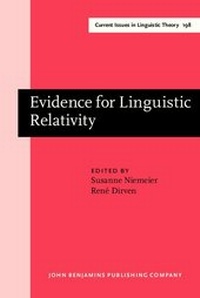
Evidence for Linguistic Relativity
1st Edition
Published on 15. April 2000
XXII, 240 pages
978-90-272-8446-4 (ISBN)
Description

This volume has arisen from the 26th International LAUD Symposium on "Humboldt and Whorf Revisited. Universal and Culture-Specific Conceptualizations in Grammar and Lexis". While contrasting two or more languages, the papers in this volume either provide empirical evidence confirming hypotheses related to linguistic relativity, or deal with methodological issues of empirical research.These new approaches to Whorf's hypotheses do not focus on mere theorizing but provide more and more empirical evidence gathered over the last years. They prove in a very sophisticated way that Whorf's ideas were very lucid ones, even if Whorf's insights were framed in a terminology which lacked the flexibility of linguistic categories developed over the last quarter of this century, especially in cognitive linguistics. To date, there is sufficient proof to claim that linguistic relativity is indeed a vital issue, and the current volume confirms a more general trend for rehabilitating Whorf's theory complex and also offers evidence for it. It contains articles written by scholars from various fields of linguistics including phonology, psycholinguistics, language acquisition, historical linguistics, anthropological linguistics and (cross-)cultural semantics, which all contribute to a re-evaluation and partial reformulation of Whorf's thinking.
More details
Other editions
Additional editions
Susanne Niemeier | Rene Dirven
Evidence for Linguistic Relativity
Book
04/2000
John Benjamins Publishing Co
€116.60
Shipment within 10-15 days
Persons
Content
- EVIDENCEFOR LINGUISTIC RELATIVITY
- Editorial page
- Title page
- Copyright page
- Table of contents
- Preface
- Introductory Comments
- 1. Characterizing linguistic relativity
- 2. Empirical evaluations of linguistic relativity
- 3. Evidence from language structure: Production, interpretation, and change
- 4. Evidence beyond language structure: Cognition, discourse, and culture
- 5. Conclusion
- Notes
- References
- Part 1 Evidencefrom Language: Production, Interpretation, and Change
- Linguistic Relativity in Speech Perception An Overview of the Influence of Language Experience on the Perception of Speech Sounds from Infancy to Adulthood
- 1. Introduction
- 2. Effects of specific language experience on speech perception in monolingual adults
- 3. The ontogeny of language-specific speech perception
- 4. Malleability of native-language perceptual patterns
- 5. Conclusion
- Notes
- References
- Equivalence and Mismatch of Semantic Features Collocations in English, Spanish and Dutch
- 1. Introduction and outline
- 2. Qualia structure
- 3. Body-part nouns and their use in collocations
- 4. Concluding remarks
- Notes
- References
- Dictionaries
- Can Grammar Make You Feel Different?
- 1. Introduction: The grammar and concepts of emotions
- 2. The Italian-American comparison
- 3. A comparison of Greek and American speakers
- 4. General discussion of results
- References
- Semantic Change as Linguistic Interpretation of the World
- 1. Introduction: On the relationship between language and cognition
- 2. Semantic structure and cognition
- 3. Semantic change as a manifestation of the cognitive function of language
- 4. The relationship between semantic change and cognitive mechanisms of the mind
- 5. Linguistic relativity in semantic change
- 6. Conclusion
- Acknowledgments
- References
- (Micro-)Categorization, Semantic Change,and the Sapir-Whorf Hypothesis
- 1. Introduction
- 2. Semantic change over stable categories
- 3. Semantic stability over changing categories
- 4. Words and categories co-evolve
- 5. Micro-categories and specialization
- 6. Conclusions
- Note
- References
- Part 2 Evidence beyond Language: Cognition, Discourse, and Culture
- Verbalized Events A Dynamic Approach to Linguistic Relativity and Determinism1
- 1. Thinking for speaking
- 2. Lexicalization of motion events
- 3. Thinking for speaking: Motion events in picture-elicited narrative
- 4. Thinking for writing (and reading): Motion events in creative fiction
- 5. Thinking for talking (and listening): Motion events inconversation
- 6. Thinking for translating: Moving motion events from one language type to the other
- 7. Listening/reading for remembering
- 8. Conclusion
- Notes
- References
- Literary Works
- Universal Ontological Knowledge and a Bias toward Language-Specific Categories in the Construal of Individuation
- 1. Introduction
- 2. Empirical tests
- 3. Discussion and conclusion
- Note
- References
- Grammar and Social Practice On the Role of 'Culture' in Linguistic Relativity
- 1. Introduction
- 2. Linguistic relativity and 'culture'
- 3. Grammars of space: 'geographic coordinates' vs. 'geometric bodies'
- 4. The grammar of space and sociocultural practice
- 5. Conclusions
- Acknowledgments
- Notes
- References
- S'Engager" vs. "To Show Restraint" Linguistic and Cultural Relativity in Discourse Management1
- 1. Introduction
- 2. Methodology
- 3. "S'engager
- 4. "To show restraint
- 5. Further proof
- 6. Conclusion: linguistic and cultural relativity
- Notes
- References
- Grammar and the Cult of the Virgin A Case Study of Polish Religious Discourse1
- 1. Introduction
- 2. Subject matter
- 3. Analysis
- 4. Conclusion
- Notes
- References
- Subject Index
- Language Index
