

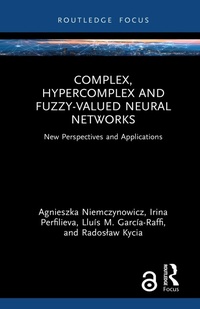
Complex, Hypercomplex and Fuzzy-Valued Neural Networks
New Perspectives and Applications
Published on 18. November 2025
182 pages
978-1-040-52380-3 (ISBN)
Description

Complex, Hypercomplex, and Fuzzy-Valued Neural Networks are extensions of classical neural networks to higher dimensions. In recent decades, this theory has emerged as a forefront in neural networks theory. There are several approaches to extend classical neural network models: quaternionic analysis, which merely uses quaternions; Clifford analysis, which relies on Clifford algebras; and finally generalizations of complex variables to higher dimensions. This book reflects a selection of papers related to complex, hypercomplex analysis, and fuzzy approaches applied to neural networks theory. The topics covered represent new perspectives and current trends in neural networks and their applications to mathematical physics, image analysis and processing, mechanics, and beyond.
More details
Language
English
Place of publication
London
United Kingdom
Publishing group
Taylor & Francis Ltd
Target group
College/higher education
Professional and scholarly
Illustrations
38 Line drawings, black and white; 2 Halftones, black and white; 40 Illustrations, black and white
File size
5,90 MB
ISBN-13
978-1-040-52380-3 (9781040523803)
Copyright in bibliographic data and cover images is held by Nielsen Book Services Limited or by the publishers or by their respective licensors: all rights reserved.
Schweitzer Classification
Other editions
Additional editions
Agnieszka Niemczynowicz | Irina Perfilieva | Lluis M. Garcia-Raffi
Complex, Hypercomplex and Fuzzy-Valued Neural Networks
New Perspectives and Applications
Book
11/2025
1st Edition
Routledge
€77.50
Shipment within 10-20 days
Persons
Agnieszka Niemczynowicz, PhD, is an Associate Professor at Cracow University of Technology. Her work focuses on mathematical modeling, data analysis, and machine learning, applied across science and engineering. She has published ~50 articles, led international grants, and received the 2022 Doak Award for a top paper in the Journal of Sound and Vibration.racow University of Technology, Poland
Irina Perfilieva, Ph.D., Dr.h.c., is an author and co-author of seven books on mathematical principles of fuzzy sets and fuzzy logic, and more than 270 papers in the area of fuzzy logic, fuzzy approximation and fuzzy relation equations. She has received several awards, including an IFSA fellow and an honorary member of EUSFLAT. Her recent interests are in the area of data analysis and the mathematical foundation of neural networks.
Dr. Luis M. Garcia Raffi is a full professor in Applied Mathematics at Universitat Politecnica de Valencia, with PhDs in Physics and Mathematics. His research spans Physics (Nuclear Physics, Phononics), Mathematics (Analysis, Topology, Machine Learning), and Didactics. He has authored several articles, collaborated internationally, and teaches AI-related topics.
Radoslaw Antoni Kycia holds PhDs in Physics (Jagiellonian University) and Geometry, Topology and Geometric Analysis (Masaryk University). He is an Associate Professor at Cracow University of Technology. His research focuses on quantum systems, topology, and machine learning. He has published over 40 articles and participated in national and EU-funded scientific projects.
Irina Perfilieva, Ph.D., Dr.h.c., is an author and co-author of seven books on mathematical principles of fuzzy sets and fuzzy logic, and more than 270 papers in the area of fuzzy logic, fuzzy approximation and fuzzy relation equations. She has received several awards, including an IFSA fellow and an honorary member of EUSFLAT. Her recent interests are in the area of data analysis and the mathematical foundation of neural networks.
Dr. Luis M. Garcia Raffi is a full professor in Applied Mathematics at Universitat Politecnica de Valencia, with PhDs in Physics and Mathematics. His research spans Physics (Nuclear Physics, Phononics), Mathematics (Analysis, Topology, Machine Learning), and Didactics. He has authored several articles, collaborated internationally, and teaches AI-related topics.
Radoslaw Antoni Kycia holds PhDs in Physics (Jagiellonian University) and Geometry, Topology and Geometric Analysis (Masaryk University). He is an Associate Professor at Cracow University of Technology. His research focuses on quantum systems, topology, and machine learning. He has published over 40 articles and participated in national and EU-funded scientific projects.
Content
1. Preface 2. Introduction 3. Part I. Real-valued neural networks a. Applications in LLM models and RAG method b. Applications in image processing c. Application in time series analysis References 4. Part II. Complex- and Quaternionic-valued neural networks and their applications a. Applications in image processing b. Applications in time series analysis References 5. Part III. Theoretical Foundation of Computation with Neural Networks, from classic to fuzzy References 6. Conclusions References
