

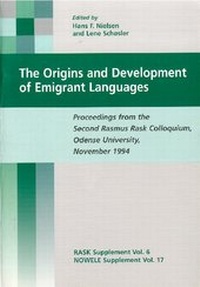
The Origins and Development of Emigrant Languages
Proceedings from the Second Rasmus Rask Colloqium, Odense University, November 1994
1st Edition
Published on 1. January 1996
XI, 318 pages
978-90-272-7279-9 (ISBN)
Description

The Origins and Development of Emigrant Languages is the proceedings from the Second Rasmus Rask Colloquium held at Odense University, November 1994
More details
Other editions
Additional editions
Hans Frede Nielsen | Lene Schosler
The Origins and Development of Emigrant Languages
Proceedings from the Second Rasmus Rask Colloqium, Odense University, November 1994
Book
01/1996
University Press of Southern Denmark
€42.40
Shipment within 10-20 days
Content
- Intro
- The Origins and Development of Emigrant Languages
- Title page
- Copyright page
- Table of contents
- PREFACE
- LIST OF DELEGATES
- EMIGRANT LANGUAGES AND ACCULTURATION: THE CASE OF ANGLO-FRENCH
- 0. Introduction
- 1.0 External History of French in England
- 1.1 Language and Dialect in Post-Conquest England
- 1.2 French in Law and Management
- 2.0 Internal Evidence of the Status of French in England
- 2.1 Semantic Change
- 2.2 Features Reflecting English Interference
- 2.3 Use of English Syntactic Constructions within French Texts
- 2.4 Use of English Words within French (and Latin) Texts
- 2.5 Transformation of the English Language
- 3. Alternative Interpretations of Later Anglo-French
- 4.0 The Table Turns
- References
- LANGUAGE CONTACT AND LEXICOGRAPHY: THE CASE OF ANGLO-NORMAN
- Notes
- Bibliography
- ADDING INSULT TO INJURY:THE ENGLISH WHO CURSE IN BORROWED FRENCH
- Notes
- Bibliography
- ANGLO-FRENCH IN THE 13TH AND 14TH CENTURIES: CONTINENTAL OR INSULAR DIALECT?*
- 1. The Anglo-French corpus
- 2. The status of Anglo-French
- 3. Continental influences
- 4. British scores
- 5. Conclusion.
- Bibliography
- AFRIKAANS, A DAUGHTER OF DUTCH
- Introduction
- 1. Nasal vowels
- 1.1 Opinions
- 1.2 What is a nasal vowel?
- 1.3 Social differences
- 1.4 Discussion
- 2. 'Toe': toon versus teen
- 3.Gaan, gaat, ga 'to go'
- Conclusion
- Notes
- References
- ON THE INTERPLAY OF INHERITED AND NON-INHERITED FEATURES IN AFRIKAANS DERIVATIONAL MORPHOLOGY*
- 1. Introduction
- 2. Afrikaans derivational morphology
- 3. The case of Afrikaans derivatives in -ing
- 4. Conclusion
- Note
- References
- THE ORIGINS AND DEVELOPMENT OFEMIGRANT ENGLISHES
- 1. The expansion of the English and of the English language
- 2. Linguistic characteristics of emigrant languages
- 2.1. Introduction
- 2.1.1. Innovation: phonology
- 2.1.2. Innovation: the lexicon
- 2.1.3. Loanwords
- 2.1.4. Word-formation
- 2.1.5. Meaning
- 3. Retention
- 3.1. Loss
- 3.2. Retention of pronunciation features
- 3.3. Retention of lexical items
- 4. A sketch contrasting English with other emigrant languages
- 5. Prophetolinguistics
- Notes
- References
- THE LANGUAGE OF THE ANGLO-SAXON SETTLERS
- Notes
- References
- THE FOLKEHØJSKOLESANG AS SITE FOR CONTACT BETWEEN DANISH AND AMERICAN LANGUAGES AND CULTURES
- The Grundtvigian Background
- Conclusion
- Notes
- References
- THE ORIGIN, DEVELOPMENT AND DECLINE OF ORKNEY AND SHETLAND NORN
- 1. General outline
- 2. The origin, development and decline of Norn
- 2.1 The origin of Norn
- 2.1.1 The date of the settlement
- 2.1.2 The places of origin of the settlers
- 2.1.3 Scandinavian and the indigenous language(s)
- 2.2 The development of Norn
- 2.2.1 Runic inscriptions
- 2.2.2 Documents in the Latin alphabet
- 2.2.3 Spoken Norn
- 2.2.4 Residual sources
- 2.3 The decline and demise of Norn
- Postscript
- Bibliography
- 'THE HENPECKED FARMER': FRAGMENTS OF AN OLD JOCULAR BALLAD IN SHETLAND NORN
- The Proper Place of these Fragments in the Ballad
- The Distribution of this Ballad
- Notes
- Bibliography
- Special note
- SCANDINAVIAN LOANWORDS IN OLD ENGLISH
- 0. Introductory remarks
- 1. The sources for the Scandinavian language in England
- 1.1. Inscriptions
- 1.2. Place-names and personal names
- 1.3. Loan-words as a primary source of our knowledge of Old Norse in England
- 2. The quantity of Scandinavian loan-words in OE
- 3. Doubtful cases
- 4. Distribution
- 5. Phonological problems
- 6. Evaluating the evidence of the Scandinavian loan-words in Old English
- References
- THE ORIGIN AND DEVELOPMENT OF THE PRONUNCIATION OF FRENCH IN QUÉBEC
- 1. The issues
- 2. Settlement, demographic growth and sociolinguistic characteristics
- 3. Reconstruction of earlier stages: prerequisites
- 3.1 Examining all potential dialectal sources
- 3.2 Establishing a reasonable historical link
- 3.2.1 Nasal vowels
- 3.2.2 Diphthongs
- 3.2.3 Lowering of /e/ to /a/
- 3.2.4 Linguistic reconstruction
- 3.3 Distinguish linguistic components
- 3.3.1 Lexicon: borrowings or vestiges
- 3.3.2 Syntax and morphology
- 4. The origin of the pronunciation of French in Québec
- 4.1 Dialectal sources of the pronunciation of Québec French
- 4.2 Regional standards as sources of the pronunciation of Québec French?
- 5. Conclusion
- Notes
- References
- LATIN IN SPAIN: EARLY IBERO-ROMANCE
- References
- L'ESPAGNOL DU CHILI ET LATHÈSE INDIGÉNISTE DE RODOLPHE LENZ
- Introduction
- La question du substrat
- Rodolphe Lenz et l'Institut Pedagogique
- Les Espagnols
- Les peuples autochtones
- Les Araucans
- Le mapudungu
- La these indigéniste de Rodolphe Lenz
- Pour et Contre la thèse de Lenz
- Conclusion
- Notes
- Bibliographie
