

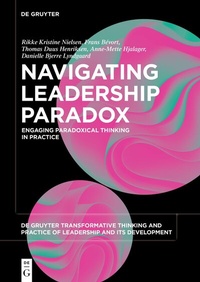
Navigating Leadership Paradox
Description

One of the most significant management challenges in modern companies and organizations is dealing with unavoidable, complex paradoxes. Today's world is multidimensional, multipolar, and multipurpose, and increasingly, classic management challenges such as leadership vs. management; exploitation vs. exploration, virtual vs. physical presence, economic sustainability vs. environmental sustainability, localization vs. globalization, etc. assume the characteristics of paradoxes rather than problems or dilemmas.
Leadership of paradox is not about making a decision once and for all or prioritizing tough trade-offs, but about navigating between opposing considerations. Navigating Leadership Paradox argues that academic knowledge pools can support leaders' decision-making and sense-making in organizations and navigating paradoxes. The book outlines a practical pathway for management leaders and professionals for steering through paradox using 5 phases, 10 paradoxes, 15 tools, 20 cases, and 25 learning points. It delineates how to identify a paradox by assessing the nature of your challenge and discusses the appropriate courses of action individually as well in collaboration with other stakeholders. It also gives inspiration and advice for professional helpers assisting others in navigating paradox as part of organizational development or other educational purposes.
This book will be essential reading for practitioners and academicians in the fields of leadership paradox, complexity management, change management, leadership dilemmas and organizational paradox.
Reviews / Votes
" Navigating Leadership Paradox provides an evidence-based approach to managing dilemmas that stump traditional decision makers. Our global/local, VUCA and multi-plex world creates organizational challenges where no obvious solutions exist. This author team provides a clear framework and process to make this complexity manageable iteratively over time, helping managers expand their comfort zones and capacity for both reflection and action." -- D enise M. Rousseau , H.J. Heinz II University Professor of Organizational Behavior and Public Policy, Carnegie Mellon University
"More than ever managers need to master and embrace the complexity of a new era ripe with leadership paradox. Managing through the pandemic in a world that has become even more digital and uncertain has accelerated the need for managers to be able to balance a range of both personal and organizational leadership paradoxes. Spanning from strategic insights and decisions to execution in a (global) world, where not much seems to be as it used to, this book provides managers with relevant, 'easy-to-use' inspiration and tools that helps you navigate the high level of leadership complexity and grasp the new reality." -- Kinga Szabo Christensen , Deputy Director General, The Danish Confederation of Industry
"Paradox in organizations is one of the main reasons why we need leadership and leaders. These are the situations where we need to be capable of navigating and relating to the consequences of our decisions. Therefore, it is important to train paradox leadership - for all of us to become better managers. The insights and tools of this book will help you navigate leadership paradox in practice." -- Rikke Molter , COO, Knudsen Extrusion
"I think this book is really needed. This is an area that has continuously gained more attention in the past years with the increased complexity of today's world. I can picture myself using it as a textbook in my Bachelor, Master and Executive level classes. In my mind, managers are those who are eager to learn and develop this area most. I can see them buying the book autonomously or within the context of a leadership course. I personally would assign the book and recommend it." -- Dr Camille Pradies , EDHEC Business School, France
"This is a wonderfully thoughtful, imaginative, evocative, and helpful book. It focuses on paradox in practice, and shows the opportunities paradoxes create for navigation by leaders and other managers, not only recognizing and accepting tensions, but also acting on them meaningfully. Further, the action can take place in managerial groups, and based on action learning approaches; it does not have to be taken alone. Anyone who encounters paradoxes and tensions in their daily (work) lives can benefit from this book." -- Jean M. Bartunek , Robert A. and Evelyn J. Ferris Chair, Department of Management and Organization, Boston College
"Anyone with leadership responsibilities will benefit hugely from this book. Developing a paradox mindset is possibly one of the most important leadership abilities for effectively navigating the complexity of today's business activities. This book provides a much needed compass for developing the capacity to work through the tensions and contradictory demands that consistently bedevil all organisations, large and small. Real examples of leadership paradoxes will be easily recognisable. Importantly they provide rich food for thought, when charting your own course in practice. An extensive toolbox mapped to each stage of the navigation process will strengthen your ability to lead organisations that thrive in the face of a volatile and uncertain future." -- Jane McKenzie , Professor of Management Knowledge and Learning, Henley Business School
" Navigating Leadership Paradox is a very timely addition to this book series. Global crises have exposed many tensions that were bubbling under the surface and put those in charge under great pressure. Trade-offs can create even bigger challenges when you are dealing with complex problems in a changing world. The authors bring paradox to life with 10 common examples that are easy to relate to. Then they offer a process and a suite of tools to help managers grapple with the paradoxical problems facing them in their own world. It's a mindset and skillset that is sorely needed, if we are going to step up and engage with the pressing global challenges we are facing." -- Dr Sharon Varney , author of Leadership in Complexity and Change: For a world in constant motion
"The ideal of paradoxical thinking - the ability to reconcile apparently polar positions - and the accompanying challenge of putting this ideal into practice captures the essence of this intriguing volume. The authors immerse the reader in the challenges posed by organizational life in an increasingly volatile, uncertain world. Getting away from rather static either-or thinking, the idea of and/also positioning is crucial given the persistence of these challenges over time, where short-term, trade-off thinking is literally incapable of producing desired, sustainable outcomes. Rather than necessarily viewing all of this as a series of stresses literally cascading on top of each other, the volume underscores that understanding the power of paradox can be energizing, providing a conceptual road map of how to make sense of the myriad tensions that surround us. This highly readable volume provides deep insight into the processes of navigating paradox - the ability to understand (mindset) and create meaning (action/meta-skill set) - with a host of highly usable tools and techniques to guide the reader through this messy process." -- Anthony F. Buono , Professor Emeritus, Bentley University
More details
Other editions
Additional editions
Persons
Content
We collectively dedicate this book to navigators of paradox, their co-navigators, helpers and educators in practice and research. May you never loose faith in your capacity for taking action and responsibility for leadership and organizational paradox.
Rikke Kristine Nielsen, Frans Bévort, Thomas Duus Henriksen, Anne-Mette Hjalager, Danielle Lyndgaard
Acknowledgments
This book is the result of the joint efforts of a transdisciplinary author collective representing both academia and practice. Yet, it is also a collective endeavor reaching far beyond the group of authors who have relied on the engagement and support of several other stakeholders and conversation partners that we wish to credit.
First and foremost, we wish to thank the courageous managers from private and public companies as well as civil society organizations who have participated and co-created our research on leadership paradox. Researching leadership paradox in practice is only possible if organizations and managers are willing to welcome researchers into their challenges and dreams. We are deeply grateful for their engagement - they are all role models in a world where we need just-in-time, relevant research more than ever!
From the research project Leadership GPS for New Times - From Comfort Zone to Competitiveness funded by the Industry Foundation we wish to credit the 11 participating companies: VELUX, DEIF A/S, Arne Pedersen A/S, Aasted ApS, Titan Wind Energy (Europe) A/S, KMC amba Grundfos, Knudsen Extrusion ApS, Lindpro A/S, Spæncom A/S, and Trelleborg Sealing Solutions AB. We also wish to highlight the contributions of researchers and consultants participating in this project in addition to the author collective: Mette Mogensen, supervisor, Work Environment in Denmark, External Lecturer, Copenhagen Business School and Roskilde University; Henrik Holt Larsen, Professor Emeritus, Copenhagen Business School; Signe Vikkelsø, Professor, Copenhagen Business School; Per Geisler, senior advisor, Danish Confederation of Industry; and Jørgen Andersen, vice president HRM, ambu A/S.
From the research project Long Lasting Leadership in Turbulent Times - Paradoxical Leadership in Practice funded by Royal Danish Defence College in collaboration with Aalborg University we wish to credit Head of Section Michael Pingel Hansen as well as managers, project managers, and employees with the Acquisition and Logistics Organisation, The Danish Ministry of Defence.
From the research project A Taste for Sustainable Fish supported by the Velux Foundations we wish to highlight the contributions of the Copenhagen Hospitality College (CHC), Project Manager Michelle Werther along with managers, faculty, and students at CHC in addition to Associate Professors Alice Juel Jacobsen and Mikkel Fugl Eskjær, Aalborg University.
We also wish to thank the many other companies and organizations who have participated in our workshops and seminars on paradoxical leadership over the last decade giving us the opportunity to sharpen our thinking and insights into paradoxical practice even further - particularly the Danish Confederation of Industry, NOCA - Network of Corporate Academies, Local Government Denmark, the municipalities of Billund and Fredensborg, the association of Danish HR Professionals, and not least Djøf trade union whose affiliated publisher, Djøf Publishers, published our first book (in Danish) on paradoxical leadership that was the springboard for developing this book (Nielsen, Mogensen, Bévort, Henriksen, Hjalager and Lyndgaard, 2019). Also, we wish to thank Jakob Larsen of Djøf Publishers for laying out the first version of some of the central illustrations used in this book.
In preparing this manuscript we have also relied on the insights and help from the De Gruyter team, including editor Steven Hardman, commissioning editor Faye Leerink, content editor Jaya Dalal, Project Manager Anne Stroka, Books Marketing Manager Heather Goss and freelance marketer Natalie Wills as well as De Gruyter Transformative Thinking and Practice of Leadership and Its Development series editor Bernd Vogel. We are excited to be part of this series and encourage readers to explore other volumes of this series.
Finally, we wish to thank our external peer reviewers, Associate Professors Josh Keller and Camille Pradies, for their constructive comments both in evaluating our initial book proposal as well as the final manuscript. Their constructive comments and insights have been much appreciated.
The gift of feedback is invaluable to paradox navigation in both research and practice, and we feel fortunate that the scholarly paradox community is as vibrant and curiosity driven as the managerial paradox navigators that we work with in practice.
Foreword
Paradoxical thinking is about being able to reconcile seemingly incompatible, or even mutually exclusive, ways of acting, i.e., cultivating the ability to 'have your cake and eat it too . '
- Navigating Leadership Paradox: Engaging Paradoxical Thinking in Practice (2023, p. 4).
If that is not a reason to start working with this book, I do not know what is!
When I learnt about the possibility of this book to be included in our series .
. I had just one thought: "Here again! Exactly what we hoped for."
Let me start with the not so obvious: Navigating Leadership Paradox: Engaging Paradoxical Thinking in Practice allows you to be a leading activist and not a leading bystander in dealing with paradoxical challenges at work and in society. And that is key, when making a difference in the little time that is left for leading towards a desirable world for all.
And then the obvious: This is a contemporary, ambitious, and innovative book. Be assured that after reading it you will have a "broadened imagination and understanding of what transformative leadership and leadership development involves" and when you start to make this book work and sweat for you, you will go away with "a widened and actionable repertoire of tangible and generative insights, activities and practices of leadership and its development". The authors also invite us to view insights and practices lived and built in other international contexts than the UK and the US. Are there differences or not? Not so much my point. Just good to hear more global voices and have broader representation, given that most business and societal leadership challenges are global and intercultural.
More so, Navigating Leadership Paradox has a focus on equipping managers to deal with and navigate paradox. This is not another musing about paradox. This book makes your thinking space spin and enables you to get your hands dirty in paradox work.
The book is also complementary to the earlier books in the series: Sharon Varney's on leadership in complexity and change and Aidan McQuade's on ethical leadership which deals with individuals staying on course in situations full of contradictions.
Navigating Leadership Paradox is your book if you have noticed these situations in your teams, organizations, or collaborations across boundaries where aspects of your remit are contradictory or opposing considerations. They do not nicely reconcile, and you still aspire with your group to pursue both or more of those contradictory ambitions over time. By the way, you then also figured that some parts of our leadership reality just do not follow our typical illusion of and hope for consistency, alignment, and clarity - leadership is about dealing with messiness and ongoing tensions.
A book that is just waiting to be worked with!
In whatever way you chose to work with Navigating Leadership Paradox, this book can nourish your appetite for understanding or feed your urge to immediately apply the practical guidance for navigating paradoxes in your leadership life spheres.
The book demystifies paradox without claiming it is easy for managers. See the "10 paradoxical tensions in leadership" - what a treat. When I read and explored the tensions, I found myself immediately in the midst of those areas we address in our work at the Henley Centre for Leadership or with clients. The "five phases of paradox navigation" are a rich journey to go through in your team or with your collaborators.
Finally, the book ends with a real trick. Let's face it, introducing leading with paradox to your organization and to your colleagues, while very appealing, also means quite a shift in how to work and how your organization functions. The last sections of the book, for example, the "five thresholds in facilitating paradox work", function as quasi meta-skills to translate the language, logic, tools, and instruments of dealing with leadership paradox into a sustained practice in your organization. That will assist you as a reader even further in bringing the book's ideas to life and to becoming a leadership activist.
Rikke, Frans, Thomas, Anne-Mette, and Danielle, thank you so much for presenting this book to us.
Bernd Vogel
Henley-on-Thames, UK
...