

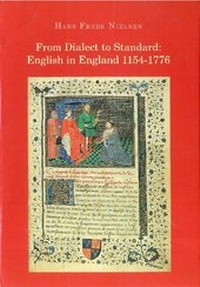
From Dialect to Standard
English in England 1154-1776
1st Edition
Published on 1. January 2005
XX, 300 pages
978-90-272-7275-1 (ISBN)
Description

From Dialect to Standard: English in England 1154-1776 is the second volume of a set of three offering a comprehensive survey of what by the author is seen as the most interesting aspects of the long history of English from its embryonic stages to the language spoken today in England and America.The present book spans the period up to 1776, the year of the American Declaration of Independence and the year in which Adam Smith published his Inquiry into the Nature and Causes of the Wealth of Nations. The title of the first volume from 1998 was The Continental Backgrounds of English and its Insular Development until 1154, the third and final volume being scheduled for publication later under the title The Development of American and British English from 1776 to the Present Day.
More details
Other editions
Additional editions
Book
01/2005
University Press of Southern Denmark
€39.22
Shipment within 10-20 days
Content
- Intro
- From Dialect to Standard: English in England 1154-1776
- Editorial page
- Title page
- Copyright page
- Table of contents
- PREFACE
- ABBREVIATIONS
- ILLUSTRATIONS
- ERRATA
- 8. THE PLANTAGENET ERA: HISTORY AND LANGUAGE
- 8.1. Political Developments between 1154 and 1485
- 8.1.1. The Angevins1
- 8.1.1.1. Angevin rule until 1272
- 8.1.1.2. From Edward I to Richard II (1272-1399)
- 8.1.2. The Lancaster and York kings (1399-1485)
- 8.2. Politics and the French Lexical Impact on English
- 8.3. The Sociolinguistic Situation in England
- 8.3.1. The Norman and early Angevin eras
- 8.3.2. The fourteenth and fifteenth centuries
- 8.4. The French Lexical Impact on English Revisited
- 8.5. Contact with Other Languages
- 8.5.1. Celtic
- 8.5.2. Scandinavian
- 8.5.3. Latin
- 8.5.3.1. Latin lexical influence on English
- 8.5.3.2. 'Latyn corrupt' and macaronic writing
- 8.5.4. Dutch
- 8.6. Concluding Remarks
- 9. THE MIDDLE ENGLISH PERIOD
- 9.1. Introduction
- 9.2. The Heterogeneity of Middle English
- 9.2.1. Some contemporary voices
- 9.2.2. Regional dialects
- 9.2.3. Variation over time
- 9.3. Textual Evidence for the Middle English Dialects
- 9.3.1. Early and late Middle English texts
- 9.3.2. Dialect samples
- 9.3.2.1. Northern
- 9.3.2.2. East Midland
- 9.3.2.3. West Midland
- 9.3.2.4. South-Western
- 9.3.2.5. South-Eastern
- 9.3.3. A selection of Middle English dialect criteria
- 9.3.3.1. Old English a
- 9.3.3.2. Old English ?
- 9.3.3.3. Old English eo
- 9.3.3.4. Old English a plus nasal
- 9.3.3.5. The Old English initial fricatives
- 9.3.3.6. Old English hw-
- 9.3.3.7. Consonantal northernisms
- 9.3.3.8. The Old English substantival plural markers
- 9.3.3.9. The 3 personal plural pronouns
- 9.3.3.10. The present tense
- 9.3.3.11. The past participles
- 9.3.3.12. The present participles
- 9.3.3.13. The infinitives
- 9.3.3.14. Lexical borrowing
- 9.3.3.15. Higden revisited. A summary
- 9.3.4. Modern surveys of the Middle English dialects
- 9.3.4.1. Moore, Meech & Whitehall
- 9.3.4.2. Kristensson
- 9.3.4.3. Mcintosh, Samuels & Benskin
- 9.4. A Linguistic Profile of Middle English
- 9.4.1. Phonology and spelling
- 9.4.1.1. The accented vowels
- 9.4.1.2. The vocalism of final unaccented syllables
- 9.4.1.3. The consonant system
- 9.4.1.4. An orthographic note
- 9.4.2. Morphology
- 9.4.2.1. Nouns
- 9.4.2.2. Pronouns and articles
- 9.4.2.3. Adjectives, adverbs and numerals
- 9.4.2.4. Verbs
- 9.4.3. Syntax
- 9.4.3.1. General remarks on Middle English word-order
- 9.4.3.2. The propword one
- 9.4.3.3. The genitive case
- 9.4.3.4. The subjunctive mood
- 9.4.3.5. The passive
- 9.4.3.6. The expanded form
- 9.4.3.7. The perfect and the pluperfect
- 9.4.3.8. The future
- 9.4.3.9. Periphrastic constructions with do and gan
- 9.4.3.10. Negation
- 9.4.3.11. Concord
- 9.4.4. Lexicon
- 9.4.4.1. Introduction
- 9.4.4.2. The lexical heritage of Middle English
- 9.4.4.3. Further observations on the French lexical impact
- 9.4.4.4. The influx of Latin words
- 9.4.4.4.1. When and why
- 9.4.4.4.2. Latin or French? A problem illustrated
- 9.4.4.4.3. Lydgate's aureate style
- 10. THE FRENCH ELEMENT IN MIDDLE ENGLISH
- 10.1. The Franco-English Contact Situation
- 10.1.1. The creolization hypothesis
- 10.1.2. A summary of the possible effects of contact with French
- 10.1.2.1. Direct evidence
- 10.1.2.2. Indirect evidence
- 10.1.3. A non-creolist voice
- 10.2. Lexical Loans
- 10.2.1. Introduction
- 10.2.2. Borrowing according to semantic sphere
- 10.2.3. Borrowing according to word-class
- 10.2.4. The general character of French loan-words
- 10.2.4.1. Everyday words
- 10.2.4.2. Examples of formal borrowing
- 10.2.5. Provenance and chronology
- 10.2.5.1. Norman French or Central French?
- 10.2.5.2. Early or late loans?
- 10.2.6. Grammatical forms and accent of French words adopted
- 10.2.6.1. Nouns and adjectives
- 10.2.6.2. Verbs
- 10.2.6.3. Accentuation
- 10.3. Synonymy
- 10.3.1. Double expressions
- 10.3.2. Semantic differentiation
- 10.3.3. Synonyms from three languages
- 10.4. Phrasal Borrowing
- 10.4.1. French phrases in English and their survival
- 10.4.2. A major investigation
- 10.4.3. The significance of phrasal borrowing
- 10.5. Word-Formation
- 10.5.1. Compounding
- 10.5.2. Prefixation
- 10.5.3. Suffixation
- 10.6. Toponymy
- 10.6.1. Settlement-names and field-names
- 10.6.2. French influence on spelling and pronunciation?
- 11. THE LONDON DIALECT AND THE RISE OF AN EARLY STANDARD LANGUAGE
- 11.1. Early London English: The Proclamation of Henry III
- 11.1.1. Introductory remarks
- 11.1.2. The proclamation
- 11.1.3. Diagnosing the text
- 11.1.4. Dialect and immigration. An extralinguistic note
- 11.2. Inciplent Attempts at Creating a Standard Language
- 11.2.1. Dialectal diversity and the North
- 11.2.2. The Wycliffite literary standard
- 11.2.3. An early London standard
- 11.3. Later London English: Chaucer's Language
- 11.3.1. On London literary usage after 1380
- 11.3.2. A Chaucer text analysed
- 11.4. Chancery English
- 11.4.1. Anew standard language
- 11.4.2. A petition from 1455
- 11.5. Two Late Fifteenth-Century Texts and the New Standard
- 11.5.1. A Paston letter (1467)
- 11.5.2. Caxton's prologue to his translation of Eneydos (1490)
- 11.6. English Written and Spoken
- 12. TUDORS, STUARTS AND BEYOND:HISTORY AND LANGUAGE UNTIL 1776
- 12.1. Political Developments
- 12.1.1. England under Tudor rule
- 12.1.1.1. The Renaissance
- 12.1.1.2. The two Henrys
- 12.1.1.3. A brother and two half-sisters
- 12.1.2. The Stuarts
- 12.1.2.1. The early Stuarts
- 12.1.2.2. Interregnum
- 12.1.2.3. Restoration monarchy
- 12.1.3. The eighteenth century (1689-1776)
- 12.1.3.1. The revolution monarchy
- 12.1.3.2. Three Georges and the first British Emplre
- 12.1.3.3. Social, religious and cultural developments
- 12.2. Modern English
- 12.3. English Enriched: The Inkhorn Controversy
- 12.3.1. Aureation
- 12.3.2. Purism
- 12.3.3. Moderation
- 12.4. English Regulated
- 12.4.1. Dictionaries
- 12.4.2. Grammars
- 12.4.3. Orthography
- 12.4.4. An English Academy?
- 12.5. Loan-Words
- 12.5.1. Introductory remarks
- 12.5.2. Lexical borrowing from the classical languages
- 12.5.2.1. Latin
- 12.5.2.2. Greek
- 12.5.3. Loans from Romance languages
- 12.5.3.1. French
- 12.5.3.2. Italian
- 12.5.3.3. Spanish and Portuguese
- 12.5.4. Loans from other European languages
- 12.5.4.1. Dutch
- 12.5.4.2. High German
- 12.5.4.3. Scandinavian
- 12.5.4.4. Celtic
- 12.5.5. Loans from non-European languages
- 13. CHANGE AND VARIATIONIN EARLY MODERN ENGLISH
- 13.1. Diachronic Developments: Five EModE Texts Compared
- 13.1.1. Shakespeare's King Lear
- 13.1.2. The Machyn Diary
- 13.1.3. Milton's Samson Agonistes
- 13.1.4. Newton's Opticks
- 13.1.5. Sterne's A Sentimental Journey
- 13.1.6. Summing up
- 13.2. Regional Variation
- 13.2.1. Edgar's dialect in King Lear Act IV, Scene vi
- 13.2.2. Captain Jamy's dialect in King Henry V Act III, Scene iii
- 13.2.3. Dialect and standard
- 13.3. Social Variation
- 13.3.1. General remarks
- 13.3.2. Cockney7
- 13.4. A Spoken Standard?
- 14. A LINGUISTIC PROFILE OF EARLY MODERN ENGLISH
- 14.1. Phonology, Spelling and Accentuation
- 14.1.1. Evidence for the pronunciation of early Modern English
- 14.1.2. Vowels
- 14.1.2.1. The inventory of vowel phonemes in the late eighteenth century
- 14.1.2.2. The Great Vowel Shift
- 14.1.2.3. The impact of M on preceding vowels
- 14.1.2.4. The ME sources of the late eighteenth-century vowel inventory
- 14.1.2.4.1. The long monophthongs
- 14.1.2.4.2. The diphthongs
- 14.1.2.4.3. The short monophthongs
- 14.1.3. Consonants
- 14.1.4. Remarks on spelling and punctuation
- 14.1.5. Prosodic features: accentuation
- 14.2. Morphology
- 14.2.1. Nouns
- 14.2.2. Pronouns and articles
- 14.2.3. Adjectives, adverbs and numerals
- 14.2.4. Verbs
- 14.3. Syntax22
- 14.3.1. General remarks on eModE word-order and sentence syntax
- 14.3.2. The propword one
- 14.3.3. The genitive case
- 14.3.4. The subjunctive mood
- 14.3.5. The passive
- 14.3.6. The expanded form
- 14.3.7. The perfect and the pluperfect
- 14.3.8. The future
- 14.3.9. Periphrastic constructions with do
- 14.3.10. Negation
- 14.3.11. Concord
- 14.4. Word-Formation
- 14.4.1. Compounding
- 14.4.2. Prefixation
- 14.4.3. Suffixation
- 14.4.4. Conversion
- 14.4.5. Other formations of new words
- REFERENCES
- INDEX
