

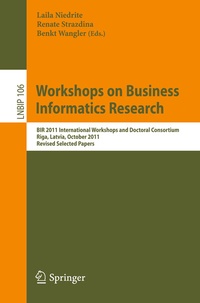
Workshops on Business Informatics Research
BIR 2011 International Workshops and Doctoral Consortium, Riga, Latvia, October 6, 2011 Revised Selected Papers
Published on 5. April 2012
XXII, 267 pages
978-3-642-29231-6 (ISBN)
Description

This book constitutes the refereed and revised proceedings of the workshops and the doctoral consortium co-located with the 10th International Conference on Perspectives in Business Informatics Research (BIR), held in Riga, Latvia, in October 2011.
The four workshops focused on Information Logistics and Knowledge Supply for Viable Enterprises (ILOG 2011), Alignment of Business Processes and Security Modeling (ABPSM 2011), Intelligent Educational Systems and Technology-Enhanced Learning (INTEL-EDU 2011), and User-Oriented Information Integration (UOII 2011). The two best papers from the doctoral consortium are also included.
More details
Other editions
Additional editions
Laila Niedrite | Renate Strazdina | Benkt Wangler
Workshops on Business Informatics Research
BIR 2011 International Workshops and Doctoral Consortium, Riga, Latvia, October 6, 2011 Revised Selected Papers
Book
04/2012
1st Edition
Springer
€53.49
Shipment within 7-9 days
Content
- Title Page
- Foreword
- BIR 2011 Associated Workshops and Doctoral Consortium Organization
- Preface
- Table of Contents
- 4th Workshop on Information Logistics and Knowledge Supply for Viable Enterprises (ILOG 2011)
- Telemedical Events: Intelligent Delivery of Telemedical Values Using CEP and HL7
- Introduction
- Motivating Use Cases
- Related Work
- ILOG
- Complex Event Processing
- Alternative Scientific Approaches
- Information-Logistical Processing of Telemedical Values Using CEP and HL7
- Architectural Overview
- Telemedical Events and HL7 Telemedical Event Format
- Telemedical ILOG Listeners (TIL)
- Summary and Outlook
- References
- Information Logistics in Engineering Change Management: Integrating Demand Patterns and Recommendation Systems
- Introduction
- Industrial Case
- Capturing Information Demand
- Information Demand Modeling
- Information Demand Patterns
- Information Demand Pattern for the Role "Change Administrator"
- Integrating Recommendation Systems and Demand Patterns
- Approach
- Architecture
- Clustering Algorithm
- Summary and Future Work
- References
- Selecting KMS for SME - A Need for Value-Orientation
- Motivation
- Background
- Knowledge Management Systems
- SME
- Using KMS in SME
- Design
- Knowledge Management in SME in Mecklenburg-Vorpommern
- Social Software and Wikis for KM
- Comparison and Conclusion
- Prospects
- Allowing for a Structured Decision on KMS
- Further Work
- References
- Managing Change in Fractal Enterprises and IS Architectures from a Viable Systems Perspective
- Introduction
- Methodological Approach: An Analysis of Fractal Processes, Viable Systems, and Holistic Service Systems from an Integrative Perspective
- Systems Viability Monitoring in Fractal Enterprises and IS Architectures from a Viable Systems Perspective
- Changing the Business Process and IS
- Conclusions
- References
- 1st International Workshop on Alignment of Business Process and Security Modeling (ABPSM 2011)
- An Extended RBAC Model for Task Delegation in Workflow Systems
- Introduction
- Background
- Resource Management in Workflows
- Organisational Resources Analysis
- Workflow Authorisation Constraints
- Task-Oriented Access Control Model
- Definitions of Map Relations
- Definitions of Functions
- Definitions of Constraints
- Model Contributions
- Securing Task Delegation
- Access Control over Delegation
- Delegation Policies
- Deployment
- Related Work
- Conclusion
- References
- Risk and Business Goal Based Security Requirement and Countermeasure Prioritization
- Introduction
- Related Work
- Metamodel of RiskREP
- Steps of the RiskREP Method
- Analysis and Discussion
- References
- Security Requirements Engineering for Secure Business Processes
- Introduction
- Modelling Security via Commitments
- Running Example
- Multi-view Modelling
- Expressing Security Needs
- Deriving Security Requirements in Terms of Commitments
- Transferring SecCo Requirements to BPMN
- Discussion and Further Work
- Conclusions
- References
- 2nd International Workshop on Intelligent Educational Systems and Technology-Enhanced Learning (INTEL-EDU 2011)
- Applied Knowledge Transfer to European SMEs by Expertise Networks Using Mixed Reality
- Working and Learning in Real and Virtual Environments
- Knowledge Transfer to Industry
- Case Study: Mechatronics Engineer Training with a Mixed Reality System
- Case Study: Knowledge Transfer on and with Virtual Interactive Product Documentations
- German-Baltic VAR Expertise Network
- Summary and Outlook
- References
- Enterprise SPICE Based Education Capability Maturity Model
- Introduction
- Motivation and Capability Maturity Modeling
- New Approach to Capability Maturity Modeling
- Education Process Modeling Related Work
- Education Capability Maturity Model - EduSpice
- Education Process Assessment and Improvement
- Conclusions and Future Work
- References
- Intellectual Ability Data Obtaining and Processing for E-Learning System Adaptation
- Introduction
- System Individualization Types
- Customization
- Personalization
- Moodle Personalization Opportunity Descriptions
- Integrated Solutions of Moodle Personalization
- A Review of the Related Works on Moodle Personalization
- Description of the Experiment
- Measured Magnitudes
- Adaptation of Experimental Environment
- Experiment Process
- Gathering and Collecting of the Experiment Results
- The Usage of the Experiment Results for Other Adaptation Cases
- Conclusions
- References
- Perceived Social Influence in Watching Online Theory Presentations
- Introduction
- Literature Review and Research Model
- Research Setup
- Research Setting
- Research Method and Research Instrument
- Research Results
- Discussion
- Conclusions
- References
- The Conceptual Framework for Integration of Multiagent Based Intelligent Tutoring and Personal Knowledge Management Systems in Educational Settings
- Introduction
- Motivation of the Work
- An Overview of Traditional Architecture of Intelligent Tutoring Systems
- The Conceptual Framework for System Integration
- Conception of Graph Based Pedagogical Model
- Architecture of Developed Intelligent Systems MIPITS and IKAS
- Conclusions
- References
- Evaluation of Engineering Course Content by Bloom's Taxonomy: A Case Study
- Introduction
- Introduction to Logistics Information System
- LIS Syllabus
- LIS Audience
- LIS Teaching Methods
- LIS Student Evaluation
- Evaluating and Enhancing Course Content
- Course Content Development
- Course Content Evaluation According to Bloom's Model
- From Empirical Experience to Qualitative Research
- Conclusions and Further Research
- References
- Calculate Learners' Competence Scores and Their Reliability in Learning Networks
- Introduction
- Related Work
- Quantify a Learner's Competences
- Weighting Contribution Types
- Calculate Absolute Competence Scores
- Determine a Score's Confidence Level
- Evaluation
- Results and Findings
- Conclusion
- References
- 1st International Workshop on User Oriented Information Integration (UOII 2011)
- Timely Report Production fromWWWData Sources
- Introduction
- Case: Communicable Disease Epidemiological Profiles
- Related Work
- Reports and Reporting
- OLAP Ontology as the Framework for Data and Reports
- Methodology and Implementation
- Conclusions, Discussion and Future Work
- References
- An Ontology-Based Quality Framework for Data Integration
- Introduction
- Related Work
- Our Quality Framework for Data Integration
- Quality Criteria, Factors and Metrics
- Quality Criteria
- Quality Factors and Metrics
- Demonstration
- Concluding Remarks
- References
- Towards Introducing User Preferences in OLAP Reporting Tool
- Introduction and Related Work
- OLAP Reporting Tool
- Logical Metadata
- Reporting Metadata
- Semantic Metadata
- OLAP Preferences Metadata
- Determining Preferences from Semantic Description
- Conclusions and Future Work
- References
- A Multimodal Approach for Determination of Vehicle Position
- Introduction
- Related Work
- Approach
- Evaluation
- Conclusion and Future Work
- References
- Doctoral Consortium Papers
- Augmenting Multicriteria Decision Aid Methods by Graphical and Analytical Reporting Tools
- Introduction
- Evaluation of Lithuanian Commercial Banks by MCDA Methods
- Variables and Data
- Presentation of Relative Soundness and Stability Positions of Commercial Banks in the Form of the Ranking Table Obtained by Several MCDA Methods
- Presentation of Relative Soundness and Stability Positions of Commercial Banks in the Form of the Ranking Table
- Reporting by Each Criterion in the Analytical Form
- Reporting by Criteria Categories in the Graphical Form
- Framework of Data Analysis
- Benefits of Data Analysis for Bank Management, Depositors, and Regulatory Institutions
- Conclusions
- References
- Towards Automated Education Demand-Offer Information Monitoring: The System's Architecture
- Introduction
- Related Works
- Monitoring Systems' Architectures
- Information Retrieval and Extraction
- Classification Structures
- Overview of EduMON System's Architecture
- Details of EduMON System's Architecture
- Source Management Services
- Information Retrieval Services
- Information Extraction Services
- Storage Services
- Change Manageme nt Services and Example of Change Detection
- Analysis Services and Presentation Services
- Conclusions and Future Work
- References
- Author Index
