

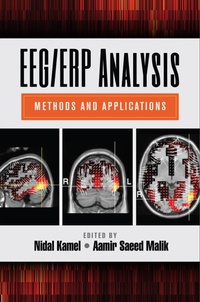
EEG/ERP Analysis
Methods and Applications
1st Edition
Published on 23. October 2014
334 pages
978-1-4822-2471-9 (ISBN)
Description

Changes in the neurological functions of the human brain are often a precursor to numerous degenerative diseases. Advanced EEG systems and other monitoring systems used in preventive diagnostic procedures incorporate innovative features for brain monitoring functions such as real-time automated signal processing techniques and sophisticated amplifiers. Highlighting the US, Europe, Australia, New Zealand, Japan, Korea, China, and many other areas, EEG/ERP Analysis: Methods and Applications examines how researchers from various disciplines have started to work in the field of brain science, and explains the different techniques used for processing EEG/ERP data. Engineers can learn more about the clinical applications, while clinicians and biomedical scientists can familiarize themselves with the technical aspects and theoretical approaches.
This book explores the recent advances involved in EEG/ERP analysis for brain monitoring, details successful EEG and ERP applications, and presents the neurological aspects in a simplified way so that those with an engineering background can better design clinical instruments. It consists of 13 chapters and includes the advanced techniques used for signal enhancement, source localization, data fusion, classification, and quantitative EEG. In addition, some of the chapters are contributed by neurologists and neurosurgeons providing the clinical aspects of EEG/ERP analysis.
Covers a wide range of EEG/ERP applications with state-of-the-art techniques for denoising, analysis, and classification
Examines new applications related to 3D display devices
Includes MATLAB (R) codes
EEG/ERP Analysis: Methods and Applications
is a resource for biomedical and neuroscience scientists who are working on neural signal processing and interpretation, and biomedical engineers who are working on EEG/ERP signal analysis methods and developing clinical instrumentation. It can also assist neurosurgeons, psychiatrists, and postgraduate students doing research in neural engineering, as well as electronic engineers in neural signal processing and instrumentation.
This book explores the recent advances involved in EEG/ERP analysis for brain monitoring, details successful EEG and ERP applications, and presents the neurological aspects in a simplified way so that those with an engineering background can better design clinical instruments. It consists of 13 chapters and includes the advanced techniques used for signal enhancement, source localization, data fusion, classification, and quantitative EEG. In addition, some of the chapters are contributed by neurologists and neurosurgeons providing the clinical aspects of EEG/ERP analysis.
Covers a wide range of EEG/ERP applications with state-of-the-art techniques for denoising, analysis, and classification
Examines new applications related to 3D display devices
Includes MATLAB (R) codes
EEG/ERP Analysis: Methods and Applications
is a resource for biomedical and neuroscience scientists who are working on neural signal processing and interpretation, and biomedical engineers who are working on EEG/ERP signal analysis methods and developing clinical instrumentation. It can also assist neurosurgeons, psychiatrists, and postgraduate students doing research in neural engineering, as well as electronic engineers in neural signal processing and instrumentation.
Reviews / Votes
"... good coverage of topics from some basic ideas such as the genesis of EEG/ ERP to advanced applications including computer-brain interface, neuro rehabilitation, and neuro feedback. I am delighted to note that applied signal processing concepts have been explained so nicely in an easy-to-understand way that is certainly a great treat for nonmathematically oriented researchers such as neuro scientists, cognitive scientists, psychologists, and psychiatrists."--Prof. D (Nanda) Nandagopal, University of South Australia, Mawson Lakes
"ERP/EEG Analysis: Methods and Applications is a brilliant book. It is a compendium of the latest brain mapping methods, techniques, and concepts presented in a self-explanatory and easy-to-understand format. In a clear exposition of difficult areas, this inspirational book demonstrates how advanced methods and techniques employed in the processing of measurements of brain activities can be employed for monitoring process of brain disorders and dysfunctions.
This comprehensive volume adequately covers brain mapping technologies, describing uses for the biomedical engineer and neuroscientist. Clinical applications of EEG/ERP in neurological disorders, psychophysiological disorders, and severe brain injuries are conspicuously presented, which makes this book essential reading for those with great interest in mapping of brain activity in health and disease.
In addition, the book's repertoire contains specialist areas pertaining to integrative modalities, neurofeedback, quantitative EEG, and the brain-computer interface. Written by world renowned experts, this book is an essential reference piece for all scientists and medical engineers interested in deciphering the neural code through neural signaling, undoubtedly to benefit a more comprehensive understanding of the brain."
--Roman R. Poznanski, Rockefeller University, New York, USA
"...this compendium of EEG/event-related brain potential analysis methods and applications presents a large amount of specialized information as clearly as its technical nature allows ... it helped me to understand how a number of analytic techniques actually work, along with the tradeoffs implicit in their use. Its value as a methodological reference clearly exceeds its bulk. And it delivers some interesting, non-mathematical thoughts along the way."
-Journal of Clinical Neurophysiology, February 2016
More details
Language
English
Place of publication
London
United Kingdom
Publishing group
Taylor & Francis Ltd
Target group
College/higher education
Biomedical scientists, clinicians who are working on neural signal processing and interpretation, neuroscientists, psychiatrists, psychologists, as well as biomedical engineers, who are working on EEG and ERP analysis methods and developing novel clinical instrumentation. In addition, this book can be used as a reference book for graduate students in neural engineer
Illustrations
86 s/w Abbildungen, 19 s/w Tabellen
86 b/w images and 19 tables
ISBN-13
978-1-4822-2471-9 (9781482224719)
Copyright in bibliographic data and cover images is held by Nielsen Book Services Limited or by the publishers or by their respective licensors: all rights reserved.
Schweitzer Classification
Other editions
Additional editions
Book
04/2017
1st Edition
CRC Press
€112.60
Shipment within 10-20 days
Book
10/2014
1st Edition
CRC Press
€207.50
Article not available for order
Persons
Dr. Nidal Kamel received his PhD (Hons) from the Technical University of Gdansk, Poland, in 1993. Since 1993 he has been involved in research projects related to brain signal processing, estimation theory, noise reduction, optimal filtering, and pattern recognition. His present research includes developing a technique for epileptic seizure detection, biomarkers for stress and major depressive disorder, and a high resolution technique for brain sources localization. Dr. Kamel is an associate professor at Universiti Teknologi PETRONAS and he is the leader of Neuro-Signal Processing Group at the Center of Image and Signal Intelligent Research (CISIR). In addition, he has published more than 150 research articles in various publications.
Dr. Aamir Saeed Malik
received his PhD in information and mechatronics from Gwangju Institute of Science & Technology in South Korea. Dr. Malik is an associate professor at the Department of Electrical and Electronic Engineering and director of mission oriented research biomedical technology at Universiti Teknologi PETRONAS. He has more than 200 publications in journals and conferences, three books, 16 patents, 34 awards and a cumulative impact factor greater than 150. His research interests include biomedical signal and image processing, and computer vision. He developed methods for acne grading, partial epileptic seizure prediction, tracking EEG signals and biomarkers for major depressive disorder.
Dr. Aamir Saeed Malik
received his PhD in information and mechatronics from Gwangju Institute of Science & Technology in South Korea. Dr. Malik is an associate professor at the Department of Electrical and Electronic Engineering and director of mission oriented research biomedical technology at Universiti Teknologi PETRONAS. He has more than 200 publications in journals and conferences, three books, 16 patents, 34 awards and a cumulative impact factor greater than 150. His research interests include biomedical signal and image processing, and computer vision. He developed methods for acne grading, partial epileptic seizure prediction, tracking EEG signals and biomarkers for major depressive disorder.
Content
Introduction to EEG and ERP Signals. Fundamentals of EEG Signal Processing. Event-Related Potentials. EEG Source Localization. Epilepsy Detection and Monitoring. Monitoring Neurological Injury by qEEG. qEEG Brain-based Computer Interface. Major Depressive Disorder. EEG and fMRI data Fusion. Memory Retention and Recall Processes. Neurofeedback. Future Aspects of EEG and ERP Signals.
