

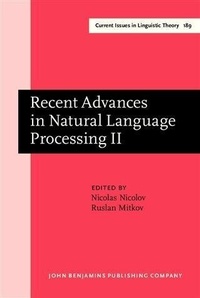
Recent Advances in Natural Language Processing
Volume II: Selected papers from RANLP '97
1st Edition
Published on 15. September 2000
XI, 422 pages
978-90-272-8397-9 (ISBN)
Description

This volume brings together revised versions of a selection of papers presented at the Second International Conference on "Recent Advances in Natural Language Processing" (RANLP'97) held in Tzigov Chark, Bulgaria, September 1997. The aim of the conference was to give researchers the opportunity to present new results in Natural Language Processing (NLP) based both on traditional and modern theories and approaches. The conference received substantial interest - 167 submissions from more than 20 countries. The best papers from the proceedings were selected for this volume, in the hope that they reflect the most significant and promising trends (and successful results) in NLP.
The contributions have been grouped according to the following topics: tagging, lexical issues and parsing, word sense disambiguation and anaphora resolution, semantics, generation, machine translation, and categorisation and applications. The volume contains an extensive index.
The contributions have been grouped according to the following topics: tagging, lexical issues and parsing, word sense disambiguation and anaphora resolution, semantics, generation, machine translation, and categorisation and applications. The volume contains an extensive index.
More details
Other editions
Additional editions
Nicolas Nicolov | Ruslan Mitkov
Recent Advances in Natural Language Processing
Volume II: Selected papers from RANLP '97
Book
09/2000
John Benjamins Publishing Co
€137.80
Shipment within 10-15 days
Persons
Content
- RECENT ADVANCES IN NATURAL LANGUAGE PROCESSING II
- Editorial page
- Title page
- Copyright page
- Table of contents
- Editors' Foreword
- I. TAGGING
- Extending N-gram Tagging to Word Graphs
- Abstract
- 1 Introduction
- 2 The word-string case
- 3 Two modifications
- 4 Two generalisations
- 5 Rescoring arc probabilities under an N-gram model
- 6 Deriving the recurrence equations
- 7 A left-to-right algorithm
- 8 Discussion
- REFERENCES
- Can We Improve Part-of-Speech Taggingby Inducing Probabilistic Part-of-Speech Annotated Lexicons from Large Corpora?
- Abstract
- 1 Introduction
- 2 Method
- 3 Results and discussion
- 4 Improving the experiment
- 5 Conclusion
- REFERENCES
- Automatically Acquiring a Language Model for Part of Speech Tagging Using Decision Trees
- Abstract
- 1 Introduction
- 2 Language model acquisition
- 3 Tagging algorithm
- 4 Experiments and results
- 5 Conclusions and further work
- REFERENCES
- II LEXICAL ISSUES & PARSING
- Designing a Dictionary of Derived Nominals
- Abstract
- 1 Introduction
- 2 Scope of the study
- 3 The complexity of nominalization arguments
- 4 Other information captured in Nomlex
- 5 Methods
- 6 Applications
- REFERENCES
- Partial Evaluation for Efficient Access to Inheritance Lexicons
- Abstract
- 1 Introduction
- 2 Partial evaluation of inheritance lexicons
- 3 Access to partially evaluated lexicons
- 4 Performance of partially evaluated lexicons
- 5 Related work
- 6 Perspectives
- REFERENCES
- Lexicon Filtering
- Abstract
- 1 Introduction
- 2 Lexicon filtering
- 3 Conclusion
- REFERENCES
- Generalized LR Parsing for Extensions of Context-Free Grammars
- Abstract
- 1 Introduction
- 2 Relating Earley and LR parsing algorithms
- 3 Using lookahead: SLR(l) and LR(1)
- 4 Compiling predictive information into tables
- 5 GLR parsing for DCG
- 6 GLR Logic Push-Down Automata and dynamic programming
- 7 Conclusion
- REFERENCES
- Statistical Ambiguity Resolution for Grammar-Based Parsing
- Abstract
- 1 Introduction
- 2 The parser
- 3 The probabilistic component
- 4 Beam search
- 5 Evaluation
- 6 Comparison to other models
- 7 Conclusion and future research
- REFERENCES
- Using the TOPSIS Multicriteria Method to Direct an Agreement Error Correction Process:An Application to Arabic
- Abstract
- 1 Introduction
- 2 Multicriteria approach
- 3 Main criteria for evaluation correction alternatives
- 4 Criteria weights
- 5 Criteria aggregation by TOPSIS
- 6 An illustrative example
- 7 Conclusion
- REFERENCES
- III DISAMBIGUATION & ANAPHORA RESOLUTION
- Combining Independent Knowledge Sources for Word Sense Disambiguation
- Abstract
- 1 Sense tagging
- 2 Recent word sense disambiguation algorithms
- 3 Comparing different approaches
- 4 Proposed approach
- 5 Partial taggers
- 6 A basic tagger
- 7 Example output
- 8 Evaluation
- 9 Conclusion
- REFERENCES
- Toward Full-Text Ontology-Based Word Sense Disambiguation
- Abstract
- 1 Disambiguation in context
- 2 Knowledge requirements for word sense disambiguation
- 3 Dynamic context helps select the right sense
- 4 Spreading markers or activation: A game of luck
- 5 Inferring and applying dynamic contexts
- 6 Richer knowledge: Current methods fizzle out
- 7 Implementation and discussion
- 8 Conclusion
- REFERENCES
- Robust Reference Resolution with Limited Knowledge: High Precision Genre-specific Approach for English and Polish
- Abstract
- 1 Introduction
- 2 Robust knowledge-poor approach to pronoun resolution in technical manuals
- 3 Evaluation
- 4 Adapting the practical approach for Polish
- 5 Evaluation (Polish)
- 6 Conclusion
- REFERENCES
- Slot Unification Grammar & Anaphora Resolution
- Abstract
- 1 Introduction
- 2 Slot Unification Grammar (SUG) with regard to DCG
- 3 Implementing SUG
- 4 Constraints on anaphora
- 5 Some examples of anaphora resolution with SUG
- 6 SUG with anaphora resolution in unrestricted texts
- 7 Conclusions
- REFERENCES
- Subject Ellipsis in Chinese News Headlines
- Abstract
- 1 Introduction
- 2 Methodology
- 3 Subject ellipsis
- 4 Conclusions
- REFERENCES
- IV SEMANTICS
- A Discourse-Semantic Account of Topic and Comment
- Abstract
- 1 The topic-comment problem
- 2 Discourse Semantics
- 3 The dynamics of discourse
- 4 Is TCM pragmatic or semantic?
- 5 The comment-predicate SPX
- REFERENCES
- Compact Representation of Ambiguous Language
- Abstract
- 1 Introduction
- 2 Underspecifying DRT
- 3 Some particular examples
- 3 Discussion
- REFERENCES
- Lexical Ambiguity in Machine Translation: Using Frame Semantics for Expressing Regularities in Polysemy
- Abstract
- 1 Lexical disambiguation in machine translation
- 2 Some influental approaches to lexical ambiguity
- 3 Danish motion verbs seen from a Frame Semantic perspective
- 4 Types of Polysemy with Danish motion verbs
- 5 Lexical rules as productive device
- 6 Shortcomings of a lexical rule approach to systematic polysemy
- 7 Conclusions
- REFERENCES
- V GENERATION
- PROTECTOR: Efficient Generation with Lexicalized Grammars
- Abstract
- 1 Introduction
- 2 Conceptual input
- 3 D-Tree Substitution Grammars
- 4 Semantics syntax relation
- 5 Derivation in our model
- 6 Generation strategy
- 7 Non-determinism in processing
- 8 Memoization example
- 9 Implementation
- 10 Results
- 11 Discussion
- 12 Further work
- 13 Conclusions
- REFERENCES
- Aggregative Utterance Planning for Interactive Instruction
- Abstract
- 1 Introduction
- 2 The framework and related work
- 3 Utterance planning
- 4 An example
- 5 Conclusion and future work
- REFERENCES
- AMALIA: A Unified Platform for Parsing and Generation
- Abstract
- 1 Introduction
- 2 Inverting grammars for generation
- 3 Unified parsing and generation
- 4 Implementation
- REFERENCES
- Information Structure and Machine Translation: Generating Danish Existential Sentences
- Abstract
- 1 Information structure and MT
- 2 A model of information structure applied to Danish
- 3 Representing information structure
- 4 A case study: existential sentences in Danish
- 5 Generation of Danish ES in ALEP
- 6 Conclusions
- REFERENCES
- VI MACHINE TRANSLATION
- Using Hybrid Methods and Resources in Semantic-based Transfer
- Abstract
- 1 Introduction
- 2 Semantic-based transfer
- 3 Transfer rule development
- 4 Disambiguation
- 5 Processing of transfer rules
- 6 Summary
- REFERENCES
- Inflectional Information in Transfer for Lexicalist Machine Translation
- Abstract
- 1 Introduction
- 2 Inflectional information
- 3 Lexicalist inflectional transfer
- 4 Conclusions
- REFERENCES
- Machine Translation with Episteme: Linguistic Knowledge Representation, Computational Efficiency and Formal Properties
- Abstract
- 1 Introduction
- 2 Computational techniques and formal properties
- 3 Machine translation strategy
- 4 Specifying linguistic knowledge in Episteme
- 5 Lexical and morphological analysis
- 6 Analysis grammar
- 7 Transfer
- 8 Generation
- 9 Episteme at work
- REFERENCES
- Combining Multiple Methods for the Automatic Construction of Multi-lingual WordNets
- Abstract
- 1 Introduction
- 2 Lexical knowledge sources
- 3 Methods
- 4 Combining methods
- 5 Conclusions
- REFERENCES
- VII CATEGORISATION & APPLICATIONS
- Probabilistic Event Categorisation
- Abstract
- 1 Introduction
- 2 The method
- 3 Properties
- 4 Selecting collocations and organising information into features
- 5 Discussion
- 6 Conclusion
- REFERENCES
- Using WordNet to Complement Training Information in Text Categorisation
- Abstract
- 1 Introduction
- 2 Task description
- 3 The vector space model for text categorisation
- 4 Using a training collection to represent categories
- 5 Using WORDNET to complement training information
- 6 Evaluation
- 7 Conclusions and future work
- REFERENCES
- Term Weight Learning for an Automatic Text Categorisation
- Abstract
- 1 Introduction
- 2 Context dependency
- 3 Term weight learning
- 4 Clustering texts based on learning
- 5 Category assignment
- 6 Experiment
- 7 Discussion
- 8 Conclusion
- REFERENCES
- Linguistic Engineering using ALEP
- Abstract
- 1 Inroduction
- 2 Processing in ALEP
- 3 Process control
- 4 Conclusions
- REFERENCES
- Using Supertags in Document Filtering: The Effect of Increased Context on Information Retrieval Effectiveness
- Abstract
- 1 Introduction
- 2 Task definition
- 3 Methodology
- 4 Supertags as labels: Information filtering experiments
- 5 Varying context in syntactic patterns
- 6 Discussion of experimental results
- REFERENCES
- MILK: A Hybrid System for Multilingual Indexing and Information Extraction
- Abstract
- 1 Introduction
- 2 IUTA: A text analyzer for Italian
- 3 From IUTA to MILK
- 4 Conclusions
- REFERENCES
- List and Addresses of Contributors
- Index of Subjects and Terms
