

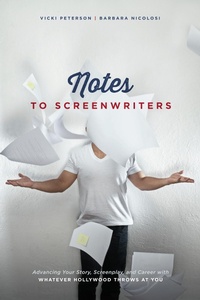
Notes to Screenwriters
Advancing Your Story, Screenplay, and Career With Whatever Hollywood Throws at You
Published on 1. January 2015
256 pages
978-1-61593-226-9 (ISBN)
Description

Screen storytelling is an essentially collaborative process. Writers need feedback but too often the notes they receive stall them and even demoralize them. This book unpacks the whys and what-fors of all the most commonly given notes on scripts, stories, and writers themselves. Coming from the perspective of experienced Hollywood professionals, Notes to Screenwriters offers insightful and concise guidance on the entire storytelling process, as well as what comes before it in the life of the writer, and after it in the marketing of the screenplay. It is a unique blend of classical storytelling principles combined with practical knowledge of the contemporary marketplace. This book is destined to be a resource for every writer who gets past the initial stage of writing a first draft and needs sage counsel for what to do next.
More details
Other editions
Additional editions
Barbara Nicolosi | Vicki Peterson
Notes to Screenwriters
Advancing Your Story, Screenplay, and Career with Whatever Hollywood Throws at You
Book
01/2015
Michael Wiese Productions
€25.50
Article not available at the moment
Persons
Barbara Nicolosi is the Founder and Chair Emeritus of Act One, Inc. a non-profit mentoring program for screenwriters and producers in Hollywood. She is a member of the Writers Guild of America-West and has written screenplays for several Hollywood production companies. She has been a development executive, story consultant and script doctor for hundreds of projects as well as a grants panelist for the National Endowment for the Arts, and a reader for the prestigious Humanitas Prize for screenwriting. Barbara has been an adjunct professor of screenwriting at Pepperdine University and Azusa Pacific University.
Content
- Intro
- Title
- Copyright
- Contents
- Dedication
- Acknowledgments
- How to Use This Book
- Foreword by David McFadzean
- Introduction: The Book That Notes Built
- Section I: Broad Notes
- Chapter 1: Notes on Taking Notes
- Chapter 2: Notes on the Storyteller
- a. Are You Good Enough?
- b. Can You "Go There"?
- c. Respecting Your Voice
- d. Your Passion Project
- e. The Essential Skills of Storytelling and Screenwriting
- f. Finding Your Voice: An Exercise
- Chapter 3: Notes on Story
- a. A Story Is Better Than the Real
- b. Story Has a Nature
- c. Movie Stories Have a Special Nature
- d. A Story Has to Matter
- e. "High Stakes" Mean Death
- f. Meeting the Audience's Needs
- g. The Catharsis of Compassion and the Fear of Evil
- h. Things Story is NOT
- i. Exercises for Crafting Your Story
- Chapter 4: Arena Notes: A World to Explore
- a. Arena Exercises
- Chapter 5: Notes on Character: The Lovable Paradox
- a. Qualities of a Relatable Character (Adapted from Aristotle's Poetics)
- b. Character Versus Characterization
- c. What Do They Want? What Do They Need?
- d. Backstory: How Did They Get Here?
- e. Finding the Haunting Paradox
- f. Character Exercises
- Chapter 6: Notes on Dialogue: Better Than Real Speech
- a. Dialogue Is Designed to Be Heard
- b. Dialogue Is Designed for Actors to Play
- c. Dialogue Has a Momentum
- d. Dialogue as a Voice of Authority
- e. Dialogue Utilizes Metaphors
- f. Dialogue Utilizes Subtext
- g. Dialogue Exists to Process Conflict
- h. Dialogue-Writing Tips and Exercises
- Chapter 7: Notes on Theme: The Good, The Great, and The Ugly
- a. Theme Is a Thesis
- b. Exercises to Strengthen Your Theme
- Chapter 8: Notes on Tone and Genre: Getting on the Same Page
- a. Genre Is What We Feel
- b. Tone Is the Rhythm of Your Story
- c. Tone and Genre Exercises
- Chapter 9: Spectacle as the Servant of All
- a. Spectacle Exercise
- Chapter 10: Structure Notes: How You Reveal the Plot
- a. Act One: The Beginning
- b. Act Two: The Middle
- c. Act Three: The End
- d. The Beauty of the Beat
- e. Scene Structure: The Building Blocks of Your Story
- f. Structure Exercises
- Chapter 11: Cinematic Notes: Does It Have To Be A Movie?
- a. A Movie Is a Harmony of Elements
- b. Moving Through Time and Place: Transitions
- c. Layering In the Meaning
- d. Death by Visual Cliché
- e. Cinematic Exercises
- Chapter 12: Section Summary: The Biggest Mistakes New Screenwriters Make
- Section II: Line Notes: Screenplay Style and Grammar
- Chapter 13: Formatting Matters
- Chapter 14: Rules of Screenplay Style
- Chapter 15: Some Additional Formatting Do's and Don'ts
- Chapter 16: Section Summary: Formatting Red Flags That Will Stop Your Screenplay
- Section III: The Working Screenwriter
- Chapter 17: So Now What?
- Chapter 18: Rewriting
- Chapter 19: Story Currency: Loglines, Synopses, Proposals, Beat Sheets, and Treatments
- a. A Penny of Your Thoughts: Loglines
- b. Putting Your Two Cents In: A Story Synopsis
- c. About a Fiver: Story Proposals
- d. About the Cost of Dinner and a Movie: The Beat Sheet
- e. Talking Real Money: The Treatment
- Chapter 20: The Writer's Real Life
- Chapter 21: Working With A Writing Partner
- Chapter 22: Working With Producers
- a. How Does a Writer Meet Producers?
- b. How to Know If a Producer Is a Good Fit for You
- c. Parameters of a Working Relationship
- Chapter 23: Studio Vs. Indie: Where Does Your Project Fit?
- Chapter 24: Networking
- Chapter 25: Success
- Chapter 26: Faqs About the Business
- Chapter 27: Section Summary: Rules for Professional Screenwriters
- Appendix A: The 100 Most Influential Movies Ever Made
- Appendix B: Correctly Formatted Title Page
- Appendix C: Correctly Formatted First Page
- Appendix D: Correctly Formatted Interior Page
- Bibliography
- About the Authors
