

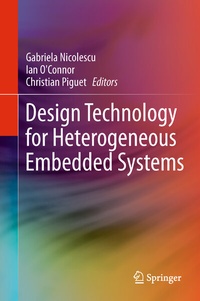
Design Technology for Heterogeneous Embedded Systems
Description

Design technology to address the new and vast problem of heterogeneous embedded systems design while remaining compatible with standard "More Moore" flows, i.e. capable of simultaneously handling both silicon complexity and system complexity, represents one of the most important challenges facing the semiconductor industry today and will be for several years to come. While the micro-electronics industry, over the years and with its spectacular and unique evolution, has built its own specific design methods to focus mainly on the management of complexity through the establishment of abstraction levels, the emergence of device heterogeneity requires new approaches enabling the satisfactory design of physically heterogeneous embedded systems for the widespread deployment of such systems.
Heterogeneous Embedded Systems , compiled largely from a set of contributions from participants of past editions of the Winter School on Heterogeneous Embedded Systems Design Technology (FETCH), proposes a necessarily broad and holistic overview of design techniques used to tackle the various facets of heterogeneity in terms of technology and opportunities at the physical level, signal representations and different abstraction levels, architectures and components based on hardware and software, in all the main phases of design (modeling, validation with multiple models of computation, synthesis and optimization). It concentrates on the specific issues at the interfaces, and is divided into two main parts. The first part examines mainly theoretical issues and focuses on the modeling, validation and design techniques themselves. The second part illustrates the use of these methods in various design contexts at the forefront of new technology and architectural developments.
More details
Other editions
Additional editions
Content
Part I: Methods, Models and Tools.- 1. Extending UML for Electronic System Design: A Code Generation Perspective.- 2. Executable Specifications for Heterogeneous Embedded Systems: An Answer to the Design of Complex Systems.- 3. Towards Autonomous Scalable Integrated Systems.- 4. On Software Simulation for MPSoC: A Modeling Approach for Functional Validation and Performance Estimation.- 5. Models for Co-design of Heterogeneous Dynamically Reconfigurable SoC's.- 6. Wireless Design Platform Combining Simulation and Testbed Environments.- 7. Property-based Dynamic Verification and Test.- 8. Trends in Design Methods for Complex Heterogeneous Systems.- 9. MPAssign: A Framework for Solving the Many-core Platform Mapping Problem.- 10. Functional Virtual Prototyping for Heterogeneous Systems.- 11. Multi-physics Optimization through Abstraction and Refinement: Application to an Active Pixel Sensor.- Part II: Design Contexts.- 12. Beyond Conventional CMOS Technology: Challenges for New Design Concepts.- 13. Through Silicon via Based Gris for Thermal Control in 3D Chips.- 14. 3D Architectures: From 3D Integration Technologies to Complex MPSoC Architectures.- 15. Emerging Memory Concepts: Materials, Modeling and Design.- 16. Embedded Medical Microsystems: Neural Recording Implants.- 17. Design Methods for Energy Harvesting: The Design of and Energy- and Data-driven Platform.- 18. Power Models and Strategies for Multiprocessor Platforms.- 19. Dynamically Reconfigurable Architectures for Software Defined Radio in Professional Embedded Systems.- 20. Methods for the Design of Ultra-lowpower Wireless Sensor Network Nodes.
