

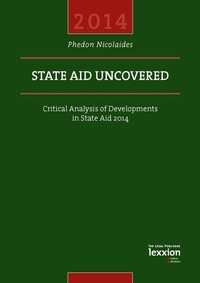
State Aid Uncovered - Critical Analysis of Developments in State Aid 2014
Published in February 2015
291 pages
978-3-86965-271-9 (ISBN)
Description

State aid law - A constantly evolving field that continued to be marked by new interpretations and applications in 2014. In this accessible and topical compilation, Phedon Nicolaides casts an critical eye on State aid rules and judgments from 2014. The book represents the first annual review of legal and policy developments of the preceding year and is made up of articles originally published on a weekly basis on Lexxion's StateAidHub.eu.
The compilation is conveniently grouped into sixteen thematic chapters covering important issues such as "Selectivity," "Infrastructure Projects," or "Recovery of Incompatible State Aid." Each article outlines the main points of the court ruling or Commission decision in question, puts the respective ruling or decision in the context of similar case law, analyses the ruling body's reasoning, and identifies any inconsistencies or insufficient assessment.
To find current analyses, visit Lexxion's StateAidHub.eu.
More details
Other editions
Additional editions
Book
02/2015
1st Edition
Lexxion Verlagsgesellschaft
€19.95
Shipment within 7-9 days
Person
Dr. Nicolaides was educated in the United States, the Netherlands and the United Kingdom. He has a PhD in Economics and a PhD in Law. He presently holds positions at the College of Europe (Bruges) and the University of Maastricht. He has published extensively on European integration, competition policy and State aid. He is also on the editorial boards of several journals. Dr. Nicolaides has organised seminars and workshops in many different Member States, and has acted as consultant to several public authorities.
Content
- Intro
- TABLE OF CONTENTS
- INTRODUCTION
- CHAPTER 1: Economic Activity
- 1.1 Land Development
- 1.2 Disposal of Dead Animals
- 1.3 Commercial Transactions v Regulatory Acts
- CHAPTER 2: State Resources
- 2.1 Support of Green Electricity with and without Transfer of State Resources
- 2.2 Electricity Levies and Public Service Compensation
- CHAPTER 3: State Resources - Imputability
- 3.1 The Roles of EU Institutions on State aid
- 3.2 State Aid Can Be Attributed to the State even when Granted through Faulty Internal Procedures
- CHAPTER 4: Advantage
- 4.1 More Favourable Conditions in other Member States do not Remove the Advantage from State Aid
- 4.2 Advantage from either Low or High Entry Prices
- 4.3 Reduction of Property Taxes
- 4.4 Reduction of Electricity Tariffs
- 4.5 Purchasing Agreements
- 4.6 Compensatory Payments
- 4.7 Sale of Public Assets
- CHAPTER 5: Advantage - Guarantees
- 5.1 Unlimited Guarantees
- 5.2 Guarantees Linked to other Measures
- CHAPTER 6: Advantage - Private Investor Principle
- 6.1 The Importance of a Correct Framing of the Private Creditor and Private Investor Tests
- 6.2 Capital Injection that Turns out to be Incompatible State Aid
- 6.3 Benchmarks of Profitability of Private Investors
- 6.4 The Profitability of an Investment Must be Determined Ex Ante
- 6.5 Simultaneity of Public and Private Investments is a Necessary but not Sufficient Condition for Public Investments to be Free of State Aid
- 6.6 The Market Economy Investor Test Applied to a Financially Troubled Company
- 6.7 Application of the Market Economy Investor Principle to a Company Processing Agricultural Products
- CHAPTER 7: Selectivity
- 7.1 Narrower Application than the Formal Scope of the Objective of a Public Measure
- 7.2 Selectivity of Tax Measures64
- 7.3 Tax Measures with Specific Objectives Can still Be General
- 7.4 Avoidance of Double Taxation
- CHAPTER 8: Selectivity - Area of Jurisdiction
- 8.1 Uniform Application within the Area of Jurisdiction74
- 8.2 Measures by Sub-National Authorities
- CHAPTER 9: Services of General Economic Interest
- 9.1 The Perils of Ex Post Compensationof Public Services Obligations
- 9.2 The Importance of Precise Definition of Public Service Obligations
- 9.3 Price Discounts and Compensation for Public Service Obligations
- 9.4 Levying Taxes to Fund Public Broadcasters
- 9.5 Compliance with the Altmark Criteria is Very Difficult
- 9.6 False Definition of SGEI: The Case of Horse Racing
- CHAPTER 10: Infrastructure Projects
- 10.1 Public Funding of Projects that Encounter Financial Problems
- 10.2 Competitive Selection of Operators of Sports Infrastructure
- 10.3 A JESSICA-Funded Public-Private Partnership
- 10.4 Multiarena in Copenhagen
- 10.5 Polish LNG Terminal
- 10.6 Management of Port Infrastructure through a Very Long Concession Contract
- 10.7 The First Application of the New GBER to Sport Infrastructure
- CHAPTER 11: Projects of Common European Interest
- 11.1 Øresund Fixed Link
- CHAPTER 12: Restructuring Aid
- 12.1 Restructuring Aid and Behavioural Remedies
- 12.2 Restructuring Aid and Sale of Beneficiary to Highest Bidder
- CHAPTER 13: Recovery of Incompatible State Aid
- 13.1 The Role of National Courts in Recovery of Incompatible State Aid
- 13.2 The Cost of Not Recovering Incompatible Aid
- 13.3 Penalty for Failure to Recover Incompatible Aid
- 13.4 Domestic Legal Problems Do Not Necessarily Make the Recovery of Incompatible Aid Absolutely Impossible
- 13.5 Recovery and Existing State Aid
- CHAPTER 14: Rights of Competitors
- 14.1 Who Can Challenge a Commission Decision Authorising State Aid?
- 14.2 Interested Party v Individually and Directly Concerned
- CHAPTER 15: SME Status
- 15.1 SMEs Linked through Natural Persons
- CHAPTER 16: New State Aid Rules
- 16.1 The New Rules on De Minimis Aid for 2014-2020: Regulation 1407/2013
- 16.2 The New General Block Exemption Regulation: The Cornerstone of the State Aid Regime, 2014-2020
- 16.3 The New Guidelines on State Aid for Environmental Protection and Energy, 2014-2020
- 16.4 Guidelines on State Aid to Promote Risk Finance Investments
- 16.5 Financial Instruments Supported by Structural and Investment Funds: Regulation 1303/2013
- 16.6 The New Guidelines on State Aid to Airports and Airlines
- 16.7 Guidance on the Application of Regulation 1370/2007 on Passenger Transport Services
