

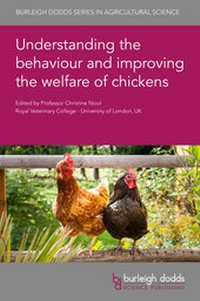
Understanding the behaviour and improving the welfare of chickens
Published on 29. September 2020
688 pages
978-1-78676-424-9 (ISBN)
Description

"Each chapter provides an overview of current knowledge on the topic in question, accompanied by an outline of advances in both scientific and applied fields. The chapters are written by twenty-five authors, all scientific experts in the subject discussed. In conclusion, Understanding the behaviour and improving the welfare of chickens is an expertly written, widely accessible book for all professionals in the field, which should provide increased understanding of chicken behaviour and welfare." (Animal Welfare - Universities Federation for Animal Welfare)
With rising consumer concerns about the welfare of farm animals, such as chickens, there is a growing urgency for the livestock production sector to ensure that welfare standards are met throughout the supply chain, from breeding to slaughter.
Understanding the behaviour and improving the welfare of chickens offers a comprehensive summary on the wealth of recent research completed on understanding chicken behaviour and discusses how best to use this rich body of knowledge to optimise welfare management of broilers and layers. This collection features expert insights into the use of wearable, video and acoustic technologies as a means of monitoring behaviour, as well as improving current welfare protocols.
With its distinguished editor and team of leading experts in their fields, Understanding the behaviour and improving the welfare of chickens will be a standard text for university researchers in poultry and veterinary science as well as ethology. The book will also be an authoritative reference for government and other agencies responsible for the poultry sector and farm animal welfare, as well as companies involved in rearing chickens and processing poultry meat and eggs.
With rising consumer concerns about the welfare of farm animals, such as chickens, there is a growing urgency for the livestock production sector to ensure that welfare standards are met throughout the supply chain, from breeding to slaughter.
Understanding the behaviour and improving the welfare of chickens offers a comprehensive summary on the wealth of recent research completed on understanding chicken behaviour and discusses how best to use this rich body of knowledge to optimise welfare management of broilers and layers. This collection features expert insights into the use of wearable, video and acoustic technologies as a means of monitoring behaviour, as well as improving current welfare protocols.
With its distinguished editor and team of leading experts in their fields, Understanding the behaviour and improving the welfare of chickens will be a standard text for university researchers in poultry and veterinary science as well as ethology. The book will also be an authoritative reference for government and other agencies responsible for the poultry sector and farm animal welfare, as well as companies involved in rearing chickens and processing poultry meat and eggs.
More details
Series
Language
English
Place of publication
Cambridge
United Kingdom
Publishing group
Burleigh Dodds
Target group
University researchers in poultry and veterinary science as well as ethology; government and other agencies responsible for the poultry sector and farm animal welfare; companies involved in rearing chickens and processing poultry meat and eggs
Illustrations
Color tables, photos and figures
ISBN-13
978-1-78676-424-9 (9781786764249)
DOI
10.19103/AS.2020.0078
Schweitzer Classification
Other editions
Additional editions
Book
09/2020
Burleigh Dodds Science Publishing Limited
€202.50
Shipment within 3-4 weeks
Persons
Editor
The Royal Veterinary College
Dr Christine Nicol is Professor of Animal Welfare at the Royal Veterinary College - University of London, UK. Professor Nicol is internationally renowned for her research on poultry and equine welfare, for which she has received many awards, including from the Universities Federation for Animal Welfare (UFAW), the International Society for Applied Ethology (ISAE), the European Association for Animal Production (EAAP), the Association for the Study of Animal Behaviour (ASAB) and the British Veterinary Association (BVA). As well as many high-cited journal articles, Professor Nicol has written or contributed to a number of books and is a current member of the Stevin Prize Committee.
Dr Christine Nicol is Professor of Animal Welfare at the Royal Veterinary College - University of London, UK. Professor Nicol is internationally renowned for her research on poultry and equine welfare, for which she has received many awards, including from the Universities Federation for Animal Welfare (UFAW), the International Society for Applied Ethology (ISAE), the European Association for Animal Production (EAAP), the Association for the Study of Animal Behaviour (ASAB) and the British Veterinary Association (BVA). As well as many high-cited journal articles, Professor Nicol has written or contributed to a number of books and is a current member of the Stevin Prize Committee.
Contributions
IFM Biology - Linköping University
IFM Biology - Linköping University
INRAE
University of Guelph
Charles Sturt University
IKERBASQUE, Basque Foundation for Science
CSIRO
Purdue University
University of Oxford
University of Oxford
Swedish University of Agricultural Sciences
Linda Keeling is Professor of Animal Welfare at the Swedish University of Agricultural Sciences. She has a background in ethology and manages an active research group dealing with basic and applied questions related to welfare assessment, affective states in animals and effects of early experience on later behaviour. She is coordinator of the Centre of Excellence for Animal Welfare Science in Sweden and a member of the EU Platform on Animal Welfare.
Linda Keeling is Professor of Animal Welfare at the Swedish University of Agricultural Sciences. She has a background in ethology and manages an active research group dealing with basic and applied questions related to welfare assessment, affective states in animals and effects of early experience on later behaviour. She is coordinator of the Centre of Excellence for Animal Welfare Science in Sweden and a member of the EU Platform on Animal Welfare.
Aarhus University
Utrecht University
Wageningen Livestock Research, Wageningen University and Research
SRUC
Institute of Animal Welfare and Animal Husbandry - Friedrich-Loeffler-Institut
Institute of Animal Welfare and Animal Husbandry - Friedrich-Loeffler-Institut
Virginia Tech
Ghent University
Institute of Biodiversity, Animal Health and Comparative Medicine, University of Glasgow
The Roslin Institute, University of Edinburgh
University of Guelph
University of Guelph
University of California-Davis
University of Bern
University of Bristol
Content
Part 1 Behaviour
1.Advances in understanding the genetics of poultry behaviour: Dominic Wright and Rie Henriksen, IFM Biology - Linköping University, Sweden;
2.Understanding the sensory perception of chickens: Birte L. Nielsen, INRAE, France;
3.Understanding states of suffering with implications for improved management of poultry: Ian J. H. Duncan, University of Guelph, Canada;
4.Understanding chicken learning and cognition and implications for improved management: Rafael Freire, Charles Sturt University, Australia;
5.Understanding poultry social behaviour and its impact on animal welfare: Inma Estevez, Neiker-Tecnalia Basque Institute for Agricultural Research and Development and IKERBASQUE, Basque Foundation for Science, Spain;
6.Poultry welfare monitoring: wearable technologies: Dana L. M. Campbell, CSIRO, Australia; and Marisa A. Erasmus, Purdue University, USA;
7.Poultry welfare monitoring: group-level technologies: Marian Stamp Dawkins and Elizabeth Rowe, University of Oxford, UK;
8.Improving welfare assessment indicators and protocols for poultry: Linda Keeling, Swedish University of Agricultural Sciences, Sweden;
Part 2 Welfare issues in breeding, management and housing
9.Welfare issues affecting broiler breeders: Anja Brinch Riber, Aarhus University, Denmark;
10.Opportunities to improve the welfare of young chickens: Elske N. de Haas, Utrecht University, The Netherlands;
11.Welfare issues in poultry housing and management: broilers: Ingrid C. de Jong, Wageningen Livestock Research,
Wageningen University and Research, The Netherlands;
12.Welfare issues in poultry housing and management: laying hens: Victoria Sandilands, Scotland's Rural College (SRUC), UK;
13.The role of perches in chicken welfare: Lars Schrader and Julia Malchow, Institute of Animal Welfare and Animal Husbandry - Friedrich-Loeffler-Institut, Germany;
14.Improving welfare in catching and transport of chickens: Leonie Jacobs, Virginia Tech, USA; and Frank A. M. Tuyttens, Institute for Agricultural and Fisheries Research (ILVO) and Ghent University, Belgium;
15.Improving welfare in poultry slaughter: Dorothy McKeegan, Institute of Biodiversity, Animal Health and Comparative Medicine, University of Glasgow, UK; and Jessica Martin, The Royal (Dick) School of Veterinary Studies and The Roslin Institute, University of Edinburgh, UK;
16.Cause and prevention of injurious pecking in chickens: Nienke van Staaveren and Alexandra Harlander, University of Guelph, Canada;
17.Bone health and associated problems in layer hens: Christina Rufener, University of California-Davis, USA; and Michael J. Toscano, University of Bern, Switzerland;
18.Poultry health monitoring and management: bone and skin health in broilers: Gina Caplen, University of Bristol, UK;
1.Advances in understanding the genetics of poultry behaviour: Dominic Wright and Rie Henriksen, IFM Biology - Linköping University, Sweden;
2.Understanding the sensory perception of chickens: Birte L. Nielsen, INRAE, France;
3.Understanding states of suffering with implications for improved management of poultry: Ian J. H. Duncan, University of Guelph, Canada;
4.Understanding chicken learning and cognition and implications for improved management: Rafael Freire, Charles Sturt University, Australia;
5.Understanding poultry social behaviour and its impact on animal welfare: Inma Estevez, Neiker-Tecnalia Basque Institute for Agricultural Research and Development and IKERBASQUE, Basque Foundation for Science, Spain;
6.Poultry welfare monitoring: wearable technologies: Dana L. M. Campbell, CSIRO, Australia; and Marisa A. Erasmus, Purdue University, USA;
7.Poultry welfare monitoring: group-level technologies: Marian Stamp Dawkins and Elizabeth Rowe, University of Oxford, UK;
8.Improving welfare assessment indicators and protocols for poultry: Linda Keeling, Swedish University of Agricultural Sciences, Sweden;
Part 2 Welfare issues in breeding, management and housing
9.Welfare issues affecting broiler breeders: Anja Brinch Riber, Aarhus University, Denmark;
10.Opportunities to improve the welfare of young chickens: Elske N. de Haas, Utrecht University, The Netherlands;
11.Welfare issues in poultry housing and management: broilers: Ingrid C. de Jong, Wageningen Livestock Research,
Wageningen University and Research, The Netherlands;
12.Welfare issues in poultry housing and management: laying hens: Victoria Sandilands, Scotland's Rural College (SRUC), UK;
13.The role of perches in chicken welfare: Lars Schrader and Julia Malchow, Institute of Animal Welfare and Animal Husbandry - Friedrich-Loeffler-Institut, Germany;
14.Improving welfare in catching and transport of chickens: Leonie Jacobs, Virginia Tech, USA; and Frank A. M. Tuyttens, Institute for Agricultural and Fisheries Research (ILVO) and Ghent University, Belgium;
15.Improving welfare in poultry slaughter: Dorothy McKeegan, Institute of Biodiversity, Animal Health and Comparative Medicine, University of Glasgow, UK; and Jessica Martin, The Royal (Dick) School of Veterinary Studies and The Roslin Institute, University of Edinburgh, UK;
16.Cause and prevention of injurious pecking in chickens: Nienke van Staaveren and Alexandra Harlander, University of Guelph, Canada;
17.Bone health and associated problems in layer hens: Christina Rufener, University of California-Davis, USA; and Michael J. Toscano, University of Bern, Switzerland;
18.Poultry health monitoring and management: bone and skin health in broilers: Gina Caplen, University of Bristol, UK;
