

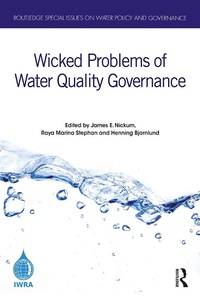
Wicked Problems of Water Quality Governance
1st Edition
Published on 26. December 2022
292 pages
978-1-000-81530-6 (ISBN)
Description

This book explores the many dimensions of water quality problems in different parts of the globe, with focus on problems of governance, from legal frameworks to social discourses and compensation measures.
Sustainable Development Goal (SDG) 6.3 on Water and Sanitation emphasizes the centrality of improving water quality to attain sustainable development. Yet the obstacles to achieving this goal are significant. This book explores the variety of difficult, possibly intractable "wicked" problems of water quality governance around the world. Cases include the challenge of managing water from source to sea, exploring why attempts to do so have come up short in limiting harm to the Great Barrier Reef; differing social discourses on market based instruments in Canada; efforts to bring to closure the human legacies of Minamata methyl mercury poisoning half a century ago in Japan; current problems of mercury use in Andean mining; misalignment of established Eastern European water laws with those of the EU; water quality markets in China; the impacts of service coverage and quality on low income households in countries from New Zealand to Bangladesh and Malawi; the importance of perceptions, ranging from the use of treated wastewater by farmers in the MENA region to consumers in Fukushima and to users of the artificial river in Beijing's Olympic Park; and finally the confluence of wicked problems in refugee camps facing COVID.
The chapters in this book were originally published in the journal, Water International.
Sustainable Development Goal (SDG) 6.3 on Water and Sanitation emphasizes the centrality of improving water quality to attain sustainable development. Yet the obstacles to achieving this goal are significant. This book explores the variety of difficult, possibly intractable "wicked" problems of water quality governance around the world. Cases include the challenge of managing water from source to sea, exploring why attempts to do so have come up short in limiting harm to the Great Barrier Reef; differing social discourses on market based instruments in Canada; efforts to bring to closure the human legacies of Minamata methyl mercury poisoning half a century ago in Japan; current problems of mercury use in Andean mining; misalignment of established Eastern European water laws with those of the EU; water quality markets in China; the impacts of service coverage and quality on low income households in countries from New Zealand to Bangladesh and Malawi; the importance of perceptions, ranging from the use of treated wastewater by farmers in the MENA region to consumers in Fukushima and to users of the artificial river in Beijing's Olympic Park; and finally the confluence of wicked problems in refugee camps facing COVID.
The chapters in this book were originally published in the journal, Water International.
More details
Series
Edition
1. Auflage
Language
English
Place of publication
London
United Kingdom
Publishing group
Taylor & Francis Ltd
Target group
College/higher education
Professional and scholarly
ISBN-13
978-1-000-81530-6 (9781000815306)
Copyright in bibliographic data and cover images is held by Nielsen Book Services Limited or by the publishers or by their respective licensors: all rights reserved.
Schweitzer Classification
Other editions
Additional editions
James E. Nickum | Raya Marina Stephan | Henning Bjornlund
Wicked Problems of Water Quality Governance
Book
08/2024
1st Edition
Routledge
€63.60
Shipment within 10-20 days
James E. Nickum | Raya Marina Stephan | Henning Bjornlund
Wicked Problems of Water Quality Governance
Book
12/2022
1st Edition
Routledge
€185.80
Shipment within 10-20 days
Persons
James E. Nickum, Fellow, Global Reach Awardee and former Vice-President of the International Water Resources Association (IWRA), is the Editor in Chief of Water International, non-resident Professorial Research Associate at the School of Oriental and African Studies (SOAS), University of London, and Adjunct Senior Research Fellow at the East-West Center, Honolulu, Hawaii.
Raya Marina Stephan is Fellow and Former Director of IWRA. She is an expert in water law, and an international consultant in water related projects with international organizations. She is the Deputy Editor in Chief of Water International.
Henning Bjornlund is Fellow and Vice President of the International Water Resources Association and Research Professor in Water Management and Policy at the University of South Australia. He has been researching water management and policy issues in Australia since 1993, in Canada since 2005, and in southern Africa since 2013 working with partners in Mozambique, Tanzania, Zimbabwe, and South Africa.
Raya Marina Stephan is Fellow and Former Director of IWRA. She is an expert in water law, and an international consultant in water related projects with international organizations. She is the Deputy Editor in Chief of Water International.
Henning Bjornlund is Fellow and Vice President of the International Water Resources Association and Research Professor in Water Management and Policy at the University of South Australia. He has been researching water management and policy issues in Australia since 1993, in Canada since 2005, and in southern Africa since 2013 working with partners in Mozambique, Tanzania, Zimbabwe, and South Africa.
Content
Introduction: The Wicked Problems of Water Quality Governance 1. IWRA's water quality project, including the report Developing a Global Compendium on Water Quality Guidelines 2. Wicked problems facing integrated water quality management: what IWRA experts tell us 3. Water quality management from source to sea: from global commitments to coordinated implementation 4. Adaptive or aspirational? Governance of diffuse water pollution affecting Australia's Great Barrier Reef 5. The social discourses on market-based instruments to manage non-point-source water pollution in the Oldman River basin, southern Alberta 6. Minamata: how a policy maker addressed a very wicked water quality policy problem 7. Mercury pollution in Colombia: challenges to reduce the use of mercury in artisanal and small-scale gold mining in the light of the Minamata Convention 8. Water laws of Georgia, Moldova and Ukraine: current problems and integration with EU legislation 9. The evolution of markets for water pollution allowances in China: a case study of Jiaxing 10. Service levels for the four billion people with piped water on premises 11. Water and sanitation in Dhaka slums: access, quality, and informality in service provision 12. Poor water service quality in developed countries may have a greater impact on lower-income households 13. Quality matters: incorporating water quality into water access monitoring in rural Malawi 14. Radiation knowledge and willingness to buy bottled water from regions near the Fukushima Daiichi Nuclear Power Plant 15. Farmer perceptions regarding irrigation with treated wastewater in the West Bank, Tunisia, and Qatar 16. Issues and challenges of reclaimed water usage: a case study of the dragon-shaped river in the Beijing Olympic Park 17. The potential impact of water quality on the spread and control of COVID-19 in Syrian refugee camps in Lebanon 18. Exploring challenges in safe water availability and accessibility in preventing COVID-19 in refugee settlements
