

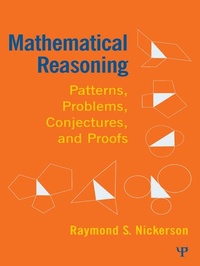
Mathematical Reasoning
Patterns, Problems, Conjectures, and Proofs
1st Edition
Published on 25. February 2011
596 pages
978-1-136-94539-7 (ISBN)
Description

The development of mathematical competence -- both by humans as a species over millennia and by individuals over their lifetimes -- is a fascinating aspect of human cognition.
This book explores when and why the rudiments of mathematical capability first appeared among human beings, what its fundamental concepts are, and how and why it has grown into the richly branching complex of specialties that it is today. It discusses whether the 'truths' of mathematics are discoveries or inventions, and what prompts the emergence of concepts that appear to be descriptive of nothing in human experience. Also covered is the role of esthetics in mathematics: What exactly are mathematicians seeing when they describe a mathematical entity as 'beautiful'? There is discussion of whether mathematical disability is distinguishable from a general cognitive deficit and whether the potential for mathematical reasoning is best developed through instruction.
This volume is unique in the vast range of psychological questions it covers, as revealed in the work habits and products of numerous mathematicians. It provides fascinating reading for researchers and students with an interest in cognition in general and mathematical cognition in particular. Instructors of mathematics will also find the book's insights illuminating.
This book explores when and why the rudiments of mathematical capability first appeared among human beings, what its fundamental concepts are, and how and why it has grown into the richly branching complex of specialties that it is today. It discusses whether the 'truths' of mathematics are discoveries or inventions, and what prompts the emergence of concepts that appear to be descriptive of nothing in human experience. Also covered is the role of esthetics in mathematics: What exactly are mathematicians seeing when they describe a mathematical entity as 'beautiful'? There is discussion of whether mathematical disability is distinguishable from a general cognitive deficit and whether the potential for mathematical reasoning is best developed through instruction.
This volume is unique in the vast range of psychological questions it covers, as revealed in the work habits and products of numerous mathematicians. It provides fascinating reading for researchers and students with an interest in cognition in general and mathematical cognition in particular. Instructors of mathematics will also find the book's insights illuminating.
Reviews / Votes
"Few authors who are not mathematicians have the understanding and sympathy for the subject and its practitioners that is shown in this book, whose author is an experimental psychologist and former VP of Bolt Beranek and Newman Inc. He surveys the nature, joys, usefulness, foundations, and teaching of mathematics, in its manifestations of pattern-finding, problem-solving, conjecture-making, and proof-devising. He concludes, "the supreme reason for acquiring some competence in mathematics is the door it opens to an immensely attractive and rewarding workspace-or playground-for the mind." This is a great book for nonmathematicians, one that a mathematician can praise." - Paul Campbell, Beloit College, USA"Nickerson is a reliable and enthusiastic guide through a many-layered forest of ideas, leading us at each turn to a new appreciation of its topography - the box canyons and precipices and monumental vistas - of this very human adventure. His excellent references mark trailheads for those who would venture farther." - Peter Killeen, Ph.D., Arizona State University, USA
"A wide-ranging and insightful account of the nature of mathematics (its origins, utility, beauty) as well as of cognition and reasoning in general. This book is a welcome antidote to the notion that math is primarily a matter of computation." - John A. Paulos, Ph.D., Temple University, USA
More details
Language
English
Place of publication
London
United Kingdom
Publishing group
Taylor & Francis Ltd
Target group
College/higher education
Illustrations
44 s/w Abbildungen, 15 s/w Tabellen
15 Tables, black and white; 44 Illustrations, black and white
File size
7,36 MB
ISBN-13
978-1-136-94539-7 (9781136945397)
Copyright in bibliographic data and cover images is held by Nielsen Book Services Limited or by the publishers or by their respective licensors: all rights reserved.
Schweitzer Classification
Other editions
Additional editions
Book
11/2015
1st Edition
Psychology Press Ltd
€75.90
Shipment within 10-20 days
Book
12/2009
1st Edition
Psychology Press Ltd
€208.90
Shipment within 3-4 weeks
Person
Raymond S. Nickerson, retired senior vice president of Bolt Beranek and Newman Inc. and research professor at Tufts University, is a fellow of the American Association for the Advancement of Science, the American Psychological Association, the Association for Psychological Science, the Human Factors and Ergonomics Society, and the Society of Experimental Psychologists. He is the founding editor of The Journal of Experimental Psychology: Applied, the founding and series editor of Reviews of Human Factors and Ergonomics, an annual publication of the Human Factors and Ergonomics Society, and the author of several books, including Aspects of Rationality: Reflections on What it Means to be Rational and Whether We Are (Psychology Press, 2008).
Content
1. What Is Mathematics? 2. Counting. 3. Numbers. 4. Deduction and Abstraction. 5. Proofs. 6. Informal Reasoning. 7. Representations. 8. Infinity. 9. Infinitesimals. 10. Predilections. 11. Esthetics in Mathematics. 12. The Usefulness of Mathematics. 13. Foundations. 14. Preschool Development. 15. Math in Schools. 16. Math Problem Solving. 17. Final Thoughts.
