

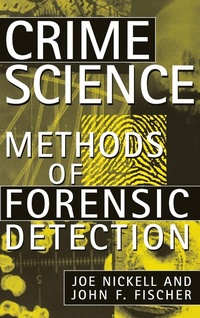
Crime Science
Description

This comprehensive guide to forensic investigation "delivers the goods for the educated layperson... readers will be hard-pressed to put it down" ( USA Today). Forensic experts Joe Nickell and John Fischer introduce readers to the work of firearms experts, document examiners, fingerprint technicians, medical examiners, and forensic anthropologists. These topics are explained in clear terms without technical jargon. Nickell and Fisher describe fingerprint classification and autopsies, explain how fibers link victims to their killers, and examine the science underlying DNA profiling and toxicological analysis. From weapons analysis to handwriting samples to shoe and tire impressions, Crime Science outlines the indispensable tools and techniques that investigators use to make sense of a crime scene. Each chapter closes with a study of an infamous case to demonstrate how the principles of forensic science work in practice. Case studies including the O.J. Simpson trial, the Lindbergh kidnapping, the death of Marilyn Monroe, the World Trade Center bombing, the assassination of the Romanovs, and the Atlanta child murders.
More details
Other editions
Additional editions
Persons
Content
- Intro
- Title Page
- Copyright Page
- Contents
- Acknowledgments
- 1. Introduction to Forensic Science and Criminalistics
- History
- The Modern Crime Laboratory
- 2. Crime-Scene Investigation
- Preliminaries
- Documentation
- Collection and Preservation
- Crime Reconstruction
- Legal Considerations
- Case Study: The Jeffrey MacDonald Case
- 3. Trace Evidence
- The Microscope
- Hair and Fibers
- Soil and Botanicals
- Glass, Paint, Etc.
- Case Study: The Atlanta Child Murders
- 4. Firearms
- Basic Arms and Ammunition Ballistics
- Identifying Characteristics
- Firearm Residues
- Case Study: The Sacco and Vanzetti Trial
- 5. Fingerprinting
- History
- Classification
- Identification
- Processing and Recovery
- Case Study: Aileen Wuornos, Female Serial Killer
- 6. Impression Analysis
- Fabric Prints
- Shoe and Tire Impressions
- Tool Marks
- Case Study: The Lindbergh Kidnapping
- 7. Questioned Documents
- Handwriting Comparison
- Forgery Detection
- Analytical Techniques
- Case Study: The Mormon Forgery Murders
- 8. Serology
- Principles
- Conventional Analyses
- DNA Testing
- Case Study: The O. J. Simpson Trial
- 9. Chemistry
- Introduction
- Drugs
- Toxicology
- Arson
- Explosives
- Case Study: The World Trade Center Bombing
- 10. Pathology
- Identification of Decedent
- Time of Death
- Autopsy
- Cause of Death
- Case Study: The Death of Marilyn Monroe
- 11. Anthropology
- Recovery of Remains
- Skeletal Examination
- Forensic Identification
- Case Study: The Assassination of the Romanovs
- Afterword
- Index
