

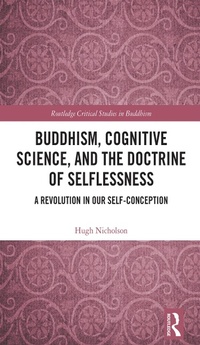
Buddhism, Cognitive Science, and the Doctrine of Selflessness
A Revolution in Our Self-Conception
1st Edition
Published on 30. September 2022
236 pages
978-1-000-65615-2 (ISBN)
Description

This book examines the relationship between Buddhist philosophy and scientific psychology by focusing on the doctrine of No-self.
The hypothesis is that No-self can function as an instrument of counter-induction, that is, an alternative conceptual scheme that exposes by contrast the intuitive or "folk" theoretical presuppositions sedimented in our perception of ourselves and others. When incorporated into regimens of meditative and ritual practice, the No-self doctrine works to challenge and disrupt our naive folk psychology. The author argues that there is a fruitful parallel between the No-self doctrine and anti-Cartesian trends in the cognitive sciences. The No-self doctrine was the product of philosophical speculation undertaken in the context of hegemonic struggles with both Buddhist and non-Buddhist rivals, and the classic No-self doctrine, accordingly, is a somewhat schematic and largely accidental anticipation of the current scientific understanding of the mind and consciousness. Nevertheless, inasmuch as it challenges and unsettles the seemingly self-evident certitudes of folk psychology, it prepares the ground for the revolution in our self-conception promised by the emerging cognitive scientific concept of mind.
A novel contribution to the study of Buddhist Philosophy, the book will also be of interest to scholars of Buddhist Studies and Asian Religions.
The hypothesis is that No-self can function as an instrument of counter-induction, that is, an alternative conceptual scheme that exposes by contrast the intuitive or "folk" theoretical presuppositions sedimented in our perception of ourselves and others. When incorporated into regimens of meditative and ritual practice, the No-self doctrine works to challenge and disrupt our naive folk psychology. The author argues that there is a fruitful parallel between the No-self doctrine and anti-Cartesian trends in the cognitive sciences. The No-self doctrine was the product of philosophical speculation undertaken in the context of hegemonic struggles with both Buddhist and non-Buddhist rivals, and the classic No-self doctrine, accordingly, is a somewhat schematic and largely accidental anticipation of the current scientific understanding of the mind and consciousness. Nevertheless, inasmuch as it challenges and unsettles the seemingly self-evident certitudes of folk psychology, it prepares the ground for the revolution in our self-conception promised by the emerging cognitive scientific concept of mind.
A novel contribution to the study of Buddhist Philosophy, the book will also be of interest to scholars of Buddhist Studies and Asian Religions.
More details
Series
Edition
1. Auflage
Language
English
Place of publication
London
United Kingdom
Publishing group
Taylor & Francis Ltd
Target group
College/higher education
Professional and scholarly
Illustrations
6 Halftones, black and white; 6 Illustrations, black and white
ISBN-13
978-1-000-65615-2 (9781000656152)
Copyright in bibliographic data and cover images is held by Nielsen Book Services Limited or by the publishers or by their respective licensors: all rights reserved.
Schweitzer Classification
Other editions
Additional editions
Hugh Nicholson
Buddhism, Cognitive Science, and the Doctrine of Selflessness
A Revolution in Our Self-Conception
Book
08/2024
1st Edition
Routledge
€63.30
Shipment within 10-20 days
Hugh Nicholson
Buddhism, Cognitive Science, and the Doctrine of Selflessness
A Revolution in Our Self-Conception
Book
09/2022
1st Edition
Routledge
€206.40
Shipment within 10-20 days
Person
Hugh Nicholson is Professor of Religious Studies at Loyola University Chicago, USA. He is a scholar of comparative religion with a specialization in South Asian religions.
Content
Preface; Abbreviations; Introduction: Against the Current; Chapter 1: Everyday Mindreading; Chapter 2: Buddhist Selflessness; Chapter 3: Anti-Cartesian Meditations; Chapter 4: No-self and the Demythologization of Buddhism; Chapter 5: Buddhist No-self as Proto-Idea; Chapter 6: Mahayana Perspectives on Selflessness: Emptiness and Representation Only; Chapter 7: Agentless Action in Zen
