

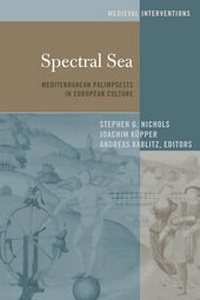
Spectral Sea
Description

From the dawn of ancient civilization to modern times, the Mediterranean Sea looms in the imagination of the people living on its shores as a space of myth and adventure, of conquest and confrontation, of migration and settlement, of religious ferment and conflict. Since its waters linked the earliest empires and centers of civilization, the Mediterranean generated globalization and multiculturalism. It gave birth to the three great monotheisms-Judaism, Christianity, and Islam-religions of the book, of the land and of the sea. Over the centuries, the Mediterranean witnessed the rise and fall of some of the oldest civilizations in the world. And as these cultures succeeded one another, century after century, each left a tantalizing imprint on later societies. Like the ancient artifacts constantly washed up from its depths, the lost cities and monuments abandoned in its deserts or sunk beneath its waves, Mediterranean topography and culture is a chaotic present spread over a palimpsest many layers deep.
No region grappled more continuously with, nor was more deeply marked by Mediterranean culture and history than Europe. Europe's religions, its languages, its learning, its laws, its sense of history, even its food and agriculture, all derived from Greek, Roman, and-in the Middle Ages-Muslim and Jewish cultures. The essays in this book lay bare the dynamics of cultural confrontation between Europe and the Mediterranean world from medieval to modern times. One momentous result of this engagement was the creation of vernacular languages and the diverse body of literature, history, and art arising from them. The achievements of the arts reveal-to borrow a geological metaphor-the grinding tectonic pates of Mediterranean cultures and languages butting up against pre-existing European strata.
More details
Other editions
Additional editions
Persons
Content
Contributors - Preface - Introduction - Marina Rustow: On the Salutary Effects of Empire: Muslims, Jews, and the Calculus of Benefaction - Daniel Heller-Roazen: Thought Things: Greek, Arabic, Latin - Stephen G. Nichols: Greek Fathers, Roman Tyrants, Spanish Martyrs: The Invention of European Vernacular Language - Jacqueline Cerquiglini-Toulet: The Gaze of the Other: Decentered Vision and Language in Fifteenth-Century French Poets - Jan-Dirk Müller: The Uncanny Beyond: The Mediterranean as Imaginary Frontier of Medieval Christian Culture - Axel Rüth: Crusade Witness: Joinville's Vie de Saint Louis - Gerhard Regn: Rome, Italy and the End of the History of Salvation: Petrarch's Italia mia - Joachim Küpper: Sentimental Revivals: Gérard de Nerval's Voyage en Orient - David E. Wellbery: "Geist" as Medium of Art: Goethe's West-östlicher Divan - Index.
