

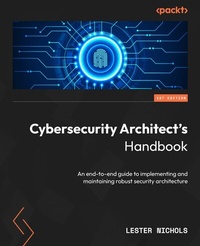
Cybersecurity Architect's Handbook
Description

Key Features
Gain insights into the cybersecurity architect role and master key skills to excel in it
Acquire a diverse skill set for becoming a cybersecurity architect through up-to-date, practical examples
Discover valuable tips and best practices to launch your career in cybersecurity
Purchase of the print or Kindle book includes a free PDF eBook
Book DescriptionStepping into the role of a Cybersecurity Architect (CSA) is no mean feat; it requires both upskilling and a fundamental shift in how you view cybersecurity. Written by a seasoned cybersecurity expert with over two decades of experience spanning the public and private sectors, this all-encompassing guide outlines an accessible a path for cybersecurity engineers and newcomers to evolve into architects, sharing best practices to enhance your skills. After a brief introduction to the role and foundational concepts, this book will help you understand the day-to-day challenges faced by CSAs, supported by practical examples. You'll gain insights into assessing and improving your organization's security posture, including system, hardware, and software security. You'll also learn how to set user and system policies and protocols through effective monitoring and enforcement, and understanding countermeasures that protect the system from unauthorized access attempts. To prepare you for the road ahead and augment your existing skills, the book provides invaluable tips and practices that will contribute to your success as a CSA. By the end of this book, you'll be well-equipped to take up the CSA role and execute robust security solutions.What you will learn
Get to grips with the foundational concepts and basics of cybersecurity
Understand cybersecurity architecture principles through scenario-based examples
Navigate the certification landscape and understand key considerations for getting certified
Implement zero-trust authentication with practical examples and best practices
Find out how to choose commercial and open source tools
Address architecture challenges, focusing on mitigating threats and organizational governance
Who this book is forThis book is for cybersecurity engineers or newcomers who aspire to become cybersecurity architects. It is also for cybersecurity professionals looking to transition into a cybersecurity architect role. Solution architects interested in understanding the scope of the role and the necessary skills for success will also find this book useful. Anyone with a basic understanding of computer and networking technologies will be able to make the most of this book.
All prices
More details
Other editions
Additional editions
Person
Lester E. Nichols III currently resides in North Texas and is the Director Security Architecture/VP Cybersecurity Operations at JPMorgan Chase & Co. Previous experience includes the Director of IT Infrastructure and Security for a development company, SOC oversight manager/Senior Infrastructure Officer within DHS and previous experience in Local/Federal/DoD/financial sectors. Lester has post graduate education with a Master's of Science Degree in Information Assurance from Norwich University, the oldest private military school in the United States, and multiple industry certifications including CISSP and SANS certs, as well as others. Lester is also a contributing author to the Computer Security Handbook 5th-6th Editions by Wiley Press.
Content
Introduction to Cybersecurity
Cybersecurity Foundation
What Is a Cybersecurity Architect and What Are Their Responsibilities?
Cybersecurity Architecture Principles, Design, and Analysis
Threat, Risk, and Governance Considerations as an Architect
Documentation as a Cybersecurity Architect - Valuable Resources and Guidance for a Cybersecurity Architect Role
Entry-Level-to-Architect Roadmap
The Certification Dilemma
Decluttering the Toolset - Part 1
Decluttering the Toolset - Part 2
Best Practices
Being Adaptable as a Cybersecurity Architect
Architecture Considerations - Design, Development, and Other Security Strategies - Part 1
Architecture Considerations - Design, Development, and Other Security Strategies - Part 2
Preface
Cyber threats pose ever-growing risks, yet security measures often lag behind. As organizations increasingly rely on interconnected technologies, the need for robust yet flexible cybersecurity architecture becomes imperative. This book equips you to meet that need. It provides IT and security professionals with a comprehensive guide to becoming proficient cybersecurity architects capable of designing and evolving strategic defenses tailored to unique environments.
Spanning foundations, career pathways, and advancements, the book explores core tenets of security alongside real-world implementation. Early chapters establish critical baseline knowledge regarding key concepts such as confidentiality, networking, risk management, and compliance. The discussion then progresses to navigating career growth as an architect, highlighting crucial skills such as documentation, vendor management, and team collaboration. Advanced sections detail processes for selecting and implementing controls, aligning security with business objectives, and cultivating personal adaptability amid constant change.
Throughout, the emphasis remains practical and actionable. Theories come alive through concrete examples drawn from diverse organizational settings. Labs, diagrams, and exercises immerse you in applying concepts firsthand. Those new to cybersecurity gain indispensable orientation while current professionals discover fresh perspectives.
Who this book is for
The book is suited to IT administrators, security analysts, developers, and leaders seeking to pivot into architect roles. However, any technology professional wanting to design comprehensive protections will find value. By equipping architects to implement strategic solutions tailored to unique risk landscapes, it enables both novice and seasoned readers to advance architectures to secure our increasingly digital future.
The three main personas who are the target audience of this content are as follows:
- Those new to cybersecurity or Information Technology (IT) looking to map a career or enhance their current path toward cybersecurity. For those at the onset of their technology or cybersecurity journey, this book provides critical orientation. Whether transitioning from a non-technical background or just embarking on the career path, the content maps a route to becoming a proficient cybersecurity architect.
- Existing IT professionals, at any level, looking to transition toward cybersecurity and, more specifically, toward cybersecurity architecture. For experienced technology professionals such as systems administrators, network engineers, or software developers seeking to transition into cybersecurity, this book bridges connections between familiar concepts and security-focused architecture.
- Existing cybersecurity professionals or entry-level cybersecurity architects looking to enhance and grow within the field and career. For cybersecurity professionals at the outset of their careers, such as analysts or associate-level architects, this book provides pathways to unlock greater responsibilities and leadership.
What this book covers
Chapter 1, Introduction to Cybersecurity, provides foundational concepts and basics to understanding the concepts of cybersecurity and, ultimately, how that plays into the role of the cybersecurity architect. This will provide a foundational level setting for those new to cybersecurity while also providing a fundamental refresher to those who have been working within cybersecurity or IT for some time.
Chapter 2, Cybersecurity Foundation, continues on from the introduction to get a bit more granular from a foundational level to discuss some of the main areas that a cybersecurity architect will need to address and understand as it relates to the business and other operational teams. This will be cursory in nature but provides the foundational aspects to progress into the discussion of the cybersecurity career path and the options available to the potential cybersecurity architect in specializing/focusing in a particular area.
Chapter 3, What Is a Cybersecurity Architect and What Are Their Responsibilities?, begins with the principle that you have enough understanding of cybersecurity to discuss the role of the cybersecurity architect and how it builds upon other technology roles. Whether that is in the area of enterprise, application, network, or platform architecture, these areas have differing focuses that span everything to a specific subset. This is also in context with the organization and technology. Once the framework of the architect is defined, the responsibilities become more evident, as it relates to the specific area of focus or organization.
Chapter 4, Cybersecurity Architecture Principles, Design, and Analysis, provides foundational concepts for cybersecurity architecture, including principles, design, and analysis. It emphasizes using clear terminology and outlining organizational goals and risk tolerance as critical inputs that shape architecture.
Chapter 5, Threat, Risk, and Governance Considerations as an Architect, discusses the areas of architecture principles, design, and analysis that will be part of the day-to-day functions of the cybersecurity architect. This will discuss the various approaches to performing the design and analysis of a particular solution or control with an understanding of the principles around the choice one would take over another depending on the situation.
Chapter 6, Documentation as a Cybersecurity Architect - Valuable Resources and Guidance for a Cybersecurity Architect Role, takes somewhat of a break from the more detailed concepts to discuss the importance of proper documentation as it relates to the cybersecurity architect role. This will discuss the need for granularity and a detailed approach to documentation through tools such as Microsoft Visio or DrawIO and other similar tools. There will also be a discussion of how to document and/or create scratchpads for notes through tools such as CherryTree. All of this is meant to help propel the visibility of solutioning and architecture design not only within the organization but also for regulatory and compliance requirements.
Chapter 7, Entry-Level-to-Architect Roadmap, discusses the journey to get to the top as a cybersecurity architect. It goes without saying that certain career paths are more direct than others for the cybersecurity architect. Like most things in technology, "it depends" can be a common answer. This chapter provides various approaches to gaining the experience or skill set to become a cybersecurity architect. Whether that is starting as an IT technician or transitioning from a developer, there are commonalities or skills that need to be gained or used to help shape the path for this career path.
Chapter 8, The Certification Dilemma, discusses a number of certifications for security architecture, as well as others to help differentiate yourself from others who are competing for the same position. It also discusses the good, bad, and ugly of the certification process and how to make the choices that will best match your overall career plan and direction.
Chapter 9, Decluttering the Toolset - Part 1, explores strategies for cybersecurity architects to thoughtfully assemble their security toolkit by evaluating solutions to find the optimal fit for their organization's specific threat landscape, business needs, and operational constraints. It provides an overview of major security tool categories such as threat modeling, network monitoring, endpoint protection, identity access management, data encryption, vulnerability management, and more. The chapter emphasizes matching defenses to an organization's unique vulnerabilities and risks rather than a one-size-fits-all approach.
Chapter 10, Decluttering the Toolset - Part 2, emphasizes the importance of thoughtfully selecting cybersecurity tools tailored to an organization's unique vulnerabilities, infrastructure, and strategic objectives. It advises taking a methodical approach to identifying specific security gaps and requirements first before assessing tools. Tight alignment with frameworks such as NIST CSF, implementing layered defenses, weighing business factors such as cost and usability, and future-proofing selections are highlighted as critical to building an optimal toolkit.
Chapter 11, Best Practices, goes into detail about best practices, as it relates to cybersecurity and why it is best to implement solutions using best practices. This includes the use of standards or technology-specific best practices. The chapter will also discuss when one may supersede another and why you may be faced with that scenario.
Chapter 12, Being Adaptable as a Cybersecurity Architect, explores how architects can cultivate personal and professional adaptability to implement pragmatic solutions tailored to unique business environments and goals. It builds on previous core concepts to underscore why rigid adherence to...
