

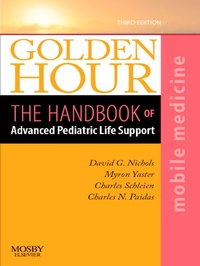
Golden Hour
The Handbook of Advanced Pediatric Life Support (Mobile Medicine Series)
3rd Edition
Published on 18. February 2011
624 pages
978-0-323-08131-3 (ISBN)
Description

The Golden Hour: The Handbook of Advanced Pediatric Life Support, by Drs. David G. Nichols, Myron Yaster, Charles Schleien, and Charles N. Paidas, a new edition in the Mobile Medicine Series, presents today's life-saving approaches for the critically ill or injured child. Time is of the essence when performing emergency techniques such as intraosseous needle insertion and intubation, so find what you need quickly using this guide's step-by-step, outline format that includes numerous algorithms, tables, and figures. Significant updates and revisions make the third edition a must-have for any physician, resident, nurse, or emergency medical technician.
Find what you need quickly when performing emergency techniques such as cardioversion/defibrillation with a step-by-step, outline format that includes numerous algorithms, tables, and figures.
- Prepare for a broad range of emergency situations with new chapters on General Surgical Emergencies; Asthma; Acute Renal Failure; Diabetic Ketoacidosis; Gastrointestinal Emergencies; Liver Failure; Hematologic and Oncologic Emergencies; Hypo/Hyperthermia; and Terrorism and Mass Casualty.
- Solve more clinical challenges with new and expanded material, including spinal cord trauma, and additional focus on the hot topic of pain and sedation.
- Get expert visual guidance with additional illustrations to supplement the comprehensive coverage.
More details
Other editions
Additional editions
David G. Nichols | Myron Yaster | Charles Schleien
Golden Hour
The Handbook of Advanced Pediatric Life Support (Mobile Medicine Series)
Book
03/2011
3rd Edition
Mosby
€56.00
Shipment within 15-20 days
Content
1. Initial Assessment
2. Airway Management
3. Respiratory Failure
4. Acute Asthma
5. Cardiopulmonary Resuscitation
6. Shock
7. Cardiovascular Emergencies
8. Electrolyte and Metabolic Disorders
9. Acute Renal Failure
10. Endocrine Emergencies: Diabetic Ketoacidosis, Hypoglycemia, and Thyroid Storm
11. Gastrointestinal Emergencies
12. Liver Failure
13. Hematologic Emergencies
14. Oncologic Emergencies
15. Head and Spinal Cord Trauma
16. Nontraumatic Stupor and Coma
17. Drug Intoxication
18. Status Epilepticus
19. Meningitis and Sepsis
20. Pain Control and Sedation Management
21. Thoracic Trauma
22. Abdominal Trauma
23. General Surgical Emergencies
24. Orthopedic Trauma
25. Ocular Emergencies and Trauma
26. Soft Tissue Injuries
27. Human and Animal Bites and Stings
28. Hypothermia and Hyperthermia
29. Terrorism and Mass Casualty Events
30. Burns
31. Child Abuse
32. Neonatal Emergencies
33. Transportation of the Critically Ill and Injured Child
