

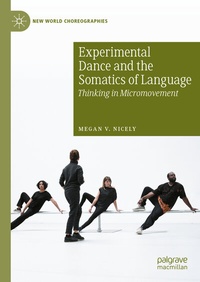
Experimental Dance and the Somatics of Language
Description

This book is about dance's relationship to language. It investigates how dance bodies work with the micromovements elicited by language's affective forces, and the micropolitics of the thought-sensations that arise when movement and words accompany one another within choreographic contexts. Situating itself where theory meets practice-the zone where ideas arise to be tested, the book draws on embodied research in practices within the lineages of American postmodern dance and Japanese butoh, set in dialog with affect-based philosophies and somatics. Understanding that language is felt , both when uttered and when unspoken, this book speaks to the choreographic thinking that takes place when language is considered a primary element in creating the sensorium.
Reviews / Votes
"Impeccably crafted. Nicely articulates the ways in which language manifests in sensation and movement. She asks important and nuanced questions about presence and awareness of ourselves and others in changing spaces and relationships, separated by Covid, ignited by social protest. An invaluable text to gain philosophical currency for sensate experience, offering exciting new formulations for dance studies."
-Tanya Calamoneri, Assistant Professor, The Ohio State University, author of
Butoh America
In Experimental Dance and the Somatics of Language , Nicely investigates the use of language in dance practice by considering the somatics of micromovement in three phases- vibration, interval, and adaptation. Nicely's ingenious move, after Deleuze, is to give language a body on the dance floor. Language, reconfigured as a source of sensation, becomes a critical analytic tool for Nicely to think through dance works past and present, contributing to performance studies' ongoing inquiry into how speech acts."
-Melinda Buckwalter, Managing Director, Five College Dance, author of Composing while Dancing
More details
Other editions
Additional editions
Person
Megan V. Nicely is an artist/scholar whose research involves choreographic experimentation through the medium of the body. She has published in TDR , Choreographic Practices, Performance Research Journal , and others, and her company Megan Nicely/Dance has performed on both U.S. coasts, in the UK and in Europe. She is Associate Professor of Performing Arts and Social Justice/Dance at University of San Francisco, USA.
Content
Chapter 1 - Introduction.- Chapter 2 - The Micropolitics of Micromovement.- Chapter 3 - Interval: Trisha Brown and the Space Between Words.- Chapter 4 - Vibration: Kasai Akira and Voice Power.- Chapter 5 - Adaptation: Deborah Hay and "Call It That".- Chapter 6 - Language as Agent: Doing and Allowing.- Chapter 7 - Movement's Return: Sensations in Context
