

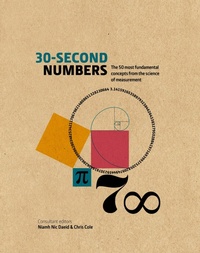
30-Second Numbers
The 50 key topics for understanding numbers and how we use them
Published on 3. March 2020
160 pages
978-1-78240-849-9 (ISBN)
Description

The successful 30-Second series tackles numbers, with experts on maths and data demystifying the essential numerical topics.
We know that we use numbers pretty often, some of us confidently, others reluctantly. But are we aware of just how essential they are to almost every decision we make? Counting and measuring when we're shopping, travelling, studying or playing are just the beginning; the applications of numbers are endless, from assessing variables and analysing data to the calculations and predictions of advanced artificial intelligence.
30-Second Numbers exploresnumber categories,the science of measuring, how guesstimates work, and the visualisation of numbers, taking you behind the digits into the world of statistics, probability, risk and ratios.
Sections include:
Fundamental Numbers - A guide to the different kinds of basic numbers, from rational to prime, complex to continuous.
Statistical Variations and Tests - Samples, populations and random variables are all explored in this section on all things stats!
Probability and Risk - Learn about prediction and hypothesis testing, as well as absolute and relative risk.
Visualising numbers - From numerical bias to logarithms and algorithms, this section shows us all the different ways we can visualise numbers.
Using Numbers - Big data, artificial intelligence and machine learning are all covered in this section, about how these concepts are applied in the real world.
Numbers are our way of imposing order on the world, and each of the 50 topics here uses just 300 words and one picture to give you a sense of control, helping you to understand trends in statistical data, how algorithms are used and the methods involved in machine learning.
In addition, each section contains a profile of a famous mathematician whose work has greatly contributed to how we understand numbers today, from Fibonacci to Pierre de Fermat.
With this book, numbers need never be daunting again.
The 30 Second series is a handy collection of quick guides which explain the key aspects of core subjects, from numbers to literature to art to Ancient China to biology, and lots more! These titles use only 300 words to explore each section within a topic, making them quick and digestible for those looking to learn a lot, fast!
We know that we use numbers pretty often, some of us confidently, others reluctantly. But are we aware of just how essential they are to almost every decision we make? Counting and measuring when we're shopping, travelling, studying or playing are just the beginning; the applications of numbers are endless, from assessing variables and analysing data to the calculations and predictions of advanced artificial intelligence.
30-Second Numbers exploresnumber categories,the science of measuring, how guesstimates work, and the visualisation of numbers, taking you behind the digits into the world of statistics, probability, risk and ratios.
Sections include:
Fundamental Numbers - A guide to the different kinds of basic numbers, from rational to prime, complex to continuous.
Statistical Variations and Tests - Samples, populations and random variables are all explored in this section on all things stats!
Probability and Risk - Learn about prediction and hypothesis testing, as well as absolute and relative risk.
Visualising numbers - From numerical bias to logarithms and algorithms, this section shows us all the different ways we can visualise numbers.
Using Numbers - Big data, artificial intelligence and machine learning are all covered in this section, about how these concepts are applied in the real world.
Numbers are our way of imposing order on the world, and each of the 50 topics here uses just 300 words and one picture to give you a sense of control, helping you to understand trends in statistical data, how algorithms are used and the methods involved in machine learning.
In addition, each section contains a profile of a famous mathematician whose work has greatly contributed to how we understand numbers today, from Fibonacci to Pierre de Fermat.
With this book, numbers need never be daunting again.
The 30 Second series is a handy collection of quick guides which explain the key aspects of core subjects, from numbers to literature to art to Ancient China to biology, and lots more! These titles use only 300 words to explore each section within a topic, making them quick and digestible for those looking to learn a lot, fast!
More details
Series
Language
English
Place of publication
London
United Kingdom
Publishing group
Quarto Publishing PLC
Product notice
Reflowable
File size
29,58 MB
ISBN-13
978-1-78240-849-9 (9781782408499)
Copyright in bibliographic data and cover images is held by Nielsen Book Services Limited or by the publishers or by their respective licensors: all rights reserved.
Schweitzer Classification
Other editions
Additional editions
Niamh Nic Daeid | Christian Cole
30-Second Numbers
The 50 key topics for understanding numbers and how we use them
Book
03/2020
Ivy Press
€38.59
Article exhausted; check different version
Persons
Niamh Nic Daeid is the director of the Leverhulme Research Centre for Forensic Science, University of Dundee, Scotland. She studied Chemistry and Mathematics at Trinity College Dublin and the Dublin Institute of Technology, specialising in statistics. Niamh has published widely in the forensic science literature, pioneering the use of chemometric analysis in the interpretation of complex data sets.
Christian Cole is a Data Scientist and Principal Investigator at the Leverhulme Research Centre for Forensic Science, University of Dundee, Scotland, where he works on biological problems with large data sets.
Christian Cole is a Data Scientist and Principal Investigator at the Leverhulme Research Centre for Forensic Science, University of Dundee, Scotland, where he works on biological problems with large data sets.
Content
- Cover
- Half Title
- Title
- Copyright
- Dedication
- CONTENTS
- Introduction
- Fundamental Numbers
- GLOSSARY
- Real Numbers
- Rational Numbers
- Irrational Numbers
- Prime Numbers
- Complex Numbers
- Discrete Numbers
- Continuous Numbers
- Zero & Negative Numbers
- Powers & Roots
- Profile: Gerolamo Cardano
- Statistical Distributions
- GLOSSARY
- Statistics
- Population & Samples
- Sampling
- Independent & Dependent Variables
- Statistical Distributions
- Normal Distribution
- Profile: Abraham de Moivre
- Random Variables
- Statistical Tests
- GLOSSARY
- Statistical Tests
- Mean
- Standard Deviation
- Measurement Error
- P-Values
- Profile: Egon Pearson
- Confidence Interval
- Bootstrapping
- Standard Error
- Linear Regression & Correlation
- Probability and Risk
- GLOSSARY
- Probability
- Profile: Pierre de Fermat
- Prediction
- Hypothesis Testing
- Bayesian Probability
- Profile: Thomas Bayes
- Conditional Probability
- Likelihood Ratios
- Absolute Risk
- Relative Risk
- Numerical Bias
- Using Numbers
- GLOSSARY
- Numerical Bases
- Logarithms
- Percentages
- Fractions
- Algorithms
- False Positives & False Negatives
- Permutations & Combinations
- Profile: Fibonacci
- Visualizing Numbers
- GLOSSARY
- Big Data
- Artificial Intelligence
- Machine Learning
- Data Visualization
- Using Shape & Colour
- Comparing Numbers
- Trends
- Profile: Sir Arthur Lyon Bowley
- Ranges
- Quartiles
- Appendices
- Further Resources
- Notes on Contributors
- Index
- Acknowledgements
