

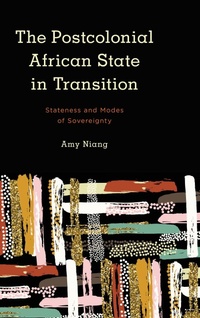
The Postcolonial African State in Transition
Stateness and Modes of Sovereignty
1st Edition
Published on 2. November 2018
256 pages
978-1-78660-654-9 (ISBN)
Description

The Postcolonial African State in Transition offers a new perspective on a set of fundamental, albeit old questions with salient contemporary resonance: what is the nature of the postcolonial state? How did it come about? And more crucially, the book poses an often neglected question: what was the postcolonial African state internally built against? Through a detailed historical investigation of the Voltaic region, the book theorizes the state in transition as the constitutive condition of the African state, rendering centralization processes as always transient, uncertain, even dangerous endeavours. In Africa and elsewhere in the colonial and postcolonial world, the centralized sovereign state has become something of a meta-model that bears the imprint of necessity and determinism.
This book argues that there is nothing natural, linear, conventional or intrinsically consensual about the centralized state form. In fact, the African state emerged, and was erected against, and at the expense of a variety of authority structures and forms of self-governance. The state has sustained itself through destructive practices, internal colonization, and in fact the production and alienation of a range of internal others.
This book argues that there is nothing natural, linear, conventional or intrinsically consensual about the centralized state form. In fact, the African state emerged, and was erected against, and at the expense of a variety of authority structures and forms of self-governance. The state has sustained itself through destructive practices, internal colonization, and in fact the production and alienation of a range of internal others.
Reviews / Votes
Amy Niang has written a book on the African state unlike any before it. It effectively argues that scholarship on the African state has thus far been predicated on two misconceptions: one regarding what historically makes a state a state; and, two, what gives political organizations their legitimacy, or stateness. This is the result of a general confusion of political power (or ascendency and control by historical entities or organizations) with political rationality: the purpose of public life, particularly with the validity of their aesthetic: form, rituals, and the like. This confusion not only privileges one historical trajectory toward stateness, Europe's; it also obscures the diversity of the human trajectory with regard to the conceptions of ethics and public morality - and therefore ethical relations, moral ends, and teleology of political instruments and institutions. This point was worth-making and it is made brilliantly with good historical references. Amy Niang's Postcolonial African State in Transition offers an eloquent intervention into postcolonial African thought. It insists that we rethink the conceptual fields through which we have understood Africa, its people, and in particular the African state and demands that we grapple with the misreading of statehood and the frameworks that have supported its fictions. By asking what social forms the centralised state displaced? And how are we to make sense of the various dimensions of the contemporary African state, the book calls on us to rethink categories such as "legitimacy," "sovereignty" and "informality" by historicising the African statecraft and reconsidering the role of Westphalia in Africa's postcolonial universes. This reconceptualization is brilliant and refreshing. It is a must read for all committed to rethinking the way we talk about African lifeworlds - its past, its present and its future. A tour de force!More details
Series
Edition
1. Auflage
Language
English
Place of publication
London
United Kingdom
Target group
Professional and scholarly
ISBN-13
978-1-78660-654-9 (9781786606549)
Copyright in bibliographic data and cover images is held by Nielsen Book Services Limited or by the publishers or by their respective licensors: all rights reserved.
Schweitzer Classification
Other editions
Additional editions
Book
11/2018
Rowman & Littlefield International
€157.50
Shipment within 3-4 weeks
Person
Amy Niang teaches International Relations at the University of the Witwatersrand and is currently a Visiting Professor at the University of Sao Paulo.
Content
Political History as State Ideology / 2. The Trail of the Horse: Stateness, Statelessness and the Ethics of State Inhibition / 3. The Time/Space Dynamics of the Constitution of the Political / 4. Statization and Centralizing Processes in 18th Century Moogo / 5. Rituals as Political References / 6. The State in Transition: A Recapitulation
