

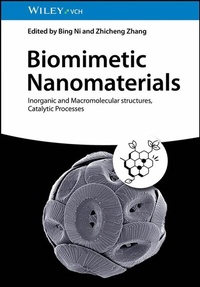
Biomimetic Nanomaterials
Inorganic and Macromolecular structures, Catalytic Processes
1st Edition
Published on 1. August 2025
352 pages
978-3-527-84984-0 (ISBN)
Description

An accurate and authoritative discussion of the structure, fabrication, and applications of biomimetic materials
In "Biomimetic Nanomaterials: Inorganic and Macromolecular Structures, Catalytic Processes", a team of distinguished researchers delivers an up-to-date discussion of select emerging topics in nature-inspired approaches to biomimetic nanomaterials. The authors focus on two core subjects: mimicking biological structures and replicating biological functions.
The book begins with an exploration of bio-inorganic structures and biomineralization processes, including biominerals and bio-inspired architectures like aerogels and chiral nanoparticles. It continues on to discuss biomacromolecule-based materials and synthetic mimics, as well as their structural and functional attributes. Finally, it covers bio-inspired functional materials, including nanozymes and catalytic systems for applications, like artificial photosynthesis, CO2 conversion, and N2 fixation.
Readers will also find:
* A thorough introduction to the foundational concepts and the latest developments in biomimetic nanomaterials
* Comprehensive explorations of the latest applications of biomimetic nanomaterials, including artificial muscles, protective coatings, and catalytic processes
* Practical discussions of the structures of biomimetic inorganic nanomaterials, like biominerals, biomorphs, artificial plastic materials, and chiral nanoparticles
* Complete treatments of particularly remarkable uses of biomimetic materials, including water splitting catalysis nanozymes
Perfect for materials scientists, bioinorganic chemists, and biotechnologists, Biomimetic Nanomaterials will also benefit bioengineers, polymer chemists, and biochemists.
In "Biomimetic Nanomaterials: Inorganic and Macromolecular Structures, Catalytic Processes", a team of distinguished researchers delivers an up-to-date discussion of select emerging topics in nature-inspired approaches to biomimetic nanomaterials. The authors focus on two core subjects: mimicking biological structures and replicating biological functions.
The book begins with an exploration of bio-inorganic structures and biomineralization processes, including biominerals and bio-inspired architectures like aerogels and chiral nanoparticles. It continues on to discuss biomacromolecule-based materials and synthetic mimics, as well as their structural and functional attributes. Finally, it covers bio-inspired functional materials, including nanozymes and catalytic systems for applications, like artificial photosynthesis, CO2 conversion, and N2 fixation.
Readers will also find:
* A thorough introduction to the foundational concepts and the latest developments in biomimetic nanomaterials
* Comprehensive explorations of the latest applications of biomimetic nanomaterials, including artificial muscles, protective coatings, and catalytic processes
* Practical discussions of the structures of biomimetic inorganic nanomaterials, like biominerals, biomorphs, artificial plastic materials, and chiral nanoparticles
* Complete treatments of particularly remarkable uses of biomimetic materials, including water splitting catalysis nanozymes
Perfect for materials scientists, bioinorganic chemists, and biotechnologists, Biomimetic Nanomaterials will also benefit bioengineers, polymer chemists, and biochemists.
More details
Other editions
Additional editions
Bing Ni | Zhicheng Zhang
Biomimetic Nanomaterials
Inorganic and Macromolecular structures, Catalytic Processes
Book
09/2025
1st Edition
Wiley-VCH
€149.00
Available immediately
Persons
Zhicheng Zhang is currently a Professor of Tianjin University, China. He obtained his Ph.D. degree from China University of Petroleum (Beijing) in 2012. Then he worked as a postdoctoral researcher at Tsinghua University. In 2014, he worked as a senior research fellow at Nanyang Technological University, Singapore. In 2019, he joined Tianjin University as a full Professor. His research interests focus on the design and synthesis of functional metal-based nanomaterials and their applications in energy conversion and catalysis. To date, he has published more than 120 peer-reviewed SCI papers. He is the associate editor of SmartMat, and editorial board member of Nano Research, Chinese Chemical Letters, and Rare Metals.
Bing Ni joined Beijing Normal University as a full professor in 2024. He obtained his B.S. and Ph.D. degree from Tsinghua University in 2014 and 2019, respectively. Then he joined Prof. Helmut Cölfen's group in the University of Konstanz, Germany, as a Humboldt research fellow. In 2023, he moved to Prof. N. A. Kotov's group, USA, as a post-doc. His research interests focus on crystal growth mechanisms and electrocatalysis. To date, he has published more than 60 peer-reviewed papers. He is a junior editorial board member of SmartMat.
Bing Ni joined Beijing Normal University as a full professor in 2024. He obtained his B.S. and Ph.D. degree from Tsinghua University in 2014 and 2019, respectively. Then he joined Prof. Helmut Cölfen's group in the University of Konstanz, Germany, as a Humboldt research fellow. In 2023, he moved to Prof. N. A. Kotov's group, USA, as a post-doc. His research interests focus on crystal growth mechanisms and electrocatalysis. To date, he has published more than 60 peer-reviewed papers. He is a junior editorial board member of SmartMat.
Content
Chapter 1. Introduction
PART I. BIOMIMETIC INORGANIC NANOSTRUCTURES
Chapter 2. Biominerals and Biomineralization
Chapter 3. Designing Functional Biomorphs
Chapter 4. Biomimetic Materials Inspired by Bone and Tooth
Chapter 5. Biomimetic Chiral Nanomaterials
PART II. BIOMACROMOLECULES AND STRUCTURAL MIMICS
Chapter 6. Bio-Macromolecular Mimics
Chapter 7. Advanced Wood-Based Bionic Materials
Chapter 8. Bio-Inspired Multifunctional Nanocellulose Materials
Chapter 9. Biomass-Based Materials For A Circular Economy
Chapter 10. Biomimetic Aerogel
Chapter 11. Mechanical Materials with Biomimetic Hierarchical Structures
PART III. NANOMATERIALS MIMICKING BIO-CATALYTIC PROCESSES
Chapter 12. Nanozymes
Chapter 13. Photosynthesis and Photocatalytic Water Splitting
Chapter 14. CO2 Conversion
Chapter 15. Artificial N2 Fixation
PART I. BIOMIMETIC INORGANIC NANOSTRUCTURES
Chapter 2. Biominerals and Biomineralization
Chapter 3. Designing Functional Biomorphs
Chapter 4. Biomimetic Materials Inspired by Bone and Tooth
Chapter 5. Biomimetic Chiral Nanomaterials
PART II. BIOMACROMOLECULES AND STRUCTURAL MIMICS
Chapter 6. Bio-Macromolecular Mimics
Chapter 7. Advanced Wood-Based Bionic Materials
Chapter 8. Bio-Inspired Multifunctional Nanocellulose Materials
Chapter 9. Biomass-Based Materials For A Circular Economy
Chapter 10. Biomimetic Aerogel
Chapter 11. Mechanical Materials with Biomimetic Hierarchical Structures
PART III. NANOMATERIALS MIMICKING BIO-CATALYTIC PROCESSES
Chapter 12. Nanozymes
Chapter 13. Photosynthesis and Photocatalytic Water Splitting
Chapter 14. CO2 Conversion
Chapter 15. Artificial N2 Fixation
