

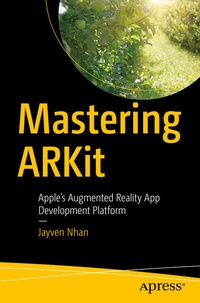
Mastering ARKit
Description

You'll learn to engineer successful, well-designed, and comprehensive augmented reality applications for Apple devices. First, uncover the foundation of augmented reality on Apple platforms. Understand the building blocks and inner workings of the technologies that power augmented reality. Then, learn about building AR apps using ARKit, SceneKit, SpriteKit, RealityKit, and RealityComposer.
You'll study augmented reality app business models, designs, and content for the ultimate user experience. Plus, you'll cover the theories and practicalities of ARKit APIs such as surface detection, working with world maps, body motion capture, face tracking, object scanning and detecting, people occlusion, and more. Chapter by chapter, this book helps you tobecome an advanced augmented reality engineer.
By the end of the book, you'll have the necessary mental models and tools to engineer delightful experiences in Apple's augmented reality platforms.
What You'll Learn
-
Build AR apps with SceneKit, SpriteKit, RealityKit, and RealityComposer
-
Understand the business models that support augmented reality
-
Incorporate surface detection, computer vision, and body motion capture in your apps
Who This Book Is For iOS developers who want to expand their knowledge of ARKit. They should have a solid foundation in the Swift programming language and understand the basics of navigating Xcode.
More details
Other editions
New editions
Additional editions
Person
Content
Chapter 1: Why Augmented Reality.- Chapter 2: Introduction to ARKit: Under the Hood and Matrixes.- Chapter 3: Designing an Augmented Reality Experience.- Chapter 4: Building Your First ARKit App with SceneKit.- Chapter 5: Understanding and Implementing 3D Objects.- Chapter 6: Detecting Horizontal Planes and Adding 3D Objects with Raycast in SceneKit.- Chapter 7: Understanding Physics by Launching a Rocketship.- Chapter 8: Light Estimation and Environment Texturing.- Chapter 9: 2D Image Recognition and Filter Modification.- Chapter 10: Saving and Restoring World-mapping Data to Create a Persistence AR Experience.- Chapter 11: Advancing App with Real-Time Image Analysis, Machine Learning, and Vision.- Chapter 12: Crafting 3D Assets.- Chapter 13: Creating Immersive Audio Experiences.- Chapter 14: Working with SpriteKit and ARKit.- Chapter 15: Building Shared Experiences with Multipeer Connectivity.- Chapter 16: Face Tracking.- Chapter 17: Reality Composer: Creating AR Content.- Chapter 18: Simultaneously Integrate Face Tracking and World Tracking.- Chapter 19: Scanning 3D Objects.- Chapter 20: Scanning 3D Objects.- Chapter 21: Body Motion Capture.- Chapter 22: People Occlusion.- Chapter 23: Create System-Wide Accessible AR Content: Quick Look with USDZ.- Chapter 24: Advancing AR Quick Look for Commerce on the Web.- Chapter 25: Working with SwiftUI and ARKit.- Chapter 26: Record Augmented Reality Experiences with ReplayKit.
