

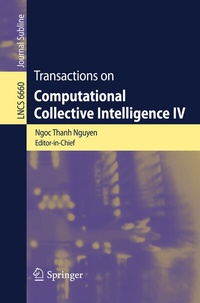
Transactions of Computational Collective Intelligence IV
Published on 18. June 2011
IX, 211 pages
978-3-642-21884-2 (ISBN)
Description

These Transactions publish research in computer-based methods of computational collective intelligence (CCI) and their applications in a wide range of fields such as the Semantic Web, social networks and multi-agent systems. TCCI strives to cover new methodological, theoretical and practical aspects of CCI understood as the form of intelligence that emerges from the collaboration and competition of many individuals (artificial and/or natural). The application of multiple computational intelligence technologies such as fuzzy systems, evolutionary computation, neural systems, consensus theory, etc., aims to support human and other collective intelligence and to create new forms of CCI in natural and/or artificial systems. This fourth issue contains a collection of 6 articles selected from high-quality submissions. The first paper of Ireneusz Czarnowski entitled "Distributed Learning with Data Reduction" consists of 120 pages and has a monograph character. The second part consists of five regular papers addressing advances in the foundations and applications of computational collective intelligence.
More details
Other editions
Additional editions

Ngoc-Thanh Nguyen
Transactions of Computational Collective Intelligence IV
Book
06/2011
1st Edition
Springer
€53.49
Shipment within 7-9 days
Content
- Title Page
- Preface
- Transactions on Computational Collective Intelligence
- Table of Contents
- Distributed Learning with Data Reduction
- Distributed Learning with Data Reduction
- Introduction
- Learning Classifiers from Data
- Problem Formulation
- Learning from Data - The Problem Taxonomies
- Learning from Data - Components of the Process
- Techniques and Algorithms
- Distributed Learning
- Problem Formulation
- Strategies of the Distributed Learning
- Distributed Learning - State-of-the-Art
- Technologies, Architectures and Systems for Distributed Learning
- Data Reduction
- Scope of the Data Reduction
- Problem Formulation
- Techniques and Algorithms for Data Reduction
- Approaches to Data Reduction
- Population-Based Multi-agent Approach to Data Reduction and Distributed Learning
- Introductory Remarks
- A-Team Concept and Its Implementation
- Agent-Based Framework for Learning Classifiers from the Reduced and Distributed Data
- Agent-Based Algorithm for Data Reduction
- Agent-Based Multiple-Objective Data Reduction
- Computational Experiments
- Evaluation of the Agent-Based Data Reduction Approach
- Evaluation of the Agent-Based Algorithms for Learning Classifiers from the Distributed and Reduced Data
- Conclusions
- Regular Papers
- Data Clustering Based on an Efficient Hybrid of K-Harmonic Means, PSO and GA
- Introduction
- Data Clustering Problem
- The Partitional Clustering
- K-harmonic Means Clustering
- Particle Swarm Optimization
- Recommended Method
- GSOKHM Method
- LSOKHM Algorithm
- Experimental Results
- Datasets
- Experimental Results
- Conclusions
- References
- A Study of Probability Collectives Multi-agent Systems on Optimization and Robustness
- Introduction
- Review of Probability Collectives
- Non-cooperative Game Theory
- Formulation of Optimization Problems
- Implementation of Probability Collectives
- Experimental Results
- The Schaffer Function F7
- The Rosenbrock Function
- De Jong Function F3
- The Ackley Path Function
- The Michalewicz Function
- Conclusions
- Inference Rules in Multi-agents' Temporal Logics
- Introduction, Research Background
- Definitions, Notation Preliminaries
- Possible Applications of Suggested Logical Operations
- Temporal Logics: Linear Case - LT LK and Close Logics
- Temporal Logics with Non-linear and Intransitive Time
- Concluding Comments
- Selecting ISPs
- Introduction
- Basics of Internet Traffic
- Measuring Browser Latency
- Low Level Measures
- Ping
- Traceroute
- Black Spots
- Conclusions and Further Area of Study
- References
- AbSM - Agent-Based Session Mobility
- Related Works
- MPEG-21
- Content DI and Context DI
- Terminal Capabilities
- Agent Systems
- JADE
- Description of the System
- Benchmarking and Hardware Evaluation
- Session Migration
- Test Setup - ``Multimedia Session'' Use Case
- Conclusion
- Author Index
