

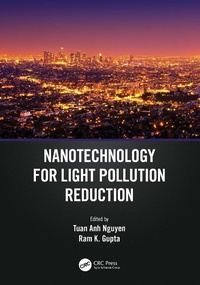
Nanotechnology for Light Pollution Reduction
1st Edition
Published on 7. September 2022
330 pages
978-1-000-64173-8 (ISBN)
Description

Light is essential for living organisms; however, excessive light causes adverse health conditions. This book covers the most recent progress on nanotechnology for reducing light pollution, discussing many approaches and technologies for controlling light pollution.
The book explores the fundamentals of light and the causes of light pollution, delving into light pollution's social, economic, and ecological impacts, its effects on living beings and the environment, as well as possible solutions and methods of control. The text discusses smart lighting technology, covering the various smart nanomaterials, nanosensors, and nanodevices involved. It also explores smart lighting involving natural light from the sun, artificial skydomes, shadow-free/secondary light sources, and the basics of many emerging devices such as light-emitting diodes and photosensors.
Nanotechnology is key to providing a new route for the next generation of lighting devices and systems with reduced light pollution. This essential reference illuminates emerging technologies and their applications, providing new directions to scientists, researchers, and students to better understand the principles, technologies, and applications of nanotechnology in light pollution.
The book explores the fundamentals of light and the causes of light pollution, delving into light pollution's social, economic, and ecological impacts, its effects on living beings and the environment, as well as possible solutions and methods of control. The text discusses smart lighting technology, covering the various smart nanomaterials, nanosensors, and nanodevices involved. It also explores smart lighting involving natural light from the sun, artificial skydomes, shadow-free/secondary light sources, and the basics of many emerging devices such as light-emitting diodes and photosensors.
Nanotechnology is key to providing a new route for the next generation of lighting devices and systems with reduced light pollution. This essential reference illuminates emerging technologies and their applications, providing new directions to scientists, researchers, and students to better understand the principles, technologies, and applications of nanotechnology in light pollution.
More details
Edition
1. Auflage
Language
English
Place of publication
London
United Kingdom
Publishing group
Taylor & Francis Ltd
Target group
College/higher education
Professional and scholarly
Adult education
Illustrations
5 Tables, black and white; 20 Line drawings, black and white; 63 Halftones, black and white; 83 Illustrations, black and white
ISBN-13
978-1-000-64173-8 (9781000641738)
Copyright in bibliographic data and cover images is held by Nielsen Book Services Limited or by the publishers or by their respective licensors: all rights reserved.
Schweitzer Classification
Other editions
Additional editions
Tuan Anh Nguyen | Ram K. Gupta
Nanotechnology for Light Pollution Reduction
Book
10/2024
1st Edition
CRC Press
€69.60
Shipment within 10-20 days
Tuan Anh Nguyen | Ram K. Gupta
Nanotechnology for Light Pollution Reduction
Book
09/2022
1st Edition
CRC Press
€205.10
Shipment within 10-20 days
Persons
Dr. Ram K. Gupta is an Associate Professor at Pittsburg State University. Dr. Gupta's research focuses on conducting polymers and composites, green energy production and storage using biowastes and nanomaterials, optoelectronics and photovoltaics devices, organic-inorganic hetero-junctions for sensors, bio-based polymers, flame-retardant polymers, bio-compatible nanofibers for tissue regeneration, scaffold and antibacterial applications, corrosion inhibiting coatings, and bio-degradable metallic implants. Dr. Gupta has published over 240 peer-reviewed articles, made over 300 national, international, and regional presentations, chaired many sessions at national/international meetings, edited many books, and written several book chapters. He has received over two and a half million dollars for research and educational activities from many funding agencies. He is serving as Editor-in-Chief, Associate Editor, and editorial board member of numerous journals.
Dr. Tuan Anh Nguyen completed his BSc in Physics from Hanoi University in 1992, and his Ph.D. in Chemistry from Paris Diderot University (France) in 2003. He was a Visiting Scientist at Seoul National University (South Korea, 2004) and the University of Wollongong (Australia, 2005). He then worked as a Postdoctoral Research Associate & Research Scientist at Montana State University (USA), 2006-2009. In 2012, he was appointed as Head of the Microanalysis Department at the Institute for Tropical Technology (Vietnam Academy of Science and Technology). He has managed 4 Ph.D. theses as thesis director and 3 are in progress. He is Editor-In-Chief of Kenkyu Journal of Nanotechnology & Nanoscience and Founding Co-Editor-In-Chief of Current Nanotoxicity & Prevention. He is the author of 4 Vietnamese books and Editor of 32 Elsevier books in the Micro & Nano Technologies Series.
Dr. Tuan Anh Nguyen completed his BSc in Physics from Hanoi University in 1992, and his Ph.D. in Chemistry from Paris Diderot University (France) in 2003. He was a Visiting Scientist at Seoul National University (South Korea, 2004) and the University of Wollongong (Australia, 2005). He then worked as a Postdoctoral Research Associate & Research Scientist at Montana State University (USA), 2006-2009. In 2012, he was appointed as Head of the Microanalysis Department at the Institute for Tropical Technology (Vietnam Academy of Science and Technology). He has managed 4 Ph.D. theses as thesis director and 3 are in progress. He is Editor-In-Chief of Kenkyu Journal of Nanotechnology & Nanoscience and Founding Co-Editor-In-Chief of Current Nanotoxicity & Prevention. He is the author of 4 Vietnamese books and Editor of 32 Elsevier books in the Micro & Nano Technologies Series.
Content
1. Light Pollution and Prevention: An Introduction
2. Freeform Optics/Nonimaging: An Introduction
3. Current Status of Light Pollution and Approaches for Its Prevention
4. Sources, Impact, and Perspective of Light Pollution
5. Health Impacts/Risks of Light Pollution
6. Light Pollution: Adverse Health Impacts
7. Environmental Aspects of Light Pollution
8. Social, Economic, and Ecological Impacts of Light Pollution
9. Smart Nanomaterials Usage for Artificial Skydomes
10. Smart Materials and Devices for Human-Centric Lighting
11. Wireless Nanosensors Network for Light Pollution Control
12. Smart Wireless Sensor Networks for Street Lighting
13. Photonic Nanodevices and Technologies against Light Pollution
14. Nanotechnology-Enabled Next-Generation LED Lights
15. Layer Structured Materials for Photonics
16. Layered Structured Materials and Nanotechnology for Photodetection
17. Nanostructured Perovskites for Light-Emitting Diodes
2. Freeform Optics/Nonimaging: An Introduction
3. Current Status of Light Pollution and Approaches for Its Prevention
4. Sources, Impact, and Perspective of Light Pollution
5. Health Impacts/Risks of Light Pollution
6. Light Pollution: Adverse Health Impacts
7. Environmental Aspects of Light Pollution
8. Social, Economic, and Ecological Impacts of Light Pollution
9. Smart Nanomaterials Usage for Artificial Skydomes
10. Smart Materials and Devices for Human-Centric Lighting
11. Wireless Nanosensors Network for Light Pollution Control
12. Smart Wireless Sensor Networks for Street Lighting
13. Photonic Nanodevices and Technologies against Light Pollution
14. Nanotechnology-Enabled Next-Generation LED Lights
15. Layer Structured Materials for Photonics
16. Layered Structured Materials and Nanotechnology for Photodetection
17. Nanostructured Perovskites for Light-Emitting Diodes
