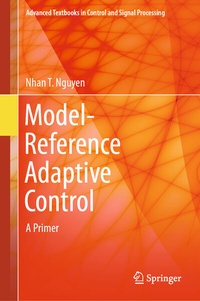
Model-Reference Adaptive Control
Description

This textbook provides readers with a good working knowledge of adaptive control theory through applications. It is intended for students beginning masters or doctoral courses, and control practitioners wishing to get up to speed in the subject expeditiously.
Readers are taught a wide variety of adaptive control techniques starting with simple methods and extending step-by-step to more complex ones. Stability proofs are provided for all adaptive control techniques without obfuscating reader understanding with excessive mathematics.
The book begins with standard model-reference adaptive control (MRAC) for first-order, second-order, and multi-input, multi-output systems. Treatment of least-squares parameter estimation and its extension to MRAC follow, helping readers to gain a different perspective on MRAC. Function approximation with orthogonal polynomials and neural networks, and MRAC using neural networks are also covered.
Robustness issues connected withMRAC are discussed, helping the student to appreciate potential pitfalls of the technique. This appreciation is encouraged by drawing parallels between various aspects of robustness and linear time-invariant systems wherever relevant.
Following on from the robustness problems is material covering robust adaptive control including standard methods and detailed exposition of recent advances, in particular, the author's work on optimal control modification. Interesting properties of the new method are illustrated in the design of adaptive systems to meet stability margins. This method has been successfully flight-tested on research aircraft, one of various flight-control applications detailed towards the end of the book along with a hybrid adaptive flight control architecture that combines direct MRAC with least-squares indirect adaptive control. In addition to the applications, understanding is encouraged by the use of end-of-chapter exercises and associated MATLAB® files.
Readers will need no more than the standard mathematics for basic control theory such as differential equations and matrix algebra; the book covers the foundations of MRAC and the necessary mathematical preliminaries.Reviews / Votes
"This book presents the fundamental theories of least-squares function approximation and least-squares adaptive control of systems with unstructured uncertainty. . The book is intended for students beginning masters or doctoral courses, and control practitioners wishing to get up to speed in the subject expeditiously." (Vjacheslav Vasiliev, zbMATH 1405.93001, 2019)More details
Other editions
Additional editions