

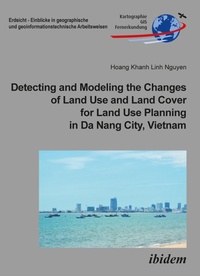
Detecting and Modeling the Changes of Land Use and Land Cover for Land Use Planning in Da Nang City, Vietnam
Published on 30. May 2018
256 pages
978-3-8382-7136-1 (ISBN)
Description

Da Nang City, located in the South Central Coast region of Vietnam, has developed in many aspects in the last two decades and has been known as one of the five independent municipalities of Vietnam. Today, it constitutes the Key Economic Zone in Central Vietnam. Rapid industrialization and urbanization have caused incessant change of land use and land cover (LULC) in Da Nang City. Linh Nguyen's study aims at detecting, quantifying, and characterizing the changes of LULC in the Da Nang City region by using multitemporal satellite images from 1979 to 2009; it further explores the effects of LULC changes on landscape structure through spatial landscape metrics. In a simulation it also shows the changes of LULC under different scenarios, utilizing the model of system dynamics and the model of dynamic conversion of land use and its effects. The results show that 37% of the total land has undergone change. Before being separated from Quang Nam Province (1979-1996), the LULC in Da Nang City changed gradually. However, after becoming an independent municipality, the LULC changed with accelerated speed, especially in the urban areas. Within 13 years (1996-2009), the urban area grew by 86.6%. The study suggests this is caused by a strong focus on economic development. Conversely, agriculture and forests had a high rate of change. The dynamic change of landscape indices reveal that agricultural areas were broken into smaller patches. However, except agriculture, patches of forestry and urban spaces tended to have a uniform landscape configuration. To simulate the future changes of LULC at Da Nang City from 2009 to 2030, three scenarios with different missions were developed, namely, Development as Usual, Aggressive Development, and Optimal Development. All scenarios result in a continuous increase in urban area and a gradual decrease in agriculture, barren, and shrub areas during the simulated period. The study provides new strategies for land use planning in comparable regions facing rapid urbanization.
More details
Series
Edition
New edition
Language
English
Place of publication
Hannover
Germany
Target group
Professional and scholarly
Edition type
New edition
File size
4,52 MB
ISBN-13
978-3-8382-7136-1 (9783838271361)
Copyright in bibliographic data and cover images is held by Nielsen Book Services Limited or by the publishers or by their respective licensors: all rights reserved.
Schweitzer Classification
Other editions
Additional editions
Hoang Khanh Linh Nguyen
Detecting and Modeling the Changes of Land Use and Land Cover for Land Use Planning in Da Nang City, Vietnam
Book
05/2018
ibidem
€49.90
Shipment within 7-9 days
Persons
Content
- Intro
- Acknowledgment
- Preface
- Abstract
- Zusammenfassung
- Abbreviations
- List of Tables
- List of Figures
- Chapter 1 Introduction
- 1.1 Study background
- 1.2 Statement of the problem
- 1.3 Research objectives
- 1.3.1 General objectives
- 1.3.2 Specific objectives
- 1.4 Outline of thesis
- Chapter 2 Theoretical Background
- Abstract
- 2.1 Land use and land cover
- 2.1.1 Definition and clarifications
- 2.1.2 LULC change
- 2.1.3 LULC change causes and consequences
- 2.1.4 Driving factors of LULC change
- 2.2 Combination of remote sensing and geographic information systems
- 2.3 Definition of landscape metric
- 2.4 Model and modeling
- 2.4.1 Definition
- 2.4.2 Kinds of models
- 2.4.3 LULC modeling
- Chapter 3 Study Area
- 3.1 Natural conditions
- 3.1.1 Location and area
- 3.1.2 Topography
- 3.1.3 Meteorological conditions
- 3.1.4 Hydrologic conditions
- 3.1.5 Natural resources
- 3.2 Social and economic conditions
- 3.2.1 Economic development
- 3.2.2 Economic structure
- 3.2.3 The situation of economic sectors
- 3.2.4 Population, labor, employment, and income
- 3.2.5 The situation of infrastructure
- 3.3 General assessment of natural, socioeconomic condition
- Chapter 4 Data and Methodology
- Abstract
- 4.1 Sensor systems
- 4.2 Data collection
- 4.3 Image preprocessing
- 4.3.1 Geometric correction
- 4.3.2 Radiometric normalization
- 4.4 Image classification and accuracy assessment
- 4.4.1 Image classification
- 4.4.2 Accuracy assessment
- 4.5 Change detection
- 4.6 Landscape metrics
- 4.7 Modeling LULC change
- 4.7.1 Nonspatial model
- 4.7.2 Spatial model
- 4.7.3 Accuracy assessment of model
- 4.8 ANOVA analysis for landscape metrics under scenarios
- Chapter 5 Land-Use/Cover Changes
- Abstract
- 5.1 Spatial-temporal dynamics and evolution of LULC changes
- 5.1.1 Urban
- 5.1.2 Agriculture
- 5.1.3 Forest
- 5.1.4 Shrub
- 5.1.5 Barren
- 5.1.6 Water
- 5.2 Landscape pattern analysis at class level
- 5.3 Discussions and conclusions
- Chapter 6 Modeling Land Use/Cover Changes
- Abstract
- 6.1 Demands of land-use/cover types
- 6.1.1 Demands of land-use/cover types from 1996 to 2009
- 6.1.2 Demands of land-use/cover types from 2009 to 2030
- 6.2 Driving factors for allocation
- 6.3 Logistic regression analysis
- 6.4 Elasticity coefficients
- 6.5 Conversion matrix
- 6.6 Validation output from the Dyna-CLUE model
- 6.6.1 Visual comparison
- 6.6.2 Agreement components
- 6.7 Analysis of the changes of scenarios
- 6.7.1 LULC changes under different scenarios
- 6.7.2 LULC changes according to administration boundary
- 6.8 Landscape structure of scenarios
- 6.8.1 At landscape level
- 6.8.2 At class level
- 6.8.3 Effects of land-use scenarios to landscape structure
- 6.9 Discussions and conclusions
- 6.9.1 Discussions
- 6.9.2 Conclusions
- Chapter 7 Conclusions
- Abstract
- 7.1 General conclusions
- 7.2 Future works
- References
- Appendices
- Appendix 1 Accuracy assessment error matrices
- LULC 1979
- LULC 1996
- LULC 2003
- LULC 2009
- Appendix 2 Scenarios of land-use/cover types from 1996 to 2030
- Appendix 3 Logistic regression of land-use/cover types
- Appendix 4 Area under the curve of land-use/cover types
- Appendix 5 Main parameters of Dyna-CLUE model
- Appendix 6 Main results obtained with ANOVA
