

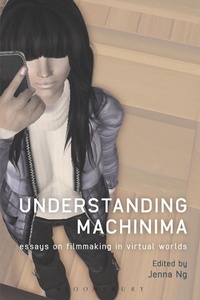
Understanding Machinima
Essays on Filmmaking in Virtual Worlds
1st Edition
Published on 30. July 2013
296 pages
978-1-4411-4962-6 (ISBN)
Description

In this groundbreaking collection, Dr. Jenna Ng brings together academics and award-winning artists and machinima makers to explore the fascinating combination of cinema, animation and games in machinima (the use of computer game engines to produce animated films in cost- and time-efficient ways). Book-ended by a preface by Henry Lowood (curator for history of science and technology collections at Stanford University) and an interview with Isabelle Arvers (machinima artist, trainer, critic, and curator), the collection features wide-ranging discussions addressing machinima not only from diverse theoretical perspectives, but also in its many dimensions as game art, First Nations media art, documentary, and pedagogical tool. Making use of interactive multimedia to enhance the text, each chapter features a QR code which leads to a mobile website cross-referencing with its print text, integrating digital and print content while also taking into account the portability of digital devices in resonance with machinima's mobile digital forms. Exploring the many dimensions of machinima production and reception, Understanding Machinima extends machinima's critical scholarship and debate, underscoring the exciting potential of this emerging media form.
Reviews / Votes
This welcome anthology helps usher machinima out of the gamer niche and into the nexus of digital animation, cinema, and art video. As the chapters of this book demonstrate, machinima realizes new ways of documenting and archiving the mediality of our set-up, far beyond the early ambitions of entertainment convergence. * Peter Krapp, Professor & Chair, Film & Media Studies, University of California, Irvine, US * Understanding Machinima is a timely and much needed intervention in Machinima studies. Comprising an excellent range of contributors, this collection focuses on Machinima's diversity of use at the same time as it considers its many media specificities, making it a necessary resource to any scholar working in the field. * Leon Gurevitch, Senior Lecturer, The School of Design, Victoria University of Wellington, New Zealand * Understanding Machinima: Essays on Filmmaking in Virtual Worlds, is personable yet edgy, conversational yet controversial. The chapters draw on personal reflection, Spinal Tap, mixed reality, Sesame Street, Bakhtin's dialogic theory, Chaucer, Iraq, First Nations, and psychoanalysis, yet they are clear and lucid. I found much to engage with, and even more to debate with. The field of machinima scholarship is small but engaging, and Understanding Machinima is a worthy contribution. * Erik Champion, Digital Humanities Lab Denmark, Aarhus University, Denmark * As machinima has evolved an intersected with many different media, the study of machinima has become increasingly interdisciplinary. With this study, Ng (Univ. of York, UK) erases many of the boundaries that existed around the study of this art form to explore machinima as 'less a discrete, distinguishable media form than a fluid dialogue of and between media.' The second major theme of the collection is 'the diversity of this machinima world and how it sands against all other ralities - physical animated, virtual, blended, hybrid, augmented.' The collection gives equal attention to the theoretical and the practical, offering readers a divers selection of perspectives on machinima and related media. Some chapters take a fairly standard approach and examine machinima as digital puppetry and machinima in a First Nations context. This title would make an excellent complement to introductory texts on machinima because it offers a timely exploration of many aspects of machinima that will not be found in most other works on the subject. Summing Up: Highly recommended. Upper-division undergraduates through faculty. * CHOICE *More details
Edition
1. Auflage
Language
English
Place of publication
New York
United States
Publishing group
Bloomsbury Publishing PLC (Digital)
Illustrations
15
ISBN-13
978-1-4411-4962-6 (9781441149626)
Copyright in bibliographic data and cover images is held by Nielsen Book Services Limited or by the publishers or by their respective licensors: all rights reserved.
Schweitzer Classification
Other editions
Additional editions

Book
09/2013
Bloomsbury Academic USA
€48.00
Shipment within 15-20 days
Person
Jenna Ng is Anniversary Research Lecturer in Film and Interactive Media at the University of York, UK. She was previously a Newton Trust/Leverhulme Early Career Fellow at the Centre for Research in the Arts, Social Sciences and Humanities (CRASSH), University of Cambridge, UK.
Content
Acknowledgements
Preface Henry Lowood
Introduction Jenna Ng
I. Thinking Machinima
1. Machinima: Cinema in a minor or multitudinous key? William Brown and Matthew Holtmeier
2. Beyond Bullet Time: Media in the knowable space Chris Burke
3. Be(ing)Dazzled: Living in machinima Sheldon Brown
4. Moving Digital Puppets Michael Nitsche, Ali Mazalek and Paul Clifton
5. Facing the Audience: A dialogic perspective on the hybrid animated film Lisbeth Frolunde
6. Dangerous Sim Crossings: Framing the Second Life art machinima Sarah Higley
II. Using Machinima
7. The Art of Games: Machinima and the limits of art games Larissa Hjorth
8. Playing Politics: Machinima as live performance and document Joseph DeLappe
9. Virtual Lens of Exposure: Aesthetics, theory, and ethics of documentary filmmaking in Second Life Sandra Danilovic
10. Call It a Vision Quest: Machinima in a First Nations context Beth Aileen Dillon and Jason Edward Lewis
11. World of Chaucer: Adaptation, pedagogy, and interdisciplinarity Chris Moore and Graham Barwell
12. A Pedagogy of Craft: Teaching Culture Analysis with machinima Jenna Ng and James Barrett
Agency, Simulation, Gamification, Machinima: An interview with Isabelle Arvers Isabelle Arvers and Jenna Ng
Notes on Contributors
Glossary
Index
Preface Henry Lowood
Introduction Jenna Ng
I. Thinking Machinima
1. Machinima: Cinema in a minor or multitudinous key? William Brown and Matthew Holtmeier
2. Beyond Bullet Time: Media in the knowable space Chris Burke
3. Be(ing)Dazzled: Living in machinima Sheldon Brown
4. Moving Digital Puppets Michael Nitsche, Ali Mazalek and Paul Clifton
5. Facing the Audience: A dialogic perspective on the hybrid animated film Lisbeth Frolunde
6. Dangerous Sim Crossings: Framing the Second Life art machinima Sarah Higley
II. Using Machinima
7. The Art of Games: Machinima and the limits of art games Larissa Hjorth
8. Playing Politics: Machinima as live performance and document Joseph DeLappe
9. Virtual Lens of Exposure: Aesthetics, theory, and ethics of documentary filmmaking in Second Life Sandra Danilovic
10. Call It a Vision Quest: Machinima in a First Nations context Beth Aileen Dillon and Jason Edward Lewis
11. World of Chaucer: Adaptation, pedagogy, and interdisciplinarity Chris Moore and Graham Barwell
12. A Pedagogy of Craft: Teaching Culture Analysis with machinima Jenna Ng and James Barrett
Agency, Simulation, Gamification, Machinima: An interview with Isabelle Arvers Isabelle Arvers and Jenna Ng
Notes on Contributors
Glossary
Index
